
Master Your Factory’s 13 Week Cash Flow Forecast
Master Your Factory’s Finances: How to Create a 13 Week Cash Flow Forecast for Manufacturers Running a profitable manufacturing business requires more than just efficient production lines and strong sales. It requires absolute mastery over your cash position. For manufacturers, cash is the true lifeblood of daily operations. You need working capital to purchase raw…
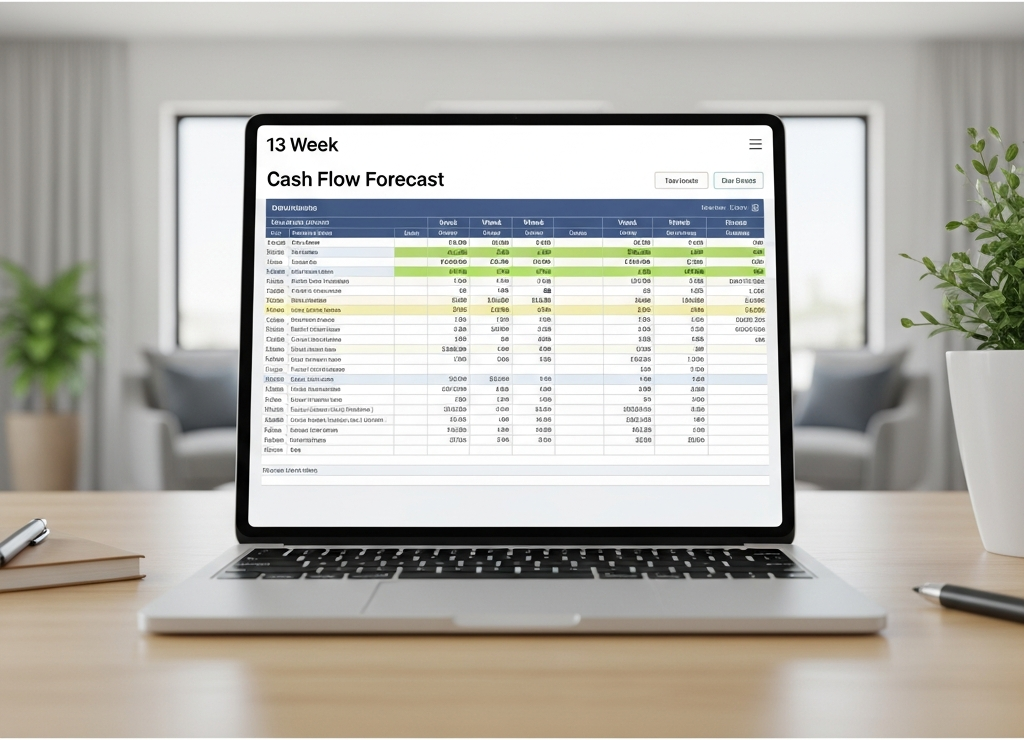
Master Your Factory’s Finances: How to Create a 13 Week Cash Flow Forecast for Manufacturers
Running a profitable manufacturing business requires more than just efficient production lines and strong sales. It requires absolute mastery over your cash position. For manufacturers, cash is the true lifeblood of daily operations.
You need working capital to purchase raw materials, maintain heavy equipment, and manage payroll long before finished goods are ever shipped. Because of the long gap between paying for production and getting paid by customers, profitability does not automatically equal liquidity.
This guide will walk you through exactly how to build, maintain, and utilize a rolling 13-week cash flow forecast for manufacturers. By the end of this post, you will have the knowledge to ensure your manufacturing business never unexpectedly runs out of capital.
13 Week Cash Flow Forecast: A tactical financial management tool that tracks the exact timing of expected cash inflows and outflows over a fiscal quarter.
What You Need to Get Started
Before diving into the calculations, you must gather specific financial data and operational insights. Building a reliable forecast requires pulling information from several different departments.
Having accurate, real-time information is critical for manufacturing forecasting. If your starting data is flawed, your projections will be practically useless. Here is exactly what you need to gather before building your model.
Reliable Accounting Software or ERP
You will need a central hub where your historical and current financial data lives. Ideally, this should be an Enterprise Resource Planning (ERP) system tailored to the complexities of manufacturing.
Enterprise Resource Planning (ERP): A centralized software system that manages and integrates a company’s financials, supply chain, operations, and manufacturing activities.
Your accounting software or ERP will be the source of truth for your starting bank balances and historical spending trends. Ensure all bank accounts are fully reconciled before pulling your starting numbers.
Current Accounts Receivable (AR) and Accounts Payable (AP) Schedules
You cannot forecast cash without knowing exactly who owes you money and who you owe money to. Gather up-to-date reports for both AR and AP.
Accounts Receivable (AR): The balance of money due to a firm for goods or services delivered to customers but not yet paid for.
Accounts Payable (AP): The amount of short-term debt a company owes to its suppliers and vendors for goods and services purchased on credit.
When looking at AR, focus on when customers actually pay, not just the official due date on the invoice. If a client is notorious for paying their Net-30 invoices in 45 days, you must build your forecast around that 45-day reality.
Production and Inventory Plans
In manufacturing, production schedules dictate your cash burn rate. You need clear visibility into upcoming production runs for the next quarter.
Gather data on expected raw material purchasing requirements, labor needs, and anticipated shipping dates for finished goods. Knowing when a massive order of raw steel or specialized electronic components must be purchased is vital for predicting cash outflows.
A Forecasting Tool
You need a place to build and host your financial model. While specialized cash flow software is ideal for complex operations, it is not strictly necessary to begin.
A well-structured spreadsheet—like Microsoft Excel or Google Sheets—is perfectly sufficient to start building your model. Spreadsheets offer the flexibility needed to customize categories to your specific manufacturing niche.
Step-by-Step Guide to Building Your 13 Week Cash Flow Forecast
Building a cash flow forecast might seem daunting, but it becomes highly manageable when broken down into logical steps. Follow this logical progression to construct your rolling forecast from scratch.
Step 1: Establish Your Starting Cash Balance
Begin Week 1 by recording your actual, cleared cash-on-hand across all operating bank accounts. This provides the baseline for all future calculations.
Cleared Cash-on-Hand: The actual, settled funds readily available in your bank accounts, excluding pending deposits or uncleared checks.
Do not include lines of credit or restricted cash that cannot be used for daily manufacturing operations. You only want to count the liquid capital you can spend today.
Step 2: Project Your Cash Inflows (Receipts)
Next, map out all expected cash coming into the business over the next 13 weeks. Be highly realistic about timing.
- Customer Payments: Base this on your current AR aging report. Again, manually adjust the expected receipt dates for customers who chronically pay late to avoid creating a falsely optimistic cash position.
- Cash Sales: Estimate direct-to-consumer sales, immediate-payment wholesale orders, or cash-on-delivery (COD) receipts.
- Other Income: Include secondary sources of cash. This might be tax rebates, proceeds from selling old equipment, or drawn funds from credit facilities.
Step 3: Estimate Your Cash Outflows (Disbursements)
This step requires detailing every single dollar leaving the business. In manufacturing, these costs are typically heavy and strict. Categorize your outflows as follows:
- Payroll and Benefits: Calculate regular wages for floor staff and management. Be sure to factor in overtime pay for expected peak production weeks, as well as payroll taxes and health benefits.
- Raw Materials and Supplier Payments: Base these numbers on your AP schedule and upcoming production requirements. Time these payments based on your vendor terms (e.g., Net-30 or Net-60).
- Overhead: Factor in your fixed facility costs. This includes factory rent or mortgage, utilities (which can fluctuate heavily based on production), insurance premiums, and software subscriptions.
- Capital Expenditures (CapEx) & Maintenance: Include scheduled machinery repairs, routine parts replacement, or planned down payments for new equipment.
- Debt Service: Record all mandatory loan repayments, equipment financing payments, and interest fees.
Step 4: Calculate Net Cash Flow and Ending Balance
Once you have your inflows and outflows mapped out, it is time for the core calculation. For each individual week, subtract total outflows from total inflows to find your Net Cash Flow.
Net Cash Flow: The total amount of money generated minus the total amount of money spent over a specific period of time.
Add this Net Cash Flow figure to your Starting Cash Balance. The result is your Ending Cash Balance for that week. Finally, this ending balance carries over to become the starting balance for the following week.
Step 5: Roll the Forecast Forward Every Week
A 13 week cash flow forecast is not a “set it and forget it” document. It is a living, breathing model known as a rolling forecast.
Rolling Forecast: A continuous planning process that updates financial projections on a regular basis by dropping past periods and adding new ones.
At the end of Week 1, update your spreadsheet. Replace your Week 1 projections with the actual banking results. Analyze any variances to see where you were wrong, drop Week 1 from the model entirely, and add a new Week 14 to the end. This habit ensures you always maintain a forward-looking, three-month view.
Common Mistakes to Avoid
When building a 13 week cash flow forecast, manufacturers frequently fall into a few specific traps. Avoid these pitfalls to keep your forecast highly accurate and dependable.
Ignoring Supply Chain Delays
Assuming raw materials will arrive and finished goods will ship perfectly on time is a critical error in today’s industrial landscape. Supply chain bottlenecks instantly derail forecasts.
When a component is delayed, production is delayed. This delays invoicing, which ultimately delays your cash inflows. Always build a conservative time buffer into your forecast to account for shipping and receiving delays.
Confusing Revenue with Cash Flow
This is the most common financial mistake in manufacturing. Booking a $100,000 manufacturing order is great for top-line revenue, but it does not mean you have $100,000 to spend today.
If the client is on Net-60 terms, that cash will not hit your bank account for two full months. You must only record the cash inflow in the specific week the cash is actually expected to clear the bank, regardless of when the sale was finalized.
Forgetting Unplanned Equipment Maintenance
Heavy machinery breaks down; it is an unavoidable reality of manufacturing. If you do not bake a contingency fund into your weekly outflows, you are putting your factory at risk.
An unexpected failure of a critical CNC machine or a factory forklift requires immediate cash for emergency maintenance or spare parts. A lack of financial padding for these emergencies can instantly push your cash position into the red.
The Final Result: Analyzing and Using Your Forecast
The final result of this process is not just a completed spreadsheet full of numbers. It is a dynamic, highly actionable roadmap of your factory’s financial health.
Identifying Potential Shortfalls in Advance
The greatest benefit of the 13 week cash flow forecast is the gift of time. With your model complete, you will clearly see if Week 8 projects a negative cash balance.
Instead of panicking in Week 8, you have two full months to proactively solve the problem. You can draw on a line of credit, delay a non-essential equipment purchase, or offer a discount to customers in exchange for early invoice payment.
Making Confident Operational Decisions
A reliable forecast removes the guesswork from factory management. You no longer have to rely on “gut feelings” when making expensive decisions.
You can confidently approve large raw material purchases, schedule weekend overtime shifts, or invest in facility upgrades. Because of your forecast, you will know exactly how those decisions will impact your liquidity in the coming quarter.
Frequently Asked Questions
Why 13 weeks specifically?
Thirteen weeks equals exactly one financial quarter. This timeframe is the recognized “sweet spot” for operational financial planning.
It is long enough to provide meaningful strategic visibility for raw material purchasing and production planning. However, it is short enough to maintain a high degree of accuracy. Predicting daily cash flows beyond three months becomes highly speculative and unreliable.
How accurate does a 13 week cash flow forecast need to be?
Accuracy shifts depending on how far out you are looking. Weeks 1 through 4 should be highly accurate, typically within a 5-10% variance. This is because these weeks are based on already-issued invoices, existing payroll, and immediate AP obligations.
Weeks 5 through 13 will naturally be less precise. They rely more heavily on sales projections, expected purchasing behavior, and estimated labor hours. However, even with a wider variance, these later weeks still provide vital directional accuracy to help you spot looming trends.
What should I do if my forecast shows a negative cash balance?
If your forecast highlights a cash deficit in the future, do not panic. You have several strategic levers to pull to reverse the trend before it happens.
First, you can manage your outflows by negotiating with vendors to delay AP payments or pausing planned capital expenditures. Second, you can accelerate inflows by expediting customer collections or offering early payment discounts. Finally, you can bridge the gap using short-term financing like an operating line of credit or invoice factoring.
Invoice Factoring: A financial transaction where a business sells its accounts receivable (invoices) to a third-party financial company at a discount in exchange for immediate cash.