Manufacturing Tracking Software: Eliminate Bottlenecks
Manufacturing Tracking Software: Financial Impact, WIP Valuation, and Bottleneck Elimination Manufacturing Tracking Software (MTS) serves as an execution-level digital sub-ledger, recording the physical movement of raw materials, work-in-progress (WIP), and finished goods. From a financial controller’s perspective, MTS links labor efficiency variance analysis to overhead absorption and working capital tied up in process bottlenecks. By…

Manufacturing Tracking Software: Financial Impact, WIP Valuation, and Bottleneck Elimination
Manufacturing Tracking Software (MTS) serves as an execution-level digital sub-ledger, recording the physical movement of raw materials, work-in-progress (WIP), and finished goods. From a financial controller’s perspective, MTS links labor efficiency variance analysis to overhead absorption and working capital tied up in process bottlenecks. By linking shop floor execution and the Enterprise Resource Planning (ERP) general ledger, this software provides the real-time data integrity required to accelerate month-end closes and defend standard costing assumptions.
What You Need Before Implementing Manufacturing Tracking Software
Clear Process Documentation and BOM Accuracy
Before software deployment, standard operating procedures (SOPs), Bills of Materials (BOMs), and production routings must be rigorously documented and validated. If your standard costs are built on flawed routing times or inaccurate material yields, the software will merely digitize flawed assumptions. Baseline documentation defines where cost collection points should occur to trigger inventory valuation journal entries.
Necessary Tracking Hardware (CapEx and Internal Controls)
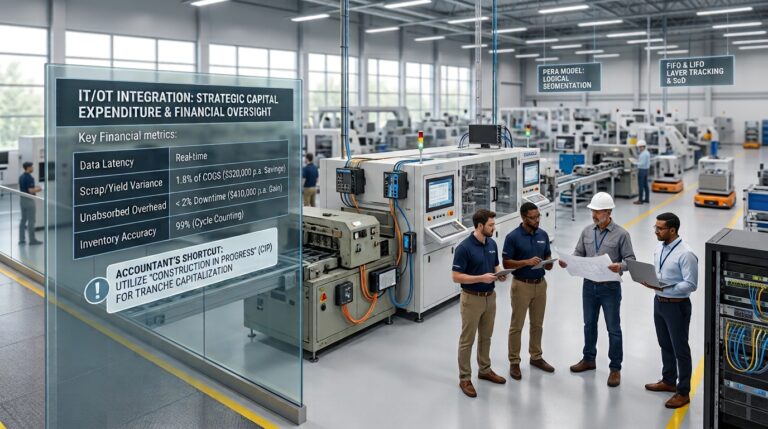
Converting physical events into digital records requires Capital Expenditure (CapEx) in fixed assets such as RFID portals, ruggedized barcode scanners, or PLC (Programmable Logic Controller) integrations. From an audit perspective, these physical data collection points are internal controls designed to prevent inventory shrinkage and enforce strict FIFO/LIFO material issuing protocols on the floor.
A Dedicated Implementation Team
Implementation spans operations and finance as much as IT. Assemble a steering committee comprising the Financial Controller, Production Manager, and Supply Chain Coordinator. Financial oversight ensures that system architecture aligns with cost accounting requirements and supports a standard 5-day month-end close, rather than introducing reconciliation delays.
Step 1: Mapping Workflows and Identifying Supply Chain Bottlenecks
Auditing the Shop Floor for Stoppages (Underabsorbed Overhead)
Physical bottlenecks set the facility’s throughput ceiling. They are also primary drivers of underabsorbed fixed manufacturing overhead. Conduct time-and-motion audits to identify stations where WIP accumulates. Excess WIP is trapped working capital that degrades your quick ratio and increases storage and handling costs.
Pinpointing Information Delays (Data Latency)
Administrative bottlenecks, such as manual clipboard tracking and spreadsheet data entry, create latency between physical material consumption and digital ERP updates. This latency can create negative inventory balances and invalid MRP runs, leaving finance dependent on periodic “backflushing” rather than real-time consumption recording.
Defining Key Performance Indicators (KPIs)
Establish financial and operational metrics. Software configurations must output data that directly translates to financial impacts.
| Operational KPI | Accounting / Financial Metric | Financial Impact |
|---|---|---|
| Cycle Time | Direct Labor Efficiency Variance | Reduces unfavorable labor cost variances. |
| Machine Utilization | Overhead Absorption Rate | Maximizes application of fixed factory overhead. |
| WIP Inventory Levels | Days Sales in Inventory (DSI) | Frees trapped working capital; improves cash flow. |
| First Pass Yield | Spoilage / Scrap Write-offs | Minimizes raw material yield variances. |
2: Deploying the Software to Automate and Monitor Production
Integrating with Existing ERP and SCM Systems
MTS must operate in a bi-directional data flow with the master ERP. The ERP holds the master data (Item Masters, Standard Costs, BOMs) and pushes production orders to the MTS. As production occurs, the MTS feeds micro-transactions back to the ERP, automatically generating the underlying journal entries (e.g., Dr. WIP Inventory, Cr. Raw Materials Inventory).
Establishing Real-Time Work-in-Progress (WIP) Tracking
Use scanners, RFID portals, or PLC endpoints to record material movements in the perpetual inventory system. Scanning a barcode at a routing step instantly updates the sub-ledger. This granular WIP tracking enables targeted cycle counting controls, reducing the need for full-plant annual shutdowns for physical stocktakes, a practice that costs days of lost production.
Training Frontline Staff for Effective Use
Floor operators execute the internal controls. Training must emphasize that missed scans result in “ghost inventory”—materials physically consumed but digitally present. Operator compliance ensures accurate perpetual inventory records. It also prevents delays in procurement and production caused by reordering decisions based on false stock levels.
Realistic Scenario: Discrete Manufacturing (Lawnmower Production)
The Context: A discrete manufacturer of internal combustion and electric lawnmowers scaling from $30M to $40M turnover.
The Problem: The business faced recurring unfavorable labor efficiency variances and persistent delays in the 5-day month-end close due to WIP reconciliation issues. The physical bottleneck was isolated at the Engine Mounting & Testing station.
Financial Impact: Prior to MTS implementation, actual cycle time at the engine station averaged 14 minutes compared with a standard cost assumption of 9 minutes. WIP inventory routinely backed up, trapping approximately $600,000 in working capital on the floor at any given time.
The Intervention & Shortcut:
Instead of requiring operators to scan every single component (bolts, washers, cables), finance reclassified Class C hardware as floor stock/expense upon receipt. Tracking was strictly limited to the serialized engine block and the main chassis (Class A items). Operators scanned the engine RFID tag upon entry to the station and upon exit.
The Result:
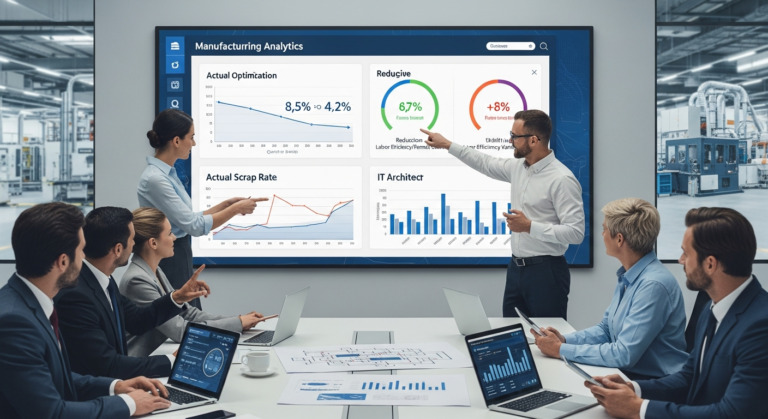
By limiting tracking to high-value constraints, the business accurately measured the 5-minute variance. Root cause analysis revealed that the variance was due to defective engine-mount alignment requiring manual rework. The design was corrected, cycle time dropped to 8.5 minutes, and the $600,000 WIP backlog was cleared, releasing cash to pay down a high-interest operating line of credit.
Common Mistakes to Avoid
Overcomplicating the Initial Rollout Phase
Attempting a full, multi-level BOM explosion and tracking every micro-movement on day one is likely to fail. Financial Practitioner Shortcut: Start by tracking major production milestones (e.g., Machining Complete, Assembly Complete, Packaged). Scale granularity only where specific variance analysis is required to justify capital equipment upgrades.
Neglecting Ongoing Data Hygiene (Scrap Mismanagement)
Scrap and rework must be recorded at the MTS terminal. If this control is ignored, month-end inventory write-offs can become significant. If an operator throws a damaged component in the bin without scanning it out as “Scrap,” the ERP assumes the material is still available, leading to raw material stock-outs and downstream delays.
Ignoring Supply Chain Integration (Inbound Logistics)
Viewing the MTS strictly as a factory-floor tool ignores the inbound supply chain. Failure to track inbound supplier deliveries against Purchase Orders via receipt scanning prevents accurate Landed Cost calculations and delays Accounts Payable three-way matching, negatively impacting supplier payment terms negotiations.
Frequently Asked Questions
How does manufacturing tracking software differ from a standard ERP?
An ERP is an aggregated financial and enterprise management ledger; high-frequency, second-by-second physical routing data belongs in MTS, the operational execution engine, often called a Manufacturing Execution System (MES). MTS translates physical shop floor events into batch-processed financial journals for the ERP.
What is the typical timeline to see bottleneck reductions?
Actionable variance data is typically generated within the first 30 days. Material financial returns, specifically the reduction of WIP carrying costs and the stabilization of labor efficiency variances, are typically realized in months 3 through 6. For middle-market SaaS MTS deployments ($10M–$60M), payback commonly depends on how much WIP and labor variance the system can reduce; many cases fall in the 4-to-8-month range.
Can small-to-medium manufacturers benefit from this software?
Yes. Cloud-based SaaS has reduced upfront infrastructure costs and shifted much of the spend from CapEx to OpEx. This allows businesses sub-$20M turnover to implement cycle counting and WIP controls, preparing records and controls for higher production volumes and strict audit compliance.
Operating Result: Controlled WIP and Faster Close
Measurable Increases in Production Throughput
MTS data should be used with Throughput Accounting principles to identify and clear constraints. The goal is to increase the contribution margin generated per minute at the bottleneck. When constraints are cleared, material spends less time waiting between receiving and shipping, so volume can rise before fixed overhead must increase.
Ongoing Visibility and Faster Response
Managers can explain variances before month-end by monitoring consumption, scrap, and queue issues while production is still running. Real-time consumption data improves cash flow management and procurement timing while supporting a shorter, better-controlled month-end financial close.