
Total Manufacturing Cost Formula: 4-Step Guide
Understanding Manufacturing Costs Definition: Total Manufacturing Cost (TMC) is the total cost of all Direct Materials (DM), Direct Labor (DL), and Manufacturing Overhead (MOH) consumed during a specific production period. Under standard absorption costing principles, TMC is the total manufacturing cost added to production before work-in-process (WIP) inventory movements are considered. Purpose: Understanding and applying…
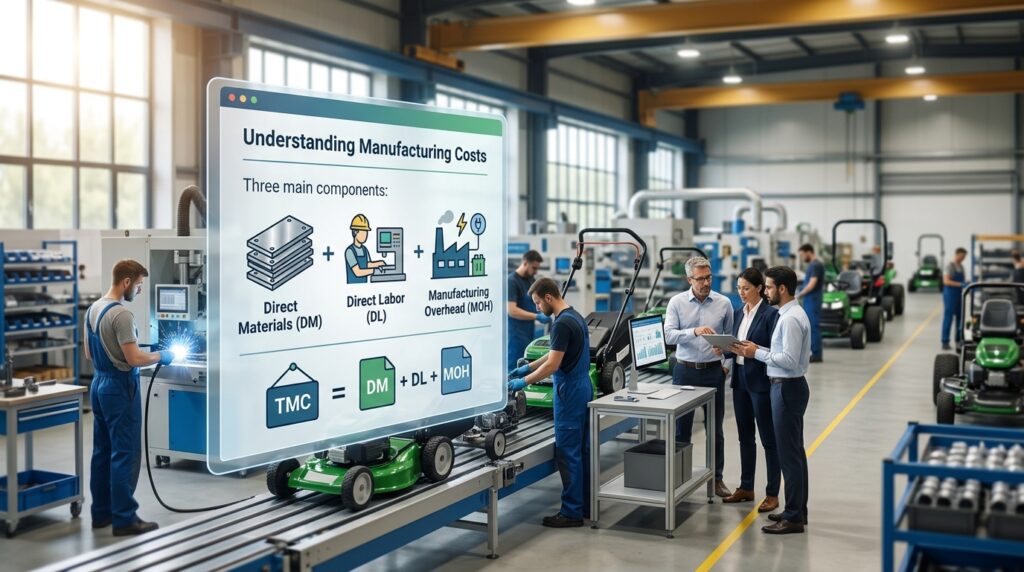
Understanding Manufacturing Costs
Definition: Total Manufacturing Cost (TMC) is the total cost of all Direct Materials (DM), Direct Labor (DL), and Manufacturing Overhead (MOH) consumed during a specific production period. Under standard absorption costing principles, TMC is the total manufacturing cost added to production before work-in-process (WIP) inventory movements are considered.
Purpose: Understanding and applying the TMC formula is essential for plant managers and financial controllers. It is the baseline for standard costs, labor efficiency variance analysis, bill of materials (BOM) rollups, and accurate inventory valuation on the balance sheet. Precise TMC tracking keeps pricing parameters tied to target gross margins instead of guesswork that can lead to margin erosion.
The Basic Formula:
Total Manufacturing Cost = Direct Materials + Direct Labor + Manufacturing Overhead
Required Data and Documentation
A rigorous 5-day month-end close depends on the accuracy of your inputs. Before running the TMC formula, verify the following data sets and internal controls.
Direct Materials Records
- Perpetual Inventory Sub-ledgers: Validated beginning and ending raw material inventory balances, governed by regular cycle counting controls.
- Landed Cost Data: Invoices and purchase orders for raw materials, including freight-in, customs duties, and international sourcing FX variances using FIFO or weighted average costing.
- BOM Consumption Reports: System-generated backflushing reports showing standard quantities issued to the floor versus actuals, used to identify purchase price variances (PPV) and material usage variances.
Direct Labor Payroll Data
- Production Routing Timesheets: Direct time tracked against specific production work orders.
- Fully Burdened Labor Rates: Gross wages plus employer statutory obligations, payroll taxes, workers’ compensation, and factory-level benefits.
Manufacturing Overhead Expenses
- General Ledger (GL) Factory Cost Centers: Trial balance extracts isolating factory operations from corporate overhead.
- Fixed Overhead Schedules: Equipment and facility depreciation schedules using straight-line or units-of-production methods.
- Variable Overhead Invoices: Factory utility metering, electricity, gas for furnaces, indirect labor payroll, shift supervisors, QA inspectors, maintenance fitters, and property taxes/insurance tied to the physical plant.
Applying the Total Manufacturing Cost Formula
The example below uses a realistic month-end calculation for a discrete manufacturing environment.
Scenario Context: Discrete Manufacturing, Commercial Lawnmowers
Profile: A $35M turnover manufacturer producing commercial lawnmowers. Moving from periodic to perpetual inventory tracking to support a targeted 5-day month-end close.
Step 1: Calculate Total Direct Materials Used
Direct materials must reflect the physical consumption of stock, not just the purchasing volume. Materials classified as indirect, such as degreasers or welding gas, must be excluded from this specific calculation and routed to overhead.
- Formula: Beginning Raw Materials Inventory + Landed Purchases – Ending Raw Materials Inventory
2: Calculate Total Direct Labor
Total the fully burdened costs of staff physically assembling the product or operating fabrication machinery, such as aluminum casting operators.
- Execution: Extract direct payroll data from the ERP. Ensure supervisors and maintenance staff are excluded; their costs reside in overhead.
3: Determine Total Manufacturing Overhead (MOH)
Capture all indirect manufacturing costs necessary to operate the facility.
- Execution: Sum indirect materials, indirect labor, and factory fixed/variable operational expenses. Practical Shortcut: Pool minor consumables, such as nuts, bolts, and Loctite, into an indirect material overhead cost pool rather than polluting the BOM with fraction-of-a-cent rollups.
4: Execute the Total Manufacturing Cost Formula
Add the three components to calculate TMC for the period.
Financial Matrix: Month-End TMC Calculation, June 202X
| Cost Category | Financial Data | Calculation / Total |
|---|---|---|
| 1. Direct Materials | Beg. RM Inventory: $450,000 + RM Purchases, Landed: $1,200,000 – End. RM Inventory: $380,000 |
$1,270,000 |
| 2. Direct Labor | Assembly Wages: $350,000 + Payroll Taxes/Benefits: $70,000 |
$420,000 |
| 3. Manufacturing Overhead | Indirect Labor, QA/Maint: $180,000 Factory Utilities: $110,000 Equip Depreciation: $220,000 Indirect Materials: $50,000 |
$560,000 |
| Total Manufacturing Cost | DM, $1.27M + DL, $420k + MOH, $560k | $2,250,000 |
Common Errors to Avoid
Plant P&L statements are commonly distorted by the following systemic errors.
Confusing Direct and Indirect Costs
- The Pitfall: Categorizing low-value, high-volume consumables, like glue, screws, or packaging tape, as Direct Materials on the BOM.
- The Impact: The result is perpetual inventory inaccuracies and BOM pollution. Treating these items as indirect materials allocated via MOH provides a cleaner standard cost and eliminates wasted labor hours in cycle counting items that cost $0.002 per unit.
Including Non-Manufacturing Operating Expenses, SG&A Bleed
- The Pitfall: Allowing Selling, General, and Administrative expenses to cross the gross margin line into factory overhead.
- The Impact: Including the CEO’s salary, corporate marketing, or outward freight (shipping to customers) in MOH artificially inflates inventory unit costs. Pricing decisions suffer, and write-downs are delayed. Only costs incurred to bring the product to its finished state in the warehouse are capitalized.
Overlooking Hidden or Variable Overhead
- The Pitfall: Utilizing a static overhead absorption rate for the entire fiscal year without adjusting for actual run rates.
- The Impact: Seasonal utility spikes, such as heating a casting facility in winter, or emergency breakdown maintenance can leave overhead severely underapplied. Unabsorbed costs then hit the P&L immediately, reducing the accuracy of monthly profit forecasts.
Using the Total Manufacturing Cost
The $2,250,000 TMC is the period manufacturing cost used for variance analysis, unit costing, and pricing decisions.
Benchmarking Production Efficiency
By comparing actual TMC components against standard cost targets, plant managers can isolate variances. If actual DL is $420,000 but standard routing times dictated it should be $390,000, you have a $30,000 adverse labor efficiency variance. The variance points to specific shop-floor bottlenecks, such as machinery downtime causing idle labor.
Calculating Per-Unit Cost
Divide the Total Manufacturing Cost, adjusted for WIP and mapped to COGM, by the volume of units produced. If the plant yielded 1,500 commercial mowers in June:
- Unit Cost = $2,250,000 / 1,500 units = $1,500 per unit.
This metric dictates your balance sheet inventory valuation.
Setting Pricing Strategies
With an established unit cost of $1,500, commercial pricing strategies can be set to protect gross margin. To achieve a target 35% gross margin, the wholesale price must be set at ~$2,307. Accurate unit costing is the main safeguard against accepting high-volume, margin-dilutive contracts.
Frequently Asked Questions
What is the difference between the Total Manufacturing Cost Formula and the Cost of Goods Manufactured (COGM)?
Total Manufacturing Cost aggregates the expenses injected into production during the current period. COGM takes the TMC and adjusts for the change in Work-In-Process (WIP) inventory.
- COGM = Beginning WIP + Total Manufacturing Cost – Ending WIP.
TMC feeds the calculation; COGM represents the cost of products actually completed and transferred to Finished Goods.
How often should plant managers calculate their total manufacturing cost?
TMC must be calculated monthly as part of a structured month-end close, ideally a 5-day close process. Quarterly or annual calculations leave management working from lagging indicators. If material prices spike or labor efficiency drops, waiting 90 days to discover the variance limits management’s ability to correct it.
Are shipping and distribution costs included in the formula?
No. Freight-out, shipping finished goods to customers, is a period cost categorized under SG&A selling expenses. It is not included in manufacturing costs. By contrast, freight-in, the cost of shipping raw materials from international suppliers to your plant, is a capitalized cost that must be absorbed into the Direct Materials valuation, Landed Cost. Confusing the two is a fundamental GAAP/IFRS violation.