Cash Flow Management for Manufacturers: The Complete Guide
Cash flow problems kill more manufacturers than lack of customers. You can have a full order book and still go bankrupt if you can’t manage the cash. The Manufacturing Cash Flow Paradox: The Classic Scenario: Month 1: Win $100K order (celebrate!) Month 2: Buy $60K in materials (cash OUT) Month 3: Pay $25K in labor…
Table of Contents
ToggleCash flow problems kill more manufacturers than lack of customers. You can have a full order book and still go bankrupt if you can't manage the cash.

The Manufacturing Cash Flow Paradox:
The Classic Scenario:
Month 1: Win $100K order (celebrate!)
Month 2: Buy $60K in materials (cash OUT)
Month 3: Pay $25K in labor (cash OUT)
Month 4: Deliver product, invoice customer
Month 5: Customer pays (finally, cash IN!)
Meanwhile: Rent, utilities, payroll, insurance keep coming
Your bank account: Shrinking, shrinking, gone…
Why Manufacturing Cash Flow Is Uniquely Challenging:
Long Cash Conversion Cycles:
- Buy materials 60-90 days before getting paid
- Production takes weeks or months
- Customers pay on Net 30-60 terms (often longer)
- Total cycle: 90-180+ days from cash out to cash in
High Working Capital Requirements:
- Raw materials inventory
- Work-in-process inventory
- Finished goods inventory
- Accounts receivable
- All tie up cash
Fixed Costs Continue:
- Factory rent/mortgage
- Equipment payments
- Insurance
- Minimum staffing
- Can’t easily scale down
Growth Makes It Worse:
- More sales = need more cash for materials
- “Profitable growth” can bankrupt you
- The growth paradox
Real-World Story: “$8M custom equipment manufacturer had record year: $10M in sales, 18% net profit margin.
Problem: Went from $200K line of credit to $400K (maxed out) and needed emergency bridge loan.
What happened?
- Revenue grew 25% (good!)
- But receivables grew 40% (customers paying slower)
- Inventory grew 35% (building stock for growth)
- Cash got sucked into growth
- Working capital crisis despite profitability
This guide prevents that.”
What You’ll Learn:
- Understanding manufacturing cash flow fundamentals
- How to forecast cash flow accurately
- The cash conversion cycle and how to shorten it
- Managing working capital effectively
- Financing options for manufacturers
- Seasonal cash flow management
- Growth without cash flow crisis
- Tools and systems for cash flow management
Who This Guide Helps:
- Manufacturers with lumpy, unpredictable cash flow
- Growing businesses constantly short on cash
- Seasonal manufacturers with feast/famine cycles
- Companies unable to take on new work due to cash constraints
- Anyone who’s ever lost sleep over making payroll
PART 1: MANUFACTURING CASH FLOW FUNDAMENTALS
Section 1.1: What Is Cash Flow?
Simple Definition: Cash flow is the movement of money in and out of your business. Positive cash flow = more coming in than going out. Negative cash flow = more going out than coming in.
Cash Flow ≠ Profit:
This is the #1 misunderstanding:
Example:
INCOME STATEMENT (Accrual Basis):
Revenue: $500,000
Expenses: $400,000
Net Profit: $100,000 ← “We’re profitable!”
CASH FLOW STATEMENT (Reality):
Cash from sales: $350,000 (some customers haven’t paid yet)
Cash expenses: $420,000 (paid suppliers immediately)
Cash Flow: -$70,000 ← “We’re broke!”
Why They Differ:
Timing Differences:
- Revenue recognized when you invoice (accrual accounting)
- Cash received when customer actually pays (often 30-90 days later)
- Expenses recognized when incurred
- Cash paid might be earlier or later
Non-Cash Expenses:
- Depreciation reduces profit but doesn’t consume cash
- Amortization, same thing
- These improve cash flow vs. profit
Capital Expenditures:
- Buying a $100K machine
- Doesn’t all hit P&L (depreciated over years)
- But cash is gone immediately
Real Example: “Manufacturer bought $80K CNC machine in December.
P&L impact: $13,000 depreciation expense (over 5 years) Cash impact: $80,000 gone immediately
Profit: Down $13K Cash: Down $80K
This is why you can be profitable and still run out of cash.”
The Three Types of Cash Flow:
- Operating Cash Flow
- Cash from normal business operations
- Sales collections minus operating expenses
- This should be positive (core business generates cash)
- Investing Cash Flow
- Equipment purchases (negative)
- Asset sales (positive)
- Usually negative for growing manufacturers
- Financing Cash Flow
- Loans received (positive)
- Loan repayments (negative)
- Owner investments/withdrawals
- Can be positive or negative
What Matters Most: Operating cash flow must be positive and sufficient to cover:
- Equipment investments
- Loan payments
- Owner distributions
- Cash reserves
If operating cash flow is negative, you have a business model problem (not just a cash flow problem).
Section 1.2: The Cash Conversion Cycle
Definition: The number of days between when you pay for materials and when you collect cash from customers.
Formula:
Cash Conversion Cycle = DIO + DSO – DPO
Where:
DIO = Days Inventory Outstanding (how long inventory sits)
DSO = Days Sales Outstanding (how long to collect from customers)
DPO = Days Payable Outstanding (how long you take to pay suppliers)
Example Calculation:
ABC Manufacturing:
DIO: 45 days (materials sit 45 days before sold)
DSO: 50 days (customers pay 50 days after invoice)
DPO: 30 days (we pay suppliers in 30 days)
Cash Conversion Cycle = 45 + 50 – 30 = 65 days
What This Means: “For 65 days, your cash is tied up in operations. You’ve paid for materials and labor, but haven’t been paid by customers yet.”
Visualizing the Cycle:
DAY 0: Order materials
DAY 15: Materials arrive
DAY 30: Pay supplier (CASH OUT – $10,000)
DAY 45: Start production
DAY 60: Complete production
DAY 65: Ship to customer, send invoice
DAY 115: Customer pays (CASH IN – $15,000)
Cash Conversion Cycle: 85 days (from Day 30 payment to Day 115 collection)
During this time: Your $10,000 is unavailable for other uses
Impact of CCC Length:
Short CCC (30-45 days) = Good:
- Less cash tied up
- Can operate with less financing
- More agile, responsive
- Lower risk
Long CCC (90+ days) = Challenging:
- Lots of cash tied up in working capital
- Need substantial financing
- Vulnerable to disruptions
- High risk if customer doesn’t pay
Industry Benchmarks:
Manufacturing averages:
- Excellent: <45 days
- Good: 45-75 days
- Average: 75-120 days
- Poor: >120 days
Varies widely by type:
- High-volume, standardized: 30-60 days
- Custom, low-volume: 90-150 days
- Aerospace, defense: 180-365 days (but often get progress payments)
Why It Matters:
Example:
Manufacturer A: CCC = 45 days, $5M revenue
Cash tied up: ($5M ÷ 365) × 45 = $616,000
Manufacturer B: CCC = 90 days, $5M revenue
Cash tied up: ($5M ÷ 365) × 90 = $1,233,000
Difference: $617,000 more cash needed by Manufacturer B
The Goal: Reduce CCC by:
- Reducing inventory (↓ DIO)
- Collecting faster (↓ DSO)
- Paying suppliers later (↑ DPO)
Each day of improvement frees up cash.
Improvement Example:
Current CCC: 85 days
Improved CCC: 60 days (25-day improvement)
Annual revenue: $3M
Cash freed: ($3M ÷ 365) × 25 = $205,479
This cash can:
– Pay down debt
– Invest in equipment
– Build reserves
– Fund growth
Section 1.3: Working Capital Explained
Definition: Working capital = Current Assets – Current Liabilities
Or simply: The cash available to run daily operations.
Components:
Current Assets:
- Cash in bank
- Accounts receivable (money customers owe)
- Inventory (raw materials, WIP, finished goods)
- Other current assets
Current Liabilities:
- Accounts payable (money you owe suppliers)
- Short-term debt
- Accrued expenses (wages, taxes)
- Other current liabilities
Example:
CURRENT ASSETS:
Cash: $50,000
Accounts Receivable: $180,000
Inventory: $120,000
Total Current Assets: $350,000
CURRENT LIABILITIES:
Accounts Payable: $90,000
Accrued Payroll: $25,000
Current Portion of Debt: $15,000
Total Current Liabilities: $130,000
WORKING CAPITAL: $220,000
What This Tells You: “You have $220K in net liquid assets to operate the business. If all current liabilities came due tomorrow, you could pay them and still have $220K left.”
Working Capital Ratio:
Current Ratio = Current Assets ÷ Current Liabilities
= $350,000 ÷ $130,000
= 2.69
Interpretation:
> 2.0 = Strong (comfortable cushion)
1.5-2.0 = Good (adequate)
1.0-1.5 = Tight (manageable but watch closely)
< 1.0 = Danger (immediate attention needed)
The Manufacturing Working Capital Challenge:
High Requirements: Manufacturers typically need more working capital than service businesses:
Service Business:
- Little inventory
- Fast customer payment
- Low working capital needs
- Can operate with thin cushion
Manufacturing Business:
- Heavy inventory (3 types: raw, WIP, finished)
- Long production cycles
- Customer payment delays
- High working capital needs
- Need substantial cushion
Example Comparison:
SOFTWARE COMPANY ($5M revenue):
Inventory: $0
Receivables: $400K
Working capital need: $400-500K
MANUFACTURER ($5M revenue):
Inventory: $600K
Receivables: $500K
Working capital need: $1M-1.2M
A Manufacturer needs 2-3× more working capital!
The Working Capital Cycle:
When Growing:
Month 1: Sales $100K → Need $60K more inventory → WC requirement up
Month 2: Sales $120K → Need $70K inventory → WC requirement up
Month 3: Sales $150K → Need $90K inventory → WC requirement up
Working capital needed keeps growing faster than you can generate it!
This is the “growth trap”
Working Capital Sources:
Internal (Generated):
- Retained earnings
- Operating cash flow
- Owner contributions
External (Borrowed):
- Bank line of credit
- Term loans
- Equipment financing
- Invoice factoring
- Equity investment
Why Manufacturers Run Out:
Scenario:
Year 1 Revenue: $3M, Working Capital: $400K (adequate)
Year 2 Revenue: $4.5M (50% growth – great!)
Problem:
Working capital needed: $600K (50% more)
Generated internally: $100K (profit retained)
Shortfall: $100K
Options:
- Line of credit ($100K)
- Slow growth (can’t fund it)
- Take on investors
- Improve working capital efficiency
The Solution: Don’t just focus on sales growth—actively manage working capital efficiency:
- Faster collections (↓ receivables)
- Leaner inventory (↓ inventory)
- Better supplier terms (↑ payables)
- Strong operating cash flow (generate capital internally)
Real Example: “Manufacturer grew from $5M to $8M in 2 years (60% growth).
Working capital grew from $650K to $1.4M (+$750K needed).
They financed with:
- Retained earnings: $300K
- Line of credit: $200K
- Improved efficiency: $250K (reduced CCC from 95 days to 65 days)
Without efficiency improvements, would have needed $450K line of credit (probably unavailable) or couldn’t have grown.”
PART 2: CASH FLOW FORECASTING
Section 2.1: Why Forecast Cash Flow?
The Problem with Not Forecasting:
Most small manufacturers run cash flow reactively:
- Check bank balance daily
- Hope it’s positive
- Panic when it’s not
- Emergency measures (delay payments, rush collections)
- Constant stress
Better Approach: Proactive Forecasting
Know 3-6 months in advance:
- When cash will be tight
- When you’ll have surplus
- Exactly how much you’ll need
- Time to arrange financing before crisis
Real Story: “Manufacturer checked bank balance every morning. If low, he’d call customers begging for payment. Stressful and embarrassing.
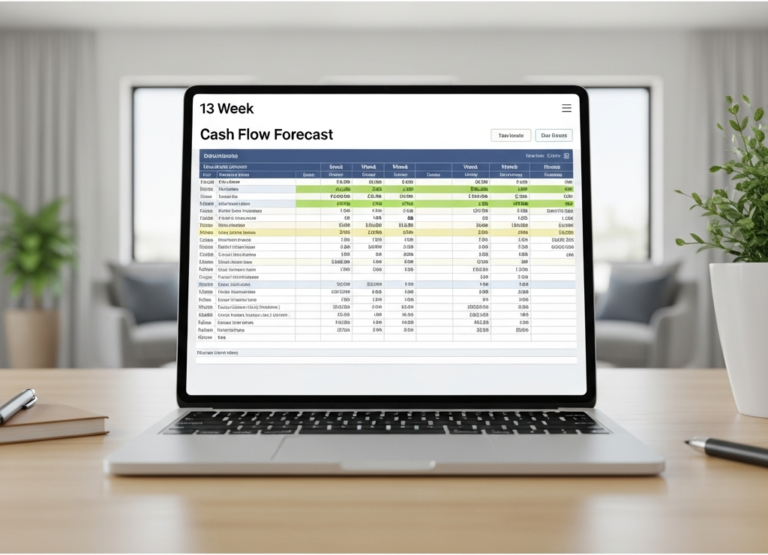
Started 13-week rolling cash forecast:
- Saw cash crunch coming 8 weeks in advance
- Arranged line of credit calmly (better terms)
- Knew exactly how much needed
- No more panic calls
- Slept better”
Benefits of Cash Flow Forecasting:
- Avoid Surprises
- No more “Where did the cash go?”
- Know slow months in advance
- Plan for large expenses
- Anticipate seasonal patterns
- Better Financing Terms
- Approach lenders from position of strength (not desperation)
- Show professional cash management
- Get better rates and terms
- Build lender confidence
- Smarter Decisions
- “Can we afford this equipment?”
- “Should we take this big order?”
- “When can we hire?”
- Data-driven, not gut-feel
- Negotiate Better
- Know when you have leverage with suppliers
- Time purchases for cash availability
- Plan customer payment timing
- Strategic use of early payment discounts
- Investor/Owner Confidence
- Professional management
- Reduced risk
- Better valuation
- Easier to raise capital if needed
- Peace of Mind
- No more 3 AM cash flow anxiety
- Confident decision-making
- Less reactive, more strategic
- Focus on growth, not survival
Section 2.2: Building a Cash Flow Forecast
Two Approaches:
Simple (Direct Method): Track cash in and cash out by category
Detailed (Indirect Method): Start with profit projection, adjust for timing
We’ll cover Simple method (easier, more practical for small manufacturers):
Step 1: Choose Your Time Horizon
Options:
- 13-week rolling: Most common for manufacturers
- Detailed weekly view
- Roll forward each week (always see 13 weeks ahead)
- Good balance of detail and manageability
- 12-month rolling: Strategic planning
- Monthly view
- Updated monthly
- See full year ahead
- Both: Best practice
- 13-week for operations
- 12-month for strategic decisions
Recommendation: Start with 13-week, add 12-month later.
Step 2: Forecast Cash Inflows
Categories:
- Customer Payments (Largest inflow)
Start with sales forecast:
SALES FORECAST (Next 13 weeks):
Week 1: $45,000
Week 2: $38,000
Week 3: $52,000
etc.
Apply payment terms to estimate collections:
PAYMENT ASSUMPTIONS:
– 40% of customers pay within 30 days
– 45% pay within 45 days
– 15% pay within 60 days
EXAMPLE:
Week 1 sales ($45,000):
– 40% collected Week 5 ($18,000)
– 45% collected Week 7 ($20,250)
– 15% collected Week 9 ($6,750)
Build aging schedule:
WEEK 5 CASH COLLECTIONS:
From Week 1 sales: $18,000 (30-day payers)
From Week -1 sales: $20,250 (45-day payers from prior week)
From Week -3 sales: $6,750 (60-day payers)
TOTAL WEEK 5: $45,000
- Other Cash Inflows
- Equipment sales
- Scrap/recycling revenue
- Tax refunds
- Loan proceeds (if planning to borrow)
- Owner contributions
Step 3: Forecast Cash Outflows
Categories:
- Materials/Inventory Purchases
Link to production schedule:
PRODUCTION FORECAST:
Week 3 production needs: $25,000 in materials
Purchase in Week 1 (2-week lead time)
Pay in Week 5 (Net 30 terms)
Week 5 Cash Out: $25,000 materials payment
- Direct Labor
Usually weekly payroll:
Production schedule → Labor hours needed → Payroll cost
Week 1: 400 hours × $28/hour fully burdened = $11,200
Week 2: 420 hours × $28/hour = $11,760
etc.
- Fixed Overhead
Regular, predictable expenses:
WEEKLY EXPENSES:
Rent: $2,500
Utilities: $800
Salaries (office): $4,200
Insurance: $600
Total Weekly: $8,100
- Variable Overhead
Fluctuates with production:
Supplies, maintenance, contract services
Estimate based on production level
- Other Regular Expenses
- Loan payments (known dates/amounts)
- Tax payments (quarterly estimates)
- Equipment leases
- Professional services
- Planned Capital Expenditures
- Equipment purchases
- Facility improvements
- Vehicle purchases
- Owner Distributions
- Regular draws
- Year-end bonuses
- Planned withdrawals
Step 4: Calculate Cash Position
Simple formula for each week:
WEEK 1:
Beginning Cash Balance: $75,000
Cash IN:
Collections: $42,000
Other: $3,500
Total IN: $45,500
Cash OUT:
Materials: $18,000
Labor: $11,200
Overhead: $12,500
Loan payment: $2,100
Total OUT: $43,800
Net Cash Flow: $1,700
Ending Cash Balance: $76,700 ← becomes Week 2 beginning balance
Repeat for all 13 weeks:
SUMMARY VIEW:
Week | Beginning | Cash IN | Cash OUT | Net Flow | Ending
—–|———–|———|———-|———-|——–
1 | $75,000 | $45,500 | $43,800 | +$1,700 | $76,700
2 | $76,700 | $38,200 | $39,500 | -$1,300 | $75,400
3 | $75,400 | $51,000 | $47,200 | +$3,800 | $79,200
4 | $79,200 | $44,500 | $41,800 | +$2,700 | $81,900
5 | $81,900 | $48,000 | $52,300 | -$4,300 | $77,600
6 | $77,600 | $39,000 | $43,000 | -$4,000 | $73,600 ← Watch!
7 | $73,600 | $42,500 | $38,900 | +$3,600 | $77,200
Identify Problem Weeks:
- Week 6: Drops to $73,600 (below comfort zone?)
- If minimum balance target is $75K: Action needed
Step 5: Scenario Planning
Model different scenarios:
Best Case:
- Customers pay faster (35 days vs 45)
- Higher sales than expected
- Result: Higher ending balances
Most Likely:
- Use average historical payment times
- Expected sales
- Normal expenses
Worst Case:
- Customers pay slower (55 days)
- Sales 20% below forecast
- Unexpected expense (equipment repair)
- Result: Cash crunch
Example:
WEEK 10 ENDING CASH:
Best Case: $95,000
Most Likely: $78,000
Worst Case: $52,000 ← Below $75K minimum!
Action: Arrange $30K line of credit availability before Week 10
Step 6: Update Weekly
Every Monday:
- Enter actual cash from prior week
- Update sales forecast based on new orders
- Adjust expenses based on new information
- Roll forward (drop Week 1, add Week 14)
- Review: Any new issues appearing?
Rolling Forecast Advantage:
- Always see 13 weeks ahead
- Catch problems early
- Adjust plans before crisis
Section 2.3: Cash Flow Forecast Template
Essential Columns:
Header:
- Week ending date
- Week number
Beginning Position:
- Beginning cash balance
Cash Inflows:
- Collections from customers
- Other operating income
- Financing proceeds
- Total Cash IN
Cash Outflows:
- Materials purchases
- Direct labor payroll
- Overhead expenses
- Loan payments
- Capital expenditures
- Owner distributions
- Total Cash OUT
Ending Position:
- Net cash flow (IN – OUT)
- Ending cash balance
- Minimum balance target (reference line)
- Surplus/(Shortfall) vs. target
Color Coding:
- Green: Above minimum + buffer
- Yellow: Above minimum, below buffer
- Red: Below minimum (action needed)
Download Our Template: [LEAD MAGNET CTA]
Free 13-week rolling cash flow forecast template:
- Pre-built formulas
- Automatic calculations
- Scenario analysis built-in
- Instructions included
- Example filled in
Video Tutorial: Watch our 12-minute walkthrough showing exactly how to build and maintain your forecast. [Embedded video]
Section 2.4: Common Forecasting Mistakes
Mistake #1: Too Optimistic on Collections
❌ Assuming customers pay on terms (Net 30 = 30 days)
✔️ Use actual historical average (often 45-55 days)
Real Data: “Terms: Net 30 Reality: Average 48 days Forecast assuming 30 days = perpetual cash shortfall surprise.”
Mistake #2: Forgetting Non-Operating Cash Flows
❌ Only forecast operations (sales, expenses)
✔️ Include: Loan payments, equipment purchases, tax payments, owner draws
Example: “Forecast looked fine until the quarterly tax payment hit. Wasn’t in forecast. Suddenly short $18K.”
Mistake #3: Not Updating Regularly
❌ Build forecast once, file away
✔️ Update weekly with actuals, roll forward
“Forecast is only useful if current. Weekly updates take 15 minutes, save thousands in overdraft fees.”
Mistake #4: Ignoring Seasonality
❌ Assume steady revenue all year
✔️ Model historical seasonal patterns
Example: “HVAC parts manufacturer:
- Summer revenue: $180K/month
- Winter revenue: $80K/month Forecasting flat $130K/month = disaster,”
Mistake #5: No Contingency
❌ Forecast exactly expected (single scenario)
✔️ Build in a buffer, worst-case scenario
“Best practice: Forecast 10% below expected sales, 10% above expected costs. Creates built-in cushion.”
Mistake #6: Forgetting Growth Working Capital Needs
❌ Forecast sales growing, but not inventory/receivables
✔️ Model working capital increases with growth
Example: “Forecast showed positive cash as sales grew 30%. Forgot: Need 30% more inventory, 30% more receivables. Result: Cash crisis despite growth.”