
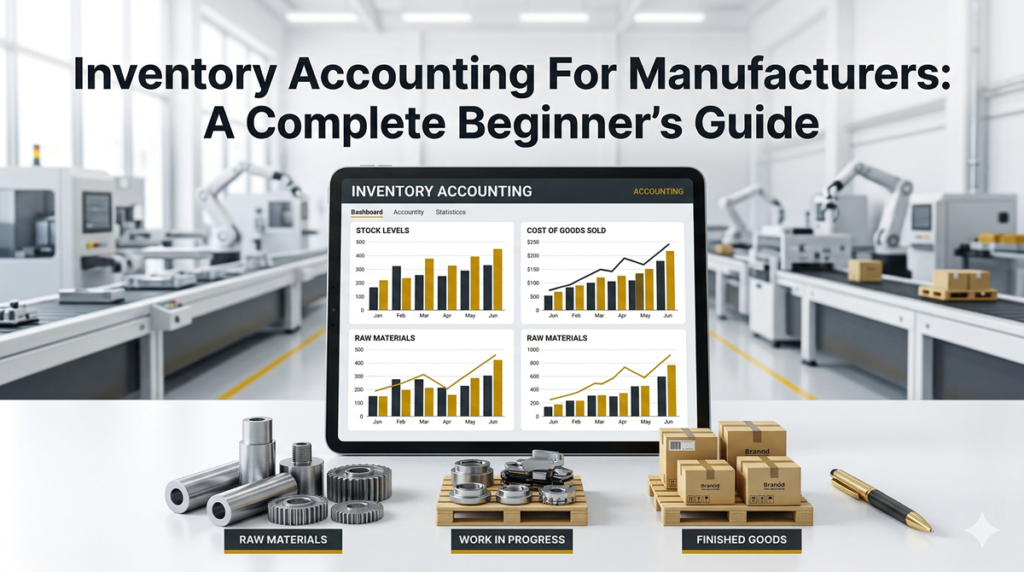
Inventory Accounting for Manufacturers: Complete Beginner’s Guide
“Get inventory accounting wrong, and you could be overstating profits by 30%, paying taxes on income you never earned, or valuing your business at twice what it’s actually worth. Here’s how to get it right.” The Inventory Accounting Problem: Real Scenario: Two manufacturers, identical operations: Company A: Inventory valued at $450,000 Company B: Inventory valued…
Table of Contents
Toggle"Get inventory accounting wrong, and you could be overstating profits by 30%, paying taxes on income you never earned, or valuing your business at twice what it's actually worth. Here's how to get it right."
The Inventory Accounting Problem:
Real Scenario:
Two manufacturers, identical operations:
Company A: Inventory valued at $450,000
Company B: Inventory valued at $720,000
Same products, same quantities.
Why the difference? Different inventory accounting methods.
Impact:
– Different profit numbers (by $270K!)
– Different tax bills (by $70K+)
– Different business valuations
– Different loan qualification
All from accounting method choice.
Why Inventory Accounting Matters for Manufacturers:
- It’s Your Largest Asset
- Typically 25-40% of total assets
- Raw materials + WIP + finished goods
- Hundreds of thousands to millions tied up
- Directly Impacts Profit
- How you value inventory = your COGS
- COGS is usually 60-75% of revenue
- Small change in inventory value = big change in profit
- Required for Financial Reporting
- Banks require accurate inventory valuation
- GAAP/IFRS compliance
- Audit requirements
- Tax calculations
- Operational Decision Making
- What to produce
- What to purchase
- What to sell off
- Profitability by product
The Unique Manufacturing Challenge:
Retailers have it easy:
- Buy widget for $10
- Value at $10
- Sell for $15
- Simple!
Manufacturers have it hard:
Raw materials: $10
+ Direct labor: $8
+ Overhead: $6
= Finished goods: $24
But which overhead? How to allocate?
What if materials cost changes mid-production?
What about work in process?
What This Guide Covers:
Part 1: Fundamentals
- Types of manufacturing inventory
- Why it’s different from retail
- Inventory flow and accounting basics
Part 2: Inventory Valuation Methods
- FIFO (First In, First Out)
- LIFO (Last In, First Out)
- Average Cost
- Specific Identification
- Standard Cost
- When to use each
Part 3: Inventory Costing
- What costs to include
- Direct vs indirect costs
- Overhead allocation
- WIP valuation
Part 4: Inventory Systems
- Perpetual vs periodic
- Cycle counting
- Physical inventory
- Reconciliation
Part 5: Financial Reporting
- Balance sheet presentation
- Income statement impact
- Lower of cost or market
- Write-downs and obsolescence
Part 6: Best Practices
- Choosing the right method
- Software and tools
- Common mistakes
- Continuous improvement
Who Should Read This:
- Manufacturing owners doing their own books
- Accountants/bookkeepers new to manufacturing
- Controllers implementing new systems
- Anyone preparing for audit or financing
- Manufacturers wanting to understand their numbers better
Real Impact: “After reading this guide, one manufacturer discovered they were using the wrong inventory method—costing them $35K annually in excess taxes. Another found $180K in inventory that wasn’t properly valued, instantly improving their balance sheet for bank financing.”
PART 1: MANUFACTURING INVENTORY FUNDAMENTALS
Section 1.1: The Three Types of Manufacturing Inventory
Unlike retail (one type), manufacturers have three:
- Raw Materials Inventory
Definition: Components, materials, and supplies not yet entered into production.
Examples:
- Steel plate (metal fabricator)
- Electronic components (electronics manufacturer)
- Lumber (furniture maker)
- Chemicals (coatings manufacturer)
- Fasteners, hardware, packaging
Valuation:
- Usually at purchase cost
- Plus: Freight, duties, handling to get to your facility
- Not included: Storage costs (those are overhead)
Accounting Entry When Purchased:
Debit: Raw Materials Inventory $10,000
Credit: Cash or Accounts Payable $10,000
Typical % of Total Inventory:
- 30-50% for most manufacturers
- Higher for assembly operations
- Lower for heavy fabrication
- Work-in-Process (WIP) Inventory
Definition: Products that have entered production but aren’t yet complete.
What’s Included:
- Raw materials issued to production
- Direct labor applied so far
- Manufacturing overhead allocated
- Partially completed assemblies
Examples:
- Half-welded frame on shop floor
- Circuit boards with some components placed
- Parts waiting between operations
- Subassemblies waiting for final assembly
Valuation Challenge: How complete is it? Need to estimate:
- Materials consumed (usually easy to track)
- Labor applied (based on time records)
- Overhead (allocated based on labor hours or other basis)
Complexity: Most challenging inventory category to value accurately.
Typical % of Total Inventory:
- 15-30% for job shops
- 5-15% for assembly operations
- Depends heavily on production cycle length
Accounting Entry When Materials Issued to Production:
Debit: Work-in-Process Inventory $10,000
Credit: Raw Materials Inventory $10,000
As Labor and Overhead Applied:
Debit: Work-in-Process Inventory $15,000
Credit: Direct Labor $8,000
Credit: Manufacturing Overhead $7,000
- Finished Goods Inventory
Definition: Completed products ready for sale but not yet sold.
What’s Included:
- All raw materials used
- All direct labor
- All manufacturing overhead
- Complete cost of production
Examples:
- Completed custom machinery awaiting shipment
- Stock of standard parts ready to sell
- Finished assemblies in warehouse
- Packaged products ready for delivery
Valuation: Full manufacturing cost (materials + labor + overhead)
Typical % of Total Inventory:
- 30-50% for make-to-stock manufacturers
- 10-20% for make-to-order/job shops
- High for companies building inventory ahead of peak season
Accounting Entry When Production Complete:
Debit: Finished Goods Inventory $33,000
Credit: Work-in-Process Inventory $33,000
When Sold:
Debit: Cost of Goods Sold $33,000
Credit: Finished Goods Inventory $33,000
Visual Flow:
RAW MATERIALS ($150,000)
↓ Issue to production
WORK-IN-PROCESS ($95,000)
↓ Add labor & overhead
↓ Complete production
FINISHED GOODS ($180,000)
↓ Ship to customer
COST OF GOODS SOLD (Expense)
Total Inventory Value:
Raw Materials: $150,000
WIP: $95,000
Finished Goods: $180,000
—————————
Total Inventory: $425,000 (appears on balance sheet)
Why This Matters:
Different from Retail:
RETAILER:
Inventory → Cost of Goods Sold (2 steps)
MANUFACTURER:
Raw Materials → WIP → Finished Goods → COGS (4 steps)
More complexity = more room for error
Need proper tracking at each stage
Common Mistakes:
❌ Counting raw materials as finished goods
❌ Not tracking WIP at all (goes straight from raw to finished)
❌ Wrong overhead allocation to WIP/finished goods
❌ Mixing up the three categories
Section 1.2: Manufacturing Inventory Flow
How Products Move Through Your Inventory:
The Journey:
Step 1: Purchase Raw Materials
Purchase Order: $25,000 steel plate
Receives at dock
Quality inspection
Move to raw materials storage
Record in system
Balance Sheet Impact:
Raw Materials Inventory: +$25,000
Cash/Payables: -$25,000
Step 2: Issue to Production
Production order #1234 starts
Material requisition: 5 sheets steel ($5,000)
Issue from raw materials to production floor
Balance Sheet Impact:
Raw Materials: -$5,000
WIP Inventory: +$5,000
Step 3: Add Labor
Welder works 20 hours @ $30/hour fully burdened
Time charged to Job #1234
Balance Sheet Impact:
WIP Inventory: +$600
Accrued Wages: +$600
Step 4: Allocate Overhead
Overhead rate: $25/direct labor hour
20 hours × $25 = $500 overhead applied
Balance Sheet Impact:
WIP Inventory: +$500
Manufacturing Overhead Applied: +$500
Step 5: Complete Production
Job #1234 complete
Total cost accumulated in WIP: $6,100
Materials: $5,000
Labor: $600
Overhead: $500
Transfer to finished goods
Balance Sheet Impact:
WIP Inventory: -$6,100
Finished Goods Inventory: +$6,100
Step 6: Ship to Customer
Customer order ships
Invoice customer: $9,500
Remove from finished goods
Balance Sheet Impact:
Finished Goods: -$6,100
COGS (Expense): +$6,100
Income Statement Impact:
Revenue: +$9,500
COGS: +$6,100
Gross Profit: +$3,400
The Complete Flow Diagram:
CASH/PAYABLES (-$25,000)
↓
RAW MATERIALS INVENTORY (+$25,000)
↓ Materials requisitioned ($5,000)
WORK-IN-PROCESS INVENTORY (+$5,000)
↓ Add labor ($600)
↓ Add overhead ($500)
WIP INVENTORY (Total: $6,100)
↓ Production complete
FINISHED GOODS INVENTORY (+$6,100)
↓ Customer shipment
COST OF GOODS SOLD (+$6,100) ← Expense on P&L
Key Concepts:
Inventory is an Asset:
- Appears on balance sheet
- Not an expense yet
- Converted to expense (COGS) when sold
The Matching Principle:
- Expense (COGS) recognized when revenue recognized
- Sold in March = COGS hits March P&L
- Even if produced in January
Timing Matters:
Produce in December: Asset on balance sheet
Sell in January: COGS expense in January
This is why inventory affects profit timing
Cash vs. Accrual:
Cash Basis (wrong for inventory):
– Expense materials when purchased
– Expense labor when paid
– Don’t track inventory values
Accrual Basis (correct):
– Capitalize costs into inventory
– Expense when sold
– Track inventory values
Section 1.3: Why Manufacturing Inventory Accounting Is Complex
The Challenges:
Challenge #1: Three Inventory Categories
Retailers: One inventory account Manufacturers: Three accounts (RM, WIP, FG)
Each needs:
- Separate tracking
- Separate valuation
- Proper transfers between categories
- Reconciliation
Challenge #2: WIP Valuation
The Problem: Half-finished product—what’s it worth?
Complications:
- How much material used? (need accurate tracking)
- How much labor applied? (need time tracking by job)
- How much overhead? (need allocation method)
- What stage of completion? (need production status)
Example:
Custom machine 60% complete:
Estimated total cost: $50,000
Simple method: 60% × $50,000 = $30,000
But what if:
– All materials already issued ($35,000)
– Labor only 40% complete ($6,000)
– Overhead allocated on labor ($4,000)
More accurate WIP value: $45,000 (not $30,000!)
Difference impacts profit by $15,000
Challenge #3: Overhead Allocation
The Question: How much factory rent, utilities, depreciation goes into each product?
Can’t Directly Trace:
- You can trace $50 of steel to Product A
- You CAN’T trace $50 of factory rent to Product A
Must Allocate:
- Choose allocation base (labor hours, machine hours, units, etc.)
- Calculate rate
- Apply to products
- Different methods = different costs
Challenge #4: Costs Change Over Time
Scenario:
January: Buy steel at $1.00/lb
February: Buy steel at $1.10/lb
March: Buy steel at $1.05/lb
Use 1,000 lbs in March production.
What cost do you use?
$1.00? (FIFO – first in)
$1.05? (LIFO – last in)
$1.05 average? (Average cost)
Each gives different COGS, different profit!
Challenge #5: Physical vs. System Discrepancies
System Says: Raw Materials: $150,000 WIP: $95,000 Finished Goods: $180,000 Total: $425,000
Physical Count: Raw Materials: $142,000 (missing $8,000) WIP: $103,000 (extra $8,000 – not moved to FG in system) Finished Goods: $175,000 (missing $5,000 – shrinkage/damaged)
Adjustments Needed: Impact profit, need investigation
Challenge #6: Regulatory & Tax Implications
IRS Requirements:
- UNICAP rules (must include certain costs)
- Specific valuation methods required
- Can’t change methods easily
- Detailed records required
GAAP Requirements:
- Proper allocation methods
- Lower of cost or market
- Obsolescence reserves
- Consistent application
Audit Requirements:
- Support for all values
- Physical count procedures
- Reconciliation documentation
Why This Matters:
Get It Wrong:
- Misstated profits
- Wrong taxes paid
- Loan violations (covenants)
- Audit failures
- Operational blind spots
Get It Right:
- Accurate financial statements
- Correct tax calculations
- Better decision making
- Easier financing
- Audit compliance
Bottom Line: Manufacturing inventory accounting is inherently complex, but following proper methods makes it manageable.
PART 2: INVENTORY VALUATION METHODS
Section 2.1: FIFO (First In, First Out)
The Concept:
Assume oldest inventory is sold first (like milk at grocery store—grab from front).
How It Works:
Example:
PURCHASES:
Jan 1: 100 units @ $10 = $1,000
Feb 1: 100 units @ $12 = $1,200
Mar 1: 100 units @ $11 = $1,100
Total purchased: 300 units, Total cost: $3,300
SALES:
Mar 15: Sell 150 units
FIFO Assumption (oldest first):
– First 100 units @ $10 = $1,000
– Next 50 units @ $12 = $600
COGS = $1,600
ENDING INVENTORY:
– 50 units @ $12 = $600
– 100 units @ $11 = $1,100
Total = $1,700
Check: $3,300 (purchased) = $1,600 (COGS) + $1,700 (ending inventory) ✓
Advantages:
✓ Logical Flow
- Matches actual physical flow (often)
- Easy to understand and explain
- Intuitive (use oldest first)
✓ Balance Sheet Reflects Current Values
- Ending inventory at recent prices
- More accurate asset valuation
- Better for financial ratios
✓ Higher Profit in Inflationary Times
- Older (cheaper) costs hit COGS first
- Newer (higher) costs stay in inventory
- Results in higher profit
- Better for loan applications
✓ Tax Advantages in Deflationary Times
- If prices falling, FIFO gives higher COGS
- Lower profit = lower taxes
Disadvantages:
✗ Higher Taxes in Inflation
- Lower COGS = higher profit = higher taxes
- This is the big one for most manufacturers
✗ May Not Match Physical Flow
- Some products (like bulk materials) don’t flow FIFO
- But accounting doesn’t have to match physical flow
✗ Profit Fluctuations
- If material costs volatile, profit swings wildly
Best For:
✓ Companies in stable/deflationary price environments
✓ When loan qualification matters (higher assets)
✓ Perishable or date-sensitive products ✓ When tax rate expected to decrease
Real Example: “Electronics manufacturer using FIFO:
Component costs fell 15% during year due to oversupply.
FIFO impact:
- COGS included older, higher-cost components
- Profit appeared lower than if using average cost
- But ending inventory at current (lower) values
- Accurate balance sheet
- Had to write down some obsolete inventory
Decision: FIFO was right choice because:
- Prices deflating (FIFO gives tax advantage)
- Inventory turns fast (6-8×/year)
- Want current values on balance sheet”
Section 2.2: LIFO (Last In, First Out)
The Concept:
Assume newest inventory sold first (like stacking boxes—take from top).
How It Works:
Same Example:
PURCHASES:
Jan 1: 100 units @ $10 = $1,000
Feb 1: 100 units @ $12 = $1,200
Mar 1: 100 units @ $11 = $1,100
SALES:
Mar 15: Sell 150 units
LIFO Assumption (newest first):
– First 100 units @ $11 = $1,100 (most recent)
– Next 50 units @ $12 = $600 (next most recent)
COGS = $1,700
ENDING INVENTORY:
– 50 units @ $12 = $600
– 100 units @ $10 = $1,000
Total = $1,600
Check: $3,300 = $1,700 (COGS) + $1,600 (inventory) ✓
Comparison to FIFO:
FIFO LIFO Difference
COGS: $1,600 $1,700 +$100
Ending Inventory: $1,700 $1,600 -$100
Gross Profit: Higher Lower -$100
Advantages:
✓ Tax Savings in Inflation
- Newer (higher) costs hit COGS
- Higher COGS = lower profit = lower taxes
- This is the main reason companies use LIFO
✓ Matches Current Costs to Current Revenue
- COGS reflects current market prices
- Better matching principle
- More accurate margin analysis
✓ Reduces “Phantom Profits”
- Don’t report profit from selling old, cheap inventory
- Profit reflects current economic reality
Disadvantages:
✗ Lower Profit Reported
- Hurts loan applications
- Lower asset values on balance sheet
- May affect ratios/covenants
✗ Outdated Balance Sheet
- Ending inventory at old prices
- May be dramatically understated
- Misleading asset values
✗ Complex Record-Keeping
- LIFO layers to track
- More complicated than FIFO
- Higher accounting costs
✗ LIFO Liquidation Risk
- If inventory dips below normal levels
- Old, cheap LIFO layers hit COGS
- Sudden profit spike
- Tax hit
✗ Not Allowed Under IFRS
- Can’t use if reporting internationally
- US-only option
Best For:
✓ Inflationary environments (most common reason) ✓ Tax minimization priority ✓ Stable or growing inventory levels ✓ US-based companies only
LIFO Conformity Rule: If use LIFO for tax, must use for financial reporting too.
Real Example: “Steel fabricator using LIFO for 20 years:
Steel prices rose 40% over period.
LIFO impact:
- Tax savings: ~$200K over 20 years
- But balance sheet inventory understated by $500K
- Bank loan: Had to add back LIFO reserve to show true value
During recession:
- Reduced inventory 25%
- Old LIFO layers (cheap steel) hit COGS
- Profit spike (LIFO liquidation)
- Unexpected $80K tax bill
Lesson: LIFO works great until inventory shrinks”
Section 2.3: Average Cost (Weighted Average)
The Concept:
Average cost of all units, recalculated after each purchase.
How It Works:
Example:
BEGINNING: 0 units, $0
Purchase 1:
100 units @ $10 = $1,000
Average cost: $1,000 ÷ 100 = $10.00/unit
Purchase 2:
100 units @ $12 = $1,200
Total: 200 units, $2,200
New average: $2,200 ÷ 200 = $11.00/unit
Purchase 3:
100 units @ $11 = $1,100
Total: 300 units, $3,300
New average: $3,300 ÷ 300 = $11.00/unit
SALE: 150 units
COGS: 150 × $11.00 = $1,650
ENDING INVENTORY:
150 units × $11.00 = $1,650
Comparison:
Method COGS Ending Inv
FIFO: $1,600 $1,700
LIFO: $1,700 $1,600
Average: $1,650 $1,650 ← Middle ground
Advantages:
✓ Smooths Out Price Fluctuations
- No wild swings in COGS
- More consistent margins
- Easier trend analysis
✓ Simple to Understand
- Intuitive concept
- Easy to explain to stakeholders
✓ Moderate Tax Impact
- Between FIFO and LIFO
- Balanced approach
✓ Allowed Globally
- IFRS compliant
- Works everywhere
Disadvantages:
✗ Doesn’t Reflect Actual Flow
- No physical inventory flows this way
- Purely mathematical
✗ Requires Recalculation
- Every purchase changes average
- More computational work
- Needs software for practical use
✗ Can’t Use for Tax in US If Using LIFO
- LIFO conformity rule
Best For:
✓ Commodity products (grain, chemicals, bulk materials) ✓ High-volume, homogeneous products ✓ International operations (IFRS) ✓ Moderate inflation environments ✓ Companies wanting smoothed earnings
Real Example: “Chemical manufacturer using average cost:
Raw materials: Common industrial chemicals Purchases: Multiple times per week Prices: Fluctuate 5-15% constantly
Average cost method:
- Smooths daily price volatility
- COGS stays relatively stable
- Easier gross margin analysis
- Works well with their perpetual inventory system
- Software calculates automatically
Result: Predictable financial performance, easier planning”
Section 2.4: Specific Identification
The Concept:
Track actual cost of each specific item sold.
How It Works:
Each unit has unique identifier (serial number, lot number, etc.) When sold, use THAT unit’s actual cost for COGS.
Example:
Custom machine #1: Cost $45,000
Custom machine #2: Cost $52,000
Custom machine #3: Cost $48,000
Sell Machine #2:
COGS = $52,000 (actual cost of that specific machine)
Ending Inventory:
Machine #1: $45,000
Machine #3: $48,000
Total: $93,000
Best For:
✓ Unique, high-value items ✓ Custom manufacturing ✓ Each item significantly different ✓ Small quantities
Examples:
- Custom machinery
- Aircraft
- Yachts
- Custom software/systems
- Prototype equipment
- Job shops with unique orders
Advantages:
✓ Most accurate (uses actual costs) ✓ Matches reality perfectly ✓ Good for custom work
Disadvantages:
✗ Impractical for high volumes ✗ Requires detailed tracking ✗ Can manipulate profit (choose which unit to “sell”)
Real Example: “Custom CNC machine builder:
Each machine unique: $80K-$250K each Average: 2-3 machines in inventory
Specific ID perfect:
- Job cost sheet for each machine
- Actual costs tracked precisely
- Sold machine A with job cost of $127K → COGS = $127K
- No averaging, no assumptions
- Exact profit on each sale”
Section 2.5: Standard Cost
The Concept:
Predetermined cost based on standards/estimates, not actual costs.
How It Works:
STANDARD COST per Unit:
Materials: $100 (standard)
Labor: $50 (10 hours @ $5/hr standard rate)
Overhead: $40 (10 hours @ $4/hr standard rate)
Total: $190 per unit
All production valued at $190/unit
Actual costs may differ:
– Actual material: $105 (variance: $5 unfavorable)
– Actual labor: $48 (variance: $2 favorable)
– Actual overhead: $42 (variance: $2 unfavorable)
INVENTORY: Still valued at $190 (standard)
VARIANCES: Separate variance accounts tracked
When Used:
Primarily in cost accounting systems (not for tax/GAAP financial statements)
Benefits:
✓ Simplifies costing (don’t wait for actual costs)
✓ Facilitates budgeting and planning
✓ Highlights variances for management attention
✓ Consistent pricing/quoting
For Financial Reporting:
Must adjust to actual costs periodically:
- Monthly or quarterly variance analysis
- Allocate variances to COGS and inventory
- Ending inventory at actual cost (or close)
Best For:
✓ Internal management accounting
✓ Budget vs actual analysis
✓ Large manufacturers with standard products
✓ Combined with perpetual inventory systems
Real Example: “Auto parts manufacturer:
Standard costs for 200 SKUs Updated quarterly based on actual experience
Benefits:
- Instant product costing (don’t wait for actuals)
- Clear variance reporting (highlights issues)
- Simplified inventory transactions
- Better operational control
Month-end:
- Allocate variances to COGS
- Adjust inventory to approximate actual
- Financial statements reflect reality”
Section 2.6: Choosing Your Method
Decision Matrix:
Use FIFO If:
- Prices stable or falling
- Want higher asset values (balance sheet)
- International reporting (IFRS)
- Inventory turns fast
- Tax rate expected to drop
Use LIFO If:
- Prices rising (inflation)
- Tax minimization priority
- US-based only
- Stable/growing inventory levels
- Willing to accept complex accounting
Use Average Cost If:
- Commodity products
- Want smooth, predictable COGS
- High-volume, homogeneous items
- International operations
- Moderate approach desired
Use Specific Identification If:
- Unique, custom products
- High-value items
- Low volume
- Each unit significantly different
Use Standard Cost If:
- Need cost control system
- Internal management accounting
- Large-scale operations
- Combined with actual for financial reporting
Switching Methods:
Can You Change? Yes, but:
- IRS approval required for tax purposes
- Must have good business reason
- Can’t change frequently
- Restatement of prior periods may be needed
Common Switches:
- FIFO → LIFO (when inflation hits)
- Average → FIFO (for simplicity)
- Periodic → Perpetual (system upgrade)
LIFO Conformity: If LIFO for tax, must use for financial reporting. Exception: Can use different method for internal management.
Real Decision Example: “Manufacturer analysis:
Current: FIFO Material costs: Rising 8% annually Tax rate: 25% Inventory: $800K
Switch to LIFO Analysis:
- Year 1 COGS increase: ~$65K
- Tax savings: $65K × 25% = $16,250
- Balance sheet impact: Inventory lower by $65K
- Bank covenant: Current ratio drops slightly (still ok)
Decision: Switch to LIFO
- Annual tax savings justify complexity
- Balance sheet impact manageable
- Implemented over 2-year transition”
PART 3: INVENTORY COSTING (WHAT TO INCLUDE)
Section 3.1: Reduce Days Sales Outstanding (DSO)
What Is DSO? Average days to collect payment after sale.
Why It Matters: Every day faster you collect = cash freed up.
Impact Example:
$3M annual revenue, DSO 60 days
Reduce to 45 days (15-day improvement)
Cash freed: ($3M ÷ 365) × 15 = $123,287
Top 10 Tactics: (Brief overview, link to detailed pillar)
- Invoice Immediately (don’t delay)
- Offer Early Payment Discounts (2/10 Net 30)
- Require Deposits (50% on large orders)
- Tighten Credit Policies (screen new customers)
- Aggressive Collections (systematic follow-up)
- Easy Payment Options (ACH, credit cards, portal)
- Monthly Statements (keep invoices top-of-mind)
- Adjust Terms by Customer (fast payers get better terms)
- Automate (AR software, reminders)
- Customer Financing (you get paid fast, they pay over time)
For detailed implementation: [Link to DSO Pillar – Tier 1 Article]
Quick Win: “Start invoicing same day you ship (not weekly batching). Saves 3-5 days on every invoice. Zero cost, immediate impact.”
Section 3.2: Optimize Inventory Levels
The Inventory Cash Trap:
Inventory ties up cash in three forms:
- Raw materials (waiting to be used)
- Work-in-process (partially completed)
- Finished goods (waiting to ship)
Example:
Manufacturer Inventory:
Raw materials: $180,000
WIP: $95,000
Finished goods: $125,000
TOTAL: $400,000 ← Cash sitting on shelves!
Strategies to Reduce:
- Just-in-Time (JIT) Ordering
- Order materials closer to need date
- Reduce raw material inventory
- Risk: Supplier delays, but often worth it
Before:
Order 3 months of steel at once: $120,000 cash tied up
Average inventory: $60,000
After (JIT):
Order monthly as needed: $40,000 cash tied up
Average inventory: $20,000
Cash freed: $40,000
- Reduce WIP (Shorten production cycles)
- Lean manufacturing principles
- Eliminate bottlenecks
- Smaller batch sizes
- Faster throughput = less cash in WIP
- Build-to-Order vs. Build-to-Stock
- Custom manufacturers: Build only when ordered (zero finished goods)
- Stock manufacturers: Careful inventory planning
- ABC Analysis
- A items (high value, low quantity): Watch closely, order precisely
- B items (medium value/quantity): Moderate attention
- C items (low value, high quantity): Simple reorder system
- Inventory Turnover Targets
Inventory Turnover = COGS ÷ Average Inventory
Target: 4-8 turns/year for most manufacturers
Current: 3 turns ($2.4M COGS ÷ $800K inventory)
Target: 6 turns
Needed inventory: $2.4M ÷ 6 = $400K
Cash freed: $400K
Real Example: “Metal fabricator had $650K in inventory (4.2 turns).
Implemented:
- JIT ordering for common materials
- Reduced batch sizes (faster production)
- Weekly inventory reviews
- Sold off obsolete inventory
Results in 6 months:
- Inventory reduced to $420K
- Freed $230K in cash
- Turns improved to 6.8
- No impact on customer service”
Warning: Don’t cut too deep:
- Stockouts are costly (lost sales, rush fees)
- Find optimal balance
- Monitor carefully
Section 3.3: Extend Payables (Strategically)
The Strategy: Take longer to pay suppliers (without damaging relationships or credit).
Why It Helps:
Current: Pay suppliers in 25 days
Extend to: 40 days
Improvement: 15 days
Cash benefit: Keeps your cash 15 days longer
On $100K monthly purchases: $50K cash improvement
Tactics:
- Negotiate Extended Terms
- Ask key suppliers for Net 45 or Net 60
- Offer: Guaranteed volume, long-term commitment
- Frame as partnership (you grow, they grow)
- Utilize Full Payment Window
- Terms: Net 30
- Currently paying: Day 18 (too fast!)
- Start paying: Day 28-30 (use full window)
- Strategic Early Payment Discounts
- Evaluate: Is 2% discount worth it?
- Sometimes yes (2% for 20 days = 36% annual rate)
- Often no (if you’re not in debt, keep the 2%)
- Vendor Financing Programs
- Some suppliers offer extended terms (90-120 days)
- Especially for equipment/capital purchases
- Often 0% if paid in timeframe
- Supply Chain Financing
- Third party pays supplier immediately
- You pay third party later
- Small fee but extends your terms
CRITICAL WARNINGS:
❌ Don’t damage supplier relationships
- Communicate clearly
- Pay within agreed terms
- Don’t “go dark” when invoice due
❌ Don’t sacrifice early payment discounts blindly
- Calculate actual cost
- 2/10 Net 30 = expensive not to take
❌ Monitor supplier health
- Slow pay can mean they cut you off
- Especially critical sole-source suppliers
✓ Best Practice: Segment suppliers:
- Critical suppliers: Pay promptly, maintain relationship
- Commodity suppliers: Optimize payment timing
- Small suppliers: Pay faster (goodwill, they need it)
Section 3.4: Financing Options for Manufacturers
When You Need External Cash:
Even with perfect cash flow management, sometimes you need external financing:
- Seasonal working capital
- Growth funding
- Equipment purchases
- Bridge temporary gaps
Options Ranked by Cost (Low to High):
- Bank Line of Credit
What: Pre-approved credit you can draw and repay as needed
Best For:
- Seasonal working capital
- Temporary cash gaps
- Bridge between payables and receivables
Terms:
- Amount: $50K-$5M (based on financials)
- Rate: Prime + 1-3% (currently ~9-11%)
- Collateral: Usually secured by assets (receivables, inventory)
- Fees: Annual maintenance fee, sometimes draw fees
Pros:
- Lowest cost
- Flexible (borrow only what you need)
- Pay interest only on drawn amount
- Renewable annually
Cons:
- Requires strong financials
- Personal guarantee often required
- Covenants (financial ratios to maintain)
- Can be called due if covenant violated
How to Get:
- Apply during strong cash position
- Show 2-3 years of financials
- Prepare cash flow forecast
- 4-8 week approval process
- SBA Loans
What: Government-backed loans (7(a), 504 programs)
Best For:
- Equipment purchases
- Real estate
- Longer-term working capital
Terms:
- Amount: Up to $5M
- Rate: Prime + 2.25-2.75% (lower than conventional)
- Term: 10-25 years
- Down payment: 10-20%
Pros:
- Lower rates
- Longer terms
- Lower down payment than conventional
Cons:
- Slow process (2-4 months)
- Heavy documentation
- Personal guarantee required
- Closing costs higher
- Equipment Financing
What: Loan/lease secured by equipment being purchased
Best For:
- CNC machines, vehicles, production equipment
- Preserves working capital line for operations
Terms:
- Amount: Up to 100% of equipment cost
- Rate: 6-12% depending on credit
- Term: 3-7 years (matches equipment life)
Pros:
- Equipment is collateral (easier approval)
- Preserves other credit lines
- Potential tax benefits (Section 179)
Cons:
- Higher rate than bank LOC
- Equipment must have resale value
- Long-term commitment
- Invoice Factoring/Receivables Financing
What: Sell invoices at discount for immediate cash
Best For:
- Fast-growing manufacturers
- Seasonal spikes
- Can’t qualify for bank credit
- Need cash within 24-48 hours
Terms:
- Advance: 80-90% of invoice value
- Factor fee: 1.5-5% per month
- Recourse or non-recourse
- Minimum volume requirements
Pros:
- Very fast (cash in 1-2 days)
- Doesn’t create debt on balance sheet
- Scales with revenue
- Credit check is on your customers (not you)
Cons:
- Expensive (18-60% annually)
- Customers pay factor directly (relationship issues)
- Can become dependent
- Not all customers accepted
When It Makes Sense:
- Emergency situation
- Very fast growth (outpacing working capital)
- No other options available
- Short-term bridge (not permanent)
[Link to detailed factoring article]
- Merchant Cash Advance / Online Lenders
What: Fast cash based on revenue, repaid from daily sales
Best For:
- Emergencies only
- Last resort
Terms:
- Amount: $10K-$500K
- Cost: 20-80% APR equivalent (very expensive)
- Repayment: Daily or weekly deductions
- Approval: 24-48 hours
Pros:
- Very fast
- Easy approval (even with poor credit)
- No collateral required
Cons:
- EXTREMELY EXPENSIVE
- Daily repayment strains cash flow
- Can trap you in debt cycle
- Predatory in some cases
Warning: Avoid unless absolute emergency. Explore all other options first.
Choosing the Right Financing:
Decision Tree:
Need: Seasonal working capital
→ Line of Credit or Factoring
Need: Equipment purchase
→ Equipment Financing or SBA Loan
Need: Real estate
→ SBA 504 Loan or Commercial Mortgage
Need: Fast growth funding
→ Line of Credit + Factoring (temporarily)
Need: Emergency cash NOW
→ Factoring (short-term only)
Need: Long-term growth capital
→ Term Loan, SBA Loan, or Equity Investment
For Detailed Comparison: [Link to financing options comparison article or future pillar]
Section 3.5: Manage Growth Without Cash Crisis
The Growth Paradox:
More sales = need more cash (counterintuitive but true)
Why Growth Strains Cash:
MONTH 1: Sales $100K
– Need $60K inventory
– Receivables: $100K (if DSO = 30 days)
– Working capital: $160K
MONTH 6: Sales $150K (50% growth)
– Need $90K inventory (+50%)
– Receivables: $150K (+50%)
– Working capital: $240K (+50%)
Additional cash needed: $80K
Where does it come from?
Sources:
- Retained earnings (but profit may only be $20K)
- External financing ($60K gap)
- OR improve efficiency to reduce working capital needs
Sustainable Growth Rate:
Formula:
SGR = ROE × Retention Rate
Where:
ROE = Return on Equity
Retention Rate = % of profit kept in business (not distributed)
Example:
ROE: 20%
Retention: 100% (no distributions)
SGR = 20% (can grow 20%/year without external capital)
If you want to grow faster:
– Increase profitability (↑ ROE)
– Retain more earnings
– Get external financing
– Improve working capital efficiency
Strategies for Cash-Efficient Growth:
- Improve Margins First
- Higher profit per sale = more cash generated
- Less external financing needed
- Raise prices before scaling
- Fix Cash Cycle Before Growing
- Shorten DSO
- Optimize inventory
- Extend payables
- Reduce from 90 to 60 days = 33% less working capital needed
- Grow with Large, Fast-Paying Customers
- Not all growth equal
- Customer who pays in 30 days vs 60 days = 50% less cash tied up
- Be selective about which customers you pursue
- Stage Your Growth
- Don’t try to grow 50% in one year
- 15-20% sustainable without crisis
- Build infrastructure, then grow into it
- Raise Capital Before You Need It
- Apply for line of credit when business is strong
- Don’t wait for crisis (desperate = bad terms)
- Secure financing before growth push
- Progress Billing / Milestone Payments
- Large multi-month projects: Get paid along the way
- Example: 33% deposit, 33% halfway, 34% on delivery
- Dramatically reduces cash tied up
Real Example: “Manufacturer grew from $5M to $9M in 18 months (80% growth).
Cash crisis at Month 14:
- Maxed $300K line of credit
- $150K on owner’s personal credit cards
- Payroll nearly missed twice
- Inventory out of control
What went wrong:
- Focused only on sales
- Didn’t increase prices (margins fell)
- Didn’t manage working capital
- No cash flow forecast
- Growth outpaced cash generation
Recovery:
- Raised prices 12% (some customers left, ok)
- Implemented cash flow forecast
- Reduced inventory 25%
- Got larger line of credit ($500K)
- Focused on profitable growth only
Result after 12 months:
- Revenue stable at $8M (slight decline ok)
- Margin improved from 18% to 24%
- Line of credit paid down to $150K
- Healthy cash position
- Profitable, sustainable business”
Key Lesson: Revenue growth without profit and cash flow management = dangerous. Profitable growth with strong cash management = sustainable success.
PART 4: TOOLS AND SYSTEMS
Section 4.1: Cash Flow Management Software
Levels of Sophistication:
Basic: Accounting Software Cash Flow Features
QuickBooks, Xero, FreshBooks:
- Cash flow reports
- Basic forecasting
- Bank reconciliation
- Adequate for small manufacturers (<$2M)
Cost: $30-100/month Pros: Already have it, integrated with accounting Cons: Limited forecasting, manual updates
Mid-Level: Dedicated Cash Flow Software
Float, Pulse, Dryrun, Futrli:
- Connects to accounting software
- Visual dashboards
- Scenario planning
- 13-week and 12-month forecasts
- Automated updates
Cost: $50-200/month Pros: Purpose-built, better forecasting Cons: Another system to manage
Best for: $2-20M revenue
Advanced: ERP with Cash Flow Module
NetSuite, SAP Business One, Epicor:
- Fully integrated (sales, production, accounting, cash)
- Advanced analytics
- Multiple scenarios
- Real-time dashboards
- Automated workflows
Cost: $1,000-10,000+/month Pros: Complete integration, sophisticated Cons: Expensive, complex, requires dedicated staff
Best for: >$20M revenue
Our Recommendation by Size:
Revenue | Software | Cost |
<$1M | Excel + QuickBooks | <$100/mo |
$1-5M | Float or Pulse | $100-200/mo |
$5-20M | Dedicated cash mgmt software | $200-500/mo |
>$20M | ERP with cash flow module | $1K-10K/mo |
Detailed Software Comparison: [Link to Cash Flow Software Pillar – Transactional]
Section 4.2: Building a Cash Flow Dashboard
Key Metrics to Track:
Daily/Weekly:
- Current cash balance
- Cash forecast (next 4 weeks)
- Receivables aging
- Payables aging
Monthly:
- Cash conversion cycle (days)
- Days sales outstanding (DSO)
- Days inventory outstanding (DIO)
- Days payable outstanding (DPO)
- Operating cash flow
- Working capital ratio
Visual Dashboard Elements:
- Cash Balance Trend
- Line chart showing daily/weekly balance
- Target minimum line
- Color-coded zones (green/yellow/red)
- 13-Week Forecast
- Bar chart of projected cash position
- Scenario lines (best/likely/worst)
- Highlight problem weeks
- Cash Conversion Cycle
- Gauge showing current CCC
- Target and actual
- Trend over time
- Aging Summary
- Pie charts of AR and AP aging
- Highlight overdue amounts
- KPIs
- DSO, DIO, DPO (current vs target)
- Working capital ratio
- Operating cash flow (monthly)
Download Our Template: Excel dashboard template with all these elements [Lead Magnet CTA]
Section 4.3: Cash Flow Management Process
Weekly Routine:
Monday Morning (30 minutes):
- Review actual cash vs forecast from prior week
- Update 13-week forecast with new information
- Note any new large orders or expenses
- Roll forecast forward one week
- Identify any emerging issues
Friday Afternoon (15 minutes):
- Verify cash position
- Preview next week’s major cash events
- Ensure sufficient funds for payroll
- Flag any concerns for Monday review
Monthly Routine:
First Business Day (1-2 hours):
- Close prior month books
- Calculate actual DSO, DIO, DPO
- Review cash conversion cycle
- Update 12-month forecast
- Analyze variances (forecast vs actual)
- Adjust assumptions for next month
- Review working capital metrics
- Management meeting: Cash flow review
Quarterly Routine:
Strategic Review (2-3 hours):
- Review past quarter cash performance
- Update annual budget/forecast
- Reassess credit policies
- Review financing arrangements
- Evaluate need for new financing
- Set cash management goals for next quarter
- Identify process improvements
Accountability:
- Assign owner (typically CFO, controller, or owner)
- Non-negotiable routine
- Track metrics over time
- Continuous improvement mindset
PART 5: SPECIAL SITUATIONS
Section 5.1: Seasonal Cash Flow Management
The Seasonal Challenge:
Revenue varies 3-10× between peak and slow seasons.
Example Industries:
- HVAC components (summer peak)
- Snow removal equipment (winter peak)
- Lawn/garden (spring peak)
- Holiday/gift manufacturing (Q4 peak)
Cash Flow Pattern:
SLOW SEASON (Jan-Apr):
– Low revenue
– Fixed costs continue (rent, salaries, insurance)
– Cash burns down
– Stress builds
RAMP-UP (May-Jun):
– Buying inventory for peak
– Hiring seasonal labor
– MAXIMUM cash outflow
– Bank account at lowest
PEAK SEASON (Jul-Sep):
– High revenue
– But cash still going out (materials, labor)
– Haven’t collected yet
– Still strained
RECOVERY (Oct-Dec):
– Collections come in
– Cash rebuilds
– Relief
Strategies: (Brief, link to detailed article)
- 12-Month Rolling Forecast (essential for seasonal)
- Build Cash Reserves During Peak (save for slow season)
- Line of Credit (bridge slow season)
- Negotiate Seasonal Payment Terms (Net 30 in peak, Net 60 in slow)
- Pre-Sell Peak Season (get deposits early)
- Diversify Revenue (add counter-seasonal products)
- Strategic Expense Timing (major purchases in peak cash months)
For Complete Guide: [Link to Seasonal Cash Flow Pillar – Tier 1]
Section 5.2: Turnaround: Fixing a Cash Crisis
Warning Signs:
You’re in crisis if:
- Delaying vendor payments regularly
- Juggling which bills to pay
- Using credit cards for operations
- Can’t make payroll without scrambling
- Bounced checks
- Collections calls from suppliers
- Avoiding calls from creditors
Immediate Actions (This Week):
Day 1:
- Know your exact cash position (check all accounts)
- List all bills due in next 30 days with amounts and dates
- Forecast collections next 30 days (be realistic)
- Calculate gap (cash needed – cash available)
Days 2-3: 5. Call largest customers with outstanding invoices
- Politely but urgently request payment
- Offer discount for immediate payment
- Get commitments with specific dates
- Prioritize payments:
- Payroll (can’t miss)
- Critical suppliers (can’t operate without)
- Tax obligations (IRS doesn’t negotiate)
- Everyone else (communicate, ask for time)
- Cut all non-essential spending immediately
- No new purchases unless critical
- Defer maintenance
- Cut discretionary spending to zero
Days 4-7: 8. Explore emergency financing:
- Factoring (get cash in 48 hours)
- Personal credit (use sparingly)
- Family/friends (last resort)
- Communicate with creditors:
- Be honest about situation
- Propose payment plan
- Most will work with you if you communicate
- Build 13-week forecast:
- See full picture
- Plan recovery
- Prevent recurrence
Next 30-90 Days:
- Implement cash flow forecasting (permanently)
- Review and fix root cause issues
- Build cash reserves
- Consider professional help (turnaround consultant, fractional CFO)
Real Example: “Manufacturer was $180K short for payroll and suppliers.
Emergency actions:
- Collected $95K from customers in 48 hours (offered 5% discount)
- Factored $60K in invoices (expensive but necessary)
- Personal credit card: $25K
- Met obligations
Root causes identified:
- No cash flow forecast
- Extended too much credit to slow-paying customers
- Inventory out of control
- Grew too fast without working capital
6-month recovery:
- Implemented all cash flow best practices
- Paid off emergency financing
- Built $75K reserve
- Never repeated crisis”
Prevention Better Than Cure: If you implement the practices in this guide, you’ll never reach crisis stage.
PART 6: ADVANCED TOPICS
Section 6.1: Multi-Entity Cash Management
The Challenge:
Manufacturers with:
- Multiple locations
- Separate legal entities
- Different bank accounts
- Consolidated ownership
Cash Pooling Strategies:
- Notional Pooling
- Multiple accounts at same bank
- Bank treats as single pool for interest
- Each entity maintains separate account
- Optimize idle cash
- Zero Balance Accounts (ZBA)
- Master account + subsidiary accounts
- Automatic sweep to/from master
- Centralized control
- Simplified management
- Intercompany Loans
- Entity A lends to Entity B
- Formal loan documentation
- Interest charged (arm’s length)
- Legal and tax considerations
Best Practices:
- Centralized cash visibility
- Daily cash positioning
- Formal intercompany agreements
- Cash forecasting at consolidated level
- Regular rebalancing
Section 6.2: International Cash Management
Additional Complexities:
Foreign Exchange Risk:
- Receivables in foreign currency
- Payables in foreign currency
- Exchange rate fluctuations impact cash
Hedging Strategies:
- Forward contracts (lock in rate)
- Currency options
- Natural hedges (match receivables and payables in same currency)
Cross-Border Cash Flow:
- Wire transfer fees (expensive)
- Delayed settlement (2-5 days)
- Regulatory restrictions
- Tax implications
Multi-Currency Accounts:
- Hold multiple currencies
- Reduce conversion costs
- Timing of conversions
Example: “US manufacturer with Canadian customers:
Invoices in CAD: $500,000 Exchange rate today: 1.35 (CAD/USD) = $370,370 USD Rate when paid (60 days): 1.40 = $357,143 USD FX loss: $13,227
Hedging: Locked rate at 1.36 = $367,647 Fee: $2,000 Net: $365,647 (saved $8,000 vs waiting)”
Resources:
- Work with international banking specialist
- Consider multi-currency ERP
- Professional FX advisor for large exposures
Conclusion
What You’ve Learned:
This comprehensive guide covered:
✓ Fundamentals:
- Cash flow vs profit (they’re different!)
- Cash conversion cycle (measure it!)
- Working capital requirements (manufacturers need more!)
✓ Forecasting:
- 13-week rolling forecast (build and maintain it)
- Scenario planning (best/likely/worst)
- Regular updates (weekly discipline)
✓ Improvement Strategies:
- Reduce DSO (get paid faster)
- Optimize inventory (free up cash)
- Extend payables (strategically)
- Choose right financing (when needed)
- Manage growth (don’t outgrow your cash)
✓ Systems and Tools:
- Software options (right-size for your business)
- Dashboard metrics (track what matters)
- Weekly/monthly routines (make it habit)
✓ Special Situations:
- Seasonal businesses (plan ahead!)
- Cash crisis (emergency actions)
- Advanced topics (multi-entity, international)
The Bottom Line:
Cash flow management isn’t optional—it’s survival.
The Statistics Are Sobering:
- 82% of business failures are due to poor cash management
- 60% of profitable businesses fail due to cash flow problems
- Average manufacturer has only 27 days of cash on hand
But It’s Completely Manageable:
Manufacturers who implement these practices:
- Reduce cash crises by 90%+
- Sleep better at night
- Make confident growth decisions
- Negotiate from strength (not desperation)
- Build sustainable, valuable businesses
Start Where You Are:
You don’t need to implement everything at once.
This Week:
- Calculate your current cash conversion cycle
- Use our calculator
- Know your baseline
- [CTA: Download Calculator]
- Build a simple 13-week cash flow forecast
- Use our template
- Just get started
- [CTA: Download Template]
- Review your DSO
- How long to collect?
- Pick one tactic to improve it
- [Link to DSO Article]
This Month: 4. Implement weekly forecast updates
- Make it routine
- 30 minutes every Monday
- Non-negotiable
- Set up basic cash flow dashboard
- Track key metrics
- Visual management
- [CTA: Download Dashboard Template]
- Review financing options
- Before you need them
- Build relationships now
- [Link to Financing Comparison]
This Quarter: 7. Optimize working capital
- Reduce inventory
- Speed collections
- Better supplier terms
- Evaluate software
- Is Excel enough?
- Consider upgrade if managing in spreadsheets is painful
- [Link to Software Pillar]
- Build cash reserves
- Target: 2-3 months operating expenses
- Save from peak periods
- Emergency fund
Your Complete Cash Flow Toolkit:
Free Downloads:
- 13-Week Rolling Cash Flow Forecast Template
- Cash Conversion Cycle Calculator
- Cash Flow Dashboard Template
- Working Capital Analysis Worksheet
- Cash Flow Crisis Action Plan
- DSO Improvement Checklist
[PRIMARY LEAD MAGNET CTA]
Recommended Reading:
- → 10 Tactics to Reduce DSO for Manufacturers (Tier 1 Pillar)
- → 7 Strategies for Seasonal Cash Flow (Tier 1 Pillar)
- → Best Cash Flow Forecasting Software (Transactional Pillar)
- → Invoice Factoring for Manufacturers
- → Working Capital Management Best Practices
Keep Learning: Subscribe to our newsletter for weekly cash flow tips, templates, and case studies. [Email Signup CTA]
Final Thought:
“Cash flow management is like exercise—everyone knows they should do it, few actually do it consistently, and those who do reap massive benefits.
The difference? Exercise takes an hour a day. Cash flow management takes 30 minutes a week.
You can afford 30 minutes to save your business.”
Start today. Your future self will thank you.