5-Step Guide: Manufacturing Plant Management Software
Manufacturing Plant Management Software: Implementation Guide for Financial & Operational Control Manufacturing plant management software, including Manufacturing Execution Systems (MES) and ERP extensions, acts as the control layer for financial and operational data in a facility. At the plant level, it connects shop-floor execution with financial reporting. If the integration is configured and governed well,…
Manufacturing Plant Management Software: Implementation Guide for Financial & Operational Control
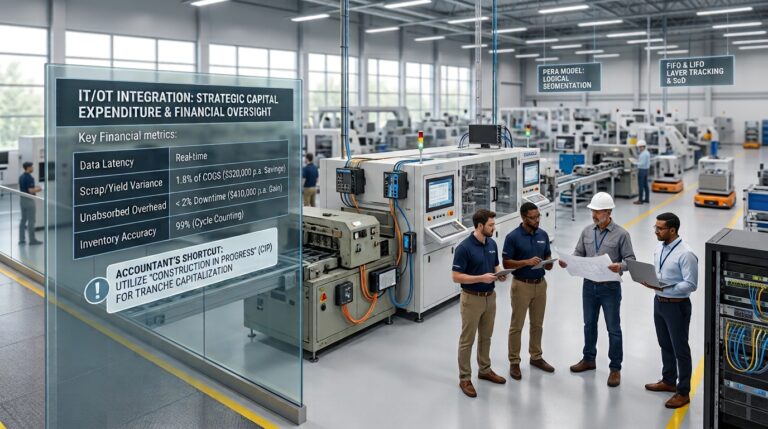
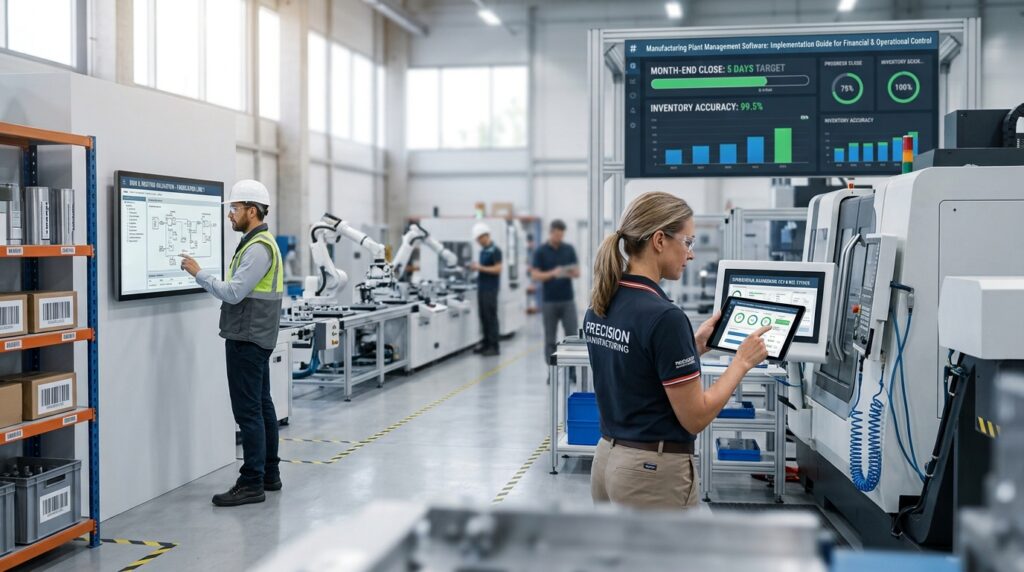
Manufacturing plant management software, including Manufacturing Execution Systems (MES) and ERP extensions, acts as the control layer for financial and operational data in a facility. At the plant level, it connects shop-floor execution with financial reporting. If the integration is configured and governed well, it strengthens cycle counting controls and standard costing accuracy while improving labor efficiency variances (LEV). The phased deployment below strengthens inventory and asset records, supports absorption costing, and shortens the month-end close.
Pre-Implementation Requirements: Financial and Operational Baseline
A system-wide implementation requires a disciplined pre-implementation phase. Capital outlays for software and integration must be mapped directly to anticipated P&L improvements.
Cross-Functional Steering Committee
Establish a project structure managed by a dedicated project manager. Mandatory operational leads include:
- Financial Controller/CFO: Oversees standard costing logic, GL mapping, and capitalization of software implementation costs, including ASC 350-40 considerations.
- Plant Manager: Dictates workflow routing and machine center capabilities.
- Production Engineers: Responsible for Bill of Materials (BOM) accuracy and yield specifications.
Defining Operational Goals and KPIs
Unclear project scope reduces ROI. Baseline your current metrics and establish hard financial targets.
- Inventory Holding Reduction: Shift from physical wall-to-wall stocktakes to perpetual inventory with ABC-stratified cycle counting.
- Cost Control: Reduce material usage variance by 8% through real-time scrap reporting.
- Financial Reporting: Enable a rigorous 5-day month-end close by eliminating manual Work-in-Progress (WIP) reconciliations.
BOM and Routing Validation
Map existing workflows and standardize operational procedures. An MES will only reflect the BOMs, routings, and yield standards loaded into it. Audit multi-level BOMs to confirm that direct material, direct labor, and variable overhead routing accurately reflect physical floor operations before digitizing them.
Budget CapEx, OpEx, and Timeline Modeling
Build a detailed financial model that separates SaaS licensing, usually OpEx, from integration, hardware, and external consulting, which may be CapEx. Include a temporary 10-15% drop in labor efficiency during the first 30 days of cutover as users adjust to the new workflows.
Realistic Scenario: Discrete Manufacturer Integration
Context: A $35M turnover discrete manufacturer of lawnmowers and woodfires, employing 120 staff. The objective is to consolidate two physical production sites into one and generate more than $1.4M in annualized overhead savings, using plant management software to absorb the throughput without increasing indirect labor.
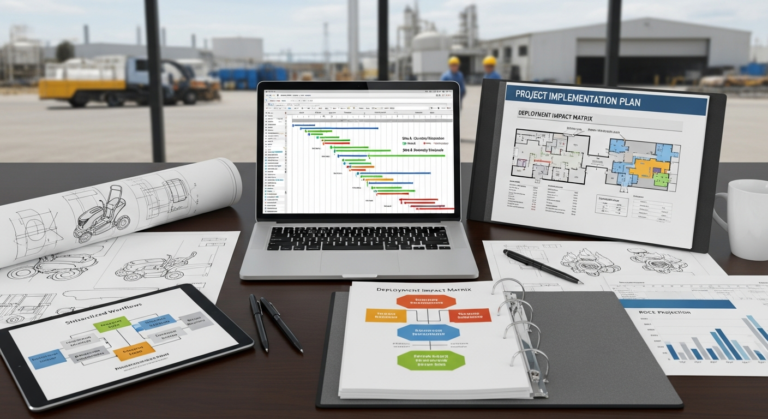
Financial Impact Matrix Target:
| Metric | Pre-Implementation | Post-Implementation Target |
|---|---|---|
| Month-End Close | 12 Days | 5 Days |
| Inventory Accuracy | 88% Annual Stocktake | 99.5% Perpetual Cycle Count |
| Labor Efficiency Variance | -$250,000 / yr Unfavorable | +$50,000 / yr Favorable |
| Scrap Rate | 4.2% of COGS | 1.8% of COGS |
Step-by-Step Implementation Process
Step 1: Needs Assessment and Vendor Selection
Audit current workflow bottlenecks, especially where physical production disconnects from the ERP. For the $35M discrete manufacturer, vendor selection should be tested against three requirements: advanced BOM rollups, real-time WIP valuation, and integration with PLC data from automated stamping machines.
- Shortcut: Prioritize vendors with native API connections to your existing ERP. This reduces middleware development costs and lowers the risk of recurring subledger reconciliation failures.
2: System Configuration and Costing Logic Customization
Configure costing, routing, and reporting rules to match your reporting structure.
- Cost Centers & Absorption Rules: Define direct labor vs. indirect overhead allocation. Set machine-hour and labor-hour overhead absorption rates based on realistic capacity, not theoretical maximums.
- Backflushing Protocol: Set up backflush accounting for low-value, high-volume C-class components, such as fasteners and washers, upon completion of sub-assemblies to reduce operator data-entry fatigue. Keep A-class components, including engines and cast aluminum decks, on explicit FIFO/LIFO lot-tracking.
3: Data Migration and Subledger Reconciliation
Migrate inventory logs, fixed asset registers, and supplier databases only after the source records are reconciled.
- Data Cleansing: Remove ghost assets and obsolete inventory, including SLOB, from legacy ledgers before migration.
- Reconciliation: Confirm that the inventory subledger balances exactly with the General Ledger (GL) control accounts at the moment of data snapshot. Disconnect IoT sensors during migration to prevent ghost transactions.
4: Shop Floor Data Collection (SFDC) Training
Operators need to understand how terminal inputs affect financial reporting.
- Role-Based Workflows: Train machine operators on barcode/RFID scanning for start and stop times. This transaction-level data replaces standard estimated times and identifies precise Labor Efficiency Variances (LEV) and machine downtime (OEE).
5: Pilot Testing and Parallel Go-Live
Start with a parallel run on a single distinct routing, such as the woodfire fabrication line, before facility-wide deployment.
- Audit Check: During the pilot, physically count raw materials consumed and WIP generated, then compare physical yields against the system’s variance reporting. Resolve pilot integration errors before executing a hard cutover.
Common Mistakes to Avoid in Manufacturing Deployments
Migrating “Dirty BOMs” and Inaccurate Routings
The Mistake: Transferring unverified BOMs into a new system.
The Consequence: The system will backflush incorrect quantities, creating significant Purchase Price Variances (PPV) and artificially inflating or deflating WIP balances. Gross margin reports will no longer reflect actual material usage and WIP.
Ignoring Segregation of Duties (Internal Controls)
The Mistake: Giving floor supervisors universal administrative access to expedite operations.
The Consequence: This weakens segregation of duties and makes unauthorized cost or inventory adjustments harder to detect. Floor managers should not be able to manually override cycle counts or alter standard cost inputs without financial controller approval.
Attempting Full Wall-to-Wall Stocktakes at Go-Live
The Mistake: Freezing the plant for 3 days to count everything manually the day before go-live.
The Consequence: Manual counting carries a high error rate.
Practical Shortcut: Execute a rigorous cycle-counting regimen on A and B tier inventory items in the 60 days leading up to go-live, ensuring 99% accuracy on 80% of the inventory value. Limit the physical count at cutover to Work-in-Progress (WIP) and finished goods.
Capitalizing Operational Standard Cost Errors
The Mistake: Failing to isolate abnormal downtime or excessive scrap generated during the learning curve phase.
The Consequence: Absorbing these inefficiencies into inventory value rather than expensing them directly as period costs violates GAAP/IFRS and artificially inflates the balance sheet.
Final Result: Operational Control and Repeatable Margin Reporting
Once stabilized, the system lets finance review margin drivers during production instead of after close.
Expedited Financial Close
Manual data collation is removed from the close process. With real-time SFDC and automated WIP valuation, financial controllers can move to a strict 5-day month-end close. Accruals, scrap write-offs, and overhead absorption adjustments are calculated perpetually.
Line-Level Variance Analysis
Management can review current P&L drivers instead of waiting for month-end variance reports. A gross margin decline can be traced to its source: supplier price movement (PPV), a slower-than-expected production run (Labor Rate/Efficiency Variance), or excessive machine downtime (Unabsorbed Overhead).
Facility Consolidation and Added Production Capacity
As shown in the scenario, one production-control system supports site rationalization. By routing all production through a single system, the business can capture the targeted $1.4M+ in overhead savings while using international supply chain integrations with fewer manual handoffs.
Frequently Asked Questions
What is the financial payback period (ROI) for plant management software?
For many discrete manufacturers, payback falls within 12 to 18 months. The main driver is lower safety stock, supported by the elimination of annual physical stocktake downtime and improved labor absorption.
How do we handle WIP during the system cutover?
WIP is the most complex accounting asset to migrate. The practical shortcut is to flush the factory floor as much as possible before go-live. Complete sub-assemblies and convert them to finished goods, or return raw materials to the warehouse. Keep physical WIP to a minimum to reduce manual valuation errors during the final subledger upload.
Can modern MES architecture connect to legacy capital equipment?
Yes. Capital replacement of legacy stamping or molding machines is not required. Modern systems can extract cycle times and yield data from 20-year-old machinery through edge-computing PLCs, retrofitted IoT sensors, or standard SCADA integrations, then feed that data into the new ERP/MES architecture for live depreciation and OEE tracking.