
Bulletproof Cash Flow Forecast Manufacturing
How to Build a Bulletproof Cash Flow Forecast for Manufacturing A cash flow forecast manufacturing model is a financial projection that estimates the money flowing in and out of your production business over a specific period. Unlike a standard profit and loss statement, a cash flow forecast specifically tracks liquidity rather than accounting earnings. Liquidity…
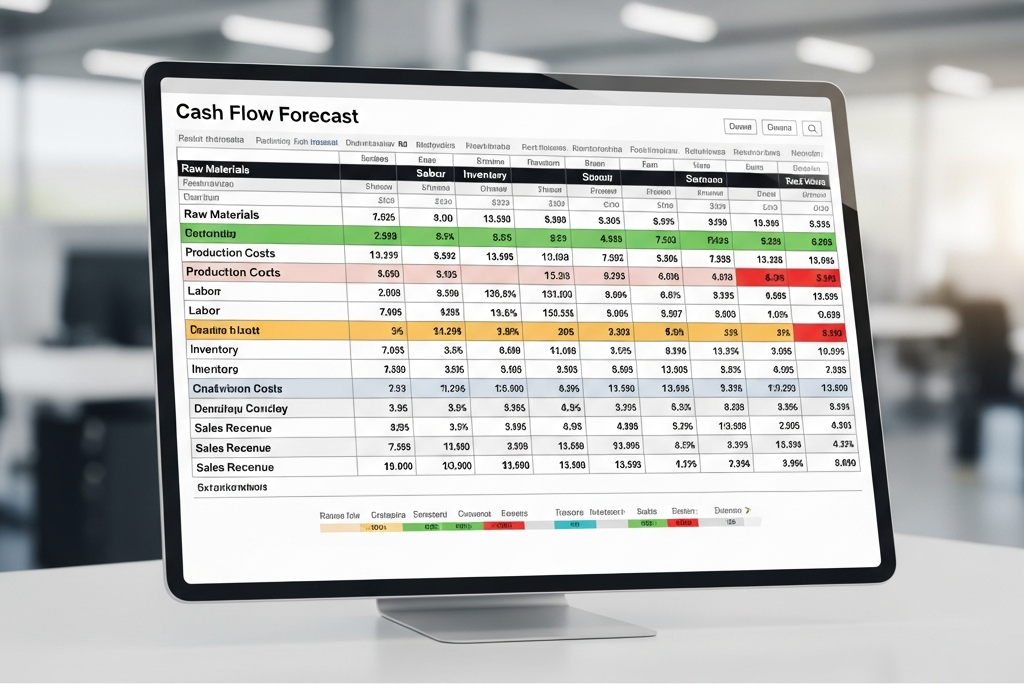
How to Build a Bulletproof Cash Flow Forecast for Manufacturing
A cash flow forecast manufacturing model is a financial projection that estimates the money flowing in and out of your production business over a specific period. Unlike a standard profit and loss statement, a cash flow forecast specifically tracks liquidity rather than accounting earnings. Liquidity is the measure of how quickly and easily your business can access physical cash to meet its immediate financial obligations.
In the manufacturing industry, heavy upfront capital is tied up in raw materials, equipment, and labor long before a finished product is sold. Because of this delayed return on investment, understanding your exact cash position is critical. It is often the deciding factor between enjoying seamless factory operations and facing a stalled production line.
Building a reliable forecast allows you to see potential financial roadblocks weeks or even months before they happen. By tracking exactly when money enters and leaves your bank account, you can confidently schedule production runs and equipment upgrades. Read on to discover how to build a bulletproof forecast, and be sure to utilize our included template to simplify the process.
What You Need to Get Started
Before you can predict the future of your factory’s finances, you need to understand your current financial reality. Gathering the right documentation will ensure your forecasting model is built on facts rather than optimistic guesswork. Preparation is the key to unlocking an accurate and reliable cash model.
Historical Financial Statements
Gather your past bank statements, accounts receivable, and accounts payable reports to establish a baseline for your typical cash cycle. Historical data reveals your actual spending habits and seasonal revenue dips, rather than just what your budget predicted.
Make sure to pull the following essential documents:
- The last 12 months of bank statements: To identify recurring automated withdrawals and deposits.
- Accounts Receivable (AR) aging reports: To see how long it actually takes your customers to pay their invoices.
- Accounts Payable (AP) aging reports: To understand your historical payment cadence to your own vendors.
Production and Sales Schedules
Compile your current sales pipeline, upcoming purchase orders, and anticipated production timelines to accurately predict future financial activities. Your sales team and your floor managers must be aligned, as a booked sale means nothing to your cash flow until the product is manufactured and shipped.
Reviewing these schedules helps you identify exactly when you will need to purchase raw materials to fulfill upcoming orders. It also alerts you to any scheduled plant maintenance that might temporarily halt production and delay your incoming revenue.
Supplier and Customer Payment Terms
Collect the exact payment terms for your vendors (e.g., Net 30, Net 60) and the expected collection cycles from your buyers. You need to know exactly when cash is legally required to change hands. If you pay your suppliers on Net 30 terms but your customers pay you on Net 60 terms, you will experience a dangerous 30-day cash gap.
Take time to map out the payment conditions for your top ten suppliers and your top ten customers. This simple exercise will instantly highlight where your cash might get trapped in the supply chain.
The Manufacturing Cash Flow Template
Building a forecast from scratch can be overwhelming, which is why utilizing a pre-built foundation is highly recommended. Download and open our provided spreadsheet template, which is pre-formatted to calculate manufacturing-specific inflows and outflows automatically.
A specialized template saves you hours of formatting and ensures you do not forget crucial industry-specific line items. Once you have your data gathered and your template open, you are ready to begin projecting your financial future.
Step 1: Project Your Cash Inflows
Cash inflows represent all the actual cash entering your business bank accounts during a specific period. Accurately projecting this money requires looking beyond just the numbers on your sales contracts. You must master the timing of when those funds will become available for you to spend.
Forecasting Sales and Collections
Input your expected revenue based on current orders and historical seasonal trends. Focus strictly on when the cash will actually hit your bank account, not just when the sale is officially booked by your sales team.
To ensure accuracy in your collections forecast, consider the following variables:
- Historical seasonality: Do your sales typically dip in the winter or surge in the spring?
- Customer deposit requirements: Do you collect a 30% or 50% deposit upfront before manufacturing begins?
- Milestone payments: Are you receiving partial payments when certain production phases are completed?
Adjusting for Late Payments
Factor in a realistic percentage of delayed payments from customers to ensure your inflows are not overly optimistic. Even the most reliable customers can face their own cash flow issues, which inevitably trickles down to your accounts receivable.
Review your historical AR aging reports to determine your average collection period. If your data shows that 20% of your invoices are typically paid 15 days late, build that exact delay into your spreadsheet.
Accounting for Alternative Funding
List any expected cash injections from business loans, lines of credit, or government grants specific to manufacturing operations. Cash inflows are not exclusively generated by selling finished goods.
If you are expecting a tax rebate for purchasing eco-friendly machinery, log the exact month that check is expected to arrive. Similarly, if you plan to draw $50,000 from your working capital line of credit to cover a slow month, record that as an inflow.
Step 2: Estimate Your Cash Outflows
Cash outflows represent every dollar that leaves your business to keep your manufacturing operations running. In the production industry, outflows are notoriously front-loaded, meaning you spend heavily long before you see a return. Carefully estimating these costs is the most vital step in protecting your liquidity.
Calculating Direct Material and Labor Costs
Map out the exact costs of raw materials, freight, and direct factory labor required to fulfill your production schedule. These are your variable costs, meaning they will fluctuate directly alongside your production volume.
When estimating these direct outflows, pay close attention to the following details:
- Raw material price volatility: Factor in potential price hikes for commodities like steel, lumber, or plastics.
- Freight and shipping costs: Estimate the shipping fees for both receiving raw materials and delivering finished goods.
- Overtime labor: Budget for premium labor rates if an upcoming large order requires your team to work weekends.
Factoring in Manufacturing Overhead
Include indirect costs such as factory rent, utilities, insurance, and routine equipment maintenance. These fixed and semi-variable expenses will drain your cash reserves even if your production lines are sitting completely idle.
Do not forget to account for annual or quarterly lump-sum payments, such as property taxes or heavy machinery insurance premiums. Spreading a yearly cost into monthly fractions on your forecast is a common mistake; you must log the outflow in the exact month the massive check is written.
Planning for Capital Expenditures (CapEx)
Capital Expenditures (CapEx) are funds used by a company to acquire, upgrade, and maintain physical assets such as property, industrial buildings, or equipment. Project the costs of purchasing new machinery, upgrading technology, or expanding facility space.
Note the exact months these large payments will be made so you are not caught off guard. If you are financing a new CNC machine, list the monthly loan payments as ongoing outflows rather than a single massive expense.
Step 3: Calculate the Final Result
With your inflows and outflows meticulously mapped out, it is time to bring the data together. This step translates your raw data into a clear, actionable narrative about your company’s financial health.
Reconciling Inflows and Outflows
Subtract your total projected outflows from your total projected inflows for each period (weekly or monthly) to find your net cash flow. Net cash flow is the total amount of money remaining after all cash leaving the business is subtracted from all cash entering the business.
If the resulting number is positive, you are generating more cash than you are burning. If the number is negative, you are operating at a cash deficit for that specific period.
Establishing Your Ending Cash Balance
Add your net cash flow to your opening bank balance to determine your ending cash balance for the period. Your ending balance for one week or month automatically becomes the opening balance for the next.
This running total is the ultimate heartbeat of your manufacturing business. It clearly illustrates whether your cash reserves are steadily growing over time or quietly bleeding out.
Analyzing the Final Result for Strategic Action
Review the completed forecast to identify upcoming cash deficits well before they become emergencies. Use this final result to proactively delay non-essential purchases or push for early customer payments.
If a severe shortfall is looming in month three, you have the power to act now. You can confidently draw on a line of credit or negotiate extended payment terms with your suppliers before a lack of cash halts production entirely.
Common Mistakes to Avoid
Even seasoned manufacturing executives can fall into forecasting traps that severely compromise their financial models. Avoiding these common pitfalls will ensure your forecast remains a reliable tool for strategic growth.
Confusing Profit with Cash Flow
A common error is assuming that a profitable month automatically means you have positive cash flow. Profit is the financial gain remaining after subtracting all operating expenses from total revenue, regardless of whether that money has actually been collected.
You can easily sell a million dollars worth of goods in a month, making you highly profitable on paper. However, if those customers have 90 days to pay you, your actual cash flow for that profitable month might be dangerously negative. Always separate paper profits from physical cash in the bank.
Ignoring Supply Chain Lead Times
Lead time is the total amount of time that elapses between placing an order with a supplier and receiving the physical goods. Failing to account for the time it takes for raw materials to arrive can severely distort your cash model.
Ignoring this timeline can lead to paying for raw inventory months before you can actually manufacture and sell the final product. Always align your cash outflows with the reality of international shipping delays and vendor processing times.
Underestimating Unplanned Downtime
Overlooking the financial impact of machine breakdowns or unexpected repairs can quickly drain your cash reserves. Machinery fails, power grids go down, and key employees call in sick.
Always build a conservative contingency buffer into your projected outflows. Reserving an extra 5% to 10% for emergency maintenance will ensure a blown motor does not bankrupt your entire monthly operating budget.
Frequently Asked Questions
What is the ideal timeframe for a cash flow forecast in manufacturing?
For most manufacturers, a rolling 13-week cash flow forecast is ideal for tactical, short-term liquidity planning. A 13-week model covers a full business quarter, allowing you to manage immediate payroll, raw material orders, and utility bills.
Conversely, a 12-month forecast is best for long-term strategic planning and capital expenditures. Use the annual model to plan for facility expansions, major machinery purchases, and hiring initiatives.
How does inventory management affect my cash flow forecast manufacturing model?
Excess inventory ties up vital cash that could otherwise be used for operating expenses or strategic investments. Every pallet of unused steel or plastic sitting in your warehouse represents frozen liquidity.
On the flip side, holding too little inventory can halt production, anger customers, and delay your cash inflows entirely. Accurate inventory forecasting is essential to balancing this cycle and protecting your available cash.
How often should I update my manufacturing cash flow forecast?
You should update your forecast at least once a week to maintain true financial clarity. Manufacturing environments are highly dynamic, and a forecast that is a month old is essentially useless.
Regular updates ensure you are working with the most accurate financial data regarding fluctuating supplier costs and late customer payments. Make it a strict habit to reconcile your forecast every Friday afternoon so you always know exactly where you stand for the week ahead.