Best Cost Accounting Software for Manufacturing Businesses
Target Audience Strategic Purpose “If you can’t accurately calculate what each product costs to make, you’re flying blind. You might be losing money on your ‘best sellers’ and passing up profits on products you think are losers. Cost accounting software ends the guessing game.” The Cost Accounting Crisis: Real Scenario: $8M manufacturer using simple accounting:…
Target Audience
- Manufacturing CFOs/controllers needing accurate product costs
- Cost accountants in manufacturing
- Operations managers responsible for costing
- Manufacturers struggling with overhead allocation
- Companies needing better job/product profitability
- Make-to-order manufacturers with complex costing
- Decision-makers evaluating costing systems
Strategic Purpose
- Bridges multiple sub-niches (Job Costing + Inventory + Financial Reporting)
- Captures specific “cost accounting” manufacturing searches
- Natural extension from Job Costing and Inventory pillars
- Strong affiliate potential (specialized software)
- Year-round relevance
- Appeals to mid-market manufacturers ($3M-$50M)
- Differentiator (not general accounting)
“If you can’t accurately calculate what each product costs to make, you’re flying blind. You might be losing money on your ‘best sellers’ and passing up profits on products you think are losers. Cost accounting software ends the guessing game.”
The Cost Accounting Crisis:
Real Scenario:
$8M manufacturer using simple accounting:
Product Line Analysis (what they THOUGHT):
- Widget A: 45% margin – “Our star product!”
- Widget B: 22% margin – “Break-even product”
- Widget C: 35% margin – “Good performer”
Strategy: Push Widget A sales, consider dropping B
After implementing proper cost accounting software:
ACTUAL costs discovered:
- Widget A: 12% margin (LOSING money after proper overhead!)
- Widget B: 38% margin (Actually most profitable!)
- Widget C: 29% margin (Good, but not great)
What changed?
- Widget A uses 3× more machine time (overhead allocation)
- Widget A has 40% scrap rate (wasn’t tracked)
- Widget A ties up warehouse space (carrying costs)
- Widget B is simple, fast, low waste
- Widget C moderate on all factors
Impact of wrong information:
– Spent $50K marketing Widget A (losing money!)
– Nearly discontinued Widget B (their cash cow!)
– Pricing was backwards
– Sales comp rewarded wrong products
After implementing cost accounting software:
- Year 1: Discovered true costs
- Year 2: Adjusted pricing, dropped Widget A, pushed Widget B
- Year 3: Profits increased 47% on same revenue!
Cost of software: $12,000/year
Profit impact: $340,000 annually
ROI: 2,733%
No activity-based costing
- Can’t trace costs to activities
- Can’t assign activity costs to products
- No visibility into cost drivers
Poor WIP tracking
- Work-in-process costs unclear
- Can’t see job-by-job profitability
- Inventory valuation inaccurate
Limited cost analysis
- Can’t compare actual vs standard costs
- No variance analysis
- Can’t identify cost reduction opportunities
- Historical comparisons difficult
No “what-if” modeling
- Can’t model cost changes
- Can’t evaluate make-vs-buy decisions
- Can’t analyze equipment investments
What Cost Accounting Software Provides:
Accurate product costing
- Material costs (actual, not estimated)
- Direct labor (tracked by product/job)
- Overhead allocation (activity-based)
- Total landed cost
Multiple costing methods
- Job costing (make-to-order)
- Process costing (continuous production)
- Activity-based costing (ABC)
- Standard costing with variance analysis
- Actual costing
Detailed cost tracking
✔️ Integration
- ERP/accounting systems
- Production/MRP systems
- Time tracking
- Inventory management
- Shop floor data collection
✔️ Decision support
- Pricing optimization
- Product mix analysis
- Process improvement identification
- Capacity planning
- Capital investment ROI
What This Guide Covers:
1: Understanding Cost Accounting
- Cost accounting vs financial accounting
- Costing methodologies (Job, Process, ABC, Standard)
- When you need dedicated cost accounting software
- Essential features
2: Top 8 Cost Accounting Software
- Detailed reviews
- Pros, cons, pricing
- Best-for scenarios
- User experiences
3: Feature Comparison
- Side-by-side tables
- Costing methods supported
- Overhead allocation capabilities
- Reporting quality
- Integration options
4: Implementation
- Setting up cost centers
- Defining cost drivers
- Standard cost development
- Training requirements
5: Making Your Decision
- Decision framework
- ROI calculator
- Vendor evaluation
By Costing Method:
- Best for Job Costing
- Best for Process Costing
- Best for Activity-Based Costing
- Best for Standard Costing
By Company Size:
PART 1: UNDERSTANDING COST ACCOUNTING SOFTWARE
Section 1.1: Cost Accounting vs Financial Accounting
Financial Accounting:
Purpose: External reporting (investors, lenders, IRS)
Focus:
- Historical (what happened)
- GAAP compliance
- Company-wide totals
- Period-based (monthly, quarterly, annual)
Questions Answered:
- What was total revenue?
- What was net profit?
- What are total assets?
- Did we comply with accounting standards?
Users:
- Investors
- Lenders
- IRS
- Board of directors
Cost Accounting (Managerial Accounting):
Purpose: Internal decision-making
Focus:
- Forward-looking (what should we do)
- No GAAP required (use what works!)
- Product/job/customer level detail
- Real-time (continuous)
Questions Answered:
- What does Product X actually cost?
- Which customers are profitable?
- Should we make or buy Component Y?
- Where can we reduce costs?
- What should we price Product Z at?
Users:
- Management
- Operations
- Sales
- Product development
Why Manufacturers Need Both:
Financial Accounting (QuickBooks/Xero/NetSuite):
“We made $2M revenue with $400K profit (20% margin)”
Cost Accounting Software:
- “Product A: 35% margin – expand production
- Product B: 8% margin – raise prices or discontinue
- Product C: -5% margin – LOSING MONEY, stop immediately
- Customer X: 45% margin – our best customer
- Customer Y: 5% margin – high maintenance, fire them”
The Gap: Financial accounting shows aggregate profit. Cost accounting shows WHERE profit comes from.
Bottom line: You need financial accounting (required). You need cost accounting to make smart decisions.
Section 1.2: Costing Methodologies
1. Job Costing (Job Order Costing)
What It Is: Track costs for each individual job/project/order.
Best For:
- Custom manufacturing
- Make-to-order
- Job shops
- Each product unique or semi-custom
How It Works:
Job #1234 (Custom bracket):
Direct Materials:
Steel plate: $145
Hardware: $23
Coating: $18
Total materials: $186
Direct Labor:
Cutting: 2.5 hrs × $32/hr = $80
Welding: 3.0 hrs × $38/hr = $114
Finishing: 1.5 hrs × $28/hr = $42
Total labor: $236
Overhead (allocated):
Based on machine hours: 6 hrs × $45/hr = $270
Total Job Cost: $692
Quoted Price: $950
Profit: $258 (37% margin)
Actual vs Estimated:
Estimated: $625 (materials $175, labor $200, overhead $250)
Actual: $692
Variance: $67 over (10.7%)
Reason: Took 1 extra hour labor (complexity)
Software Needs:
- Job number tracking
- Material requisitions
- Labor time tracking by job
- Overhead allocation by job
- Job profitability reporting
- Actual vs estimated variance
Best Software: JobBOSS, E2 Shop System, Fishbowl, Global Shop Solutions
2. Process Costing
What It Is: Average costs across all units in a production run/period.
Best For:
- Continuous production
- Homogeneous products
- Make-to-stock
- High volume, standardized
How It Works:
Production Run – Widget X (1,000 units):
Total Costs for Period:
Materials: $8,500
Labor: $6,200
Overhead: $5,800
Total: $20,500
Units Produced: 1,000
Cost per Unit: $20,500 ÷ 1,000 = $20.50/unit
Selling Price: $32
Margin per unit: $11.50 (36%)
Software Needs:
- Production run tracking
- Batch/lot costing
- Equivalent units calculation
- Department/process center costing
- Cost per unit reports
- Period comparisons
Best Software: NetSuite, SAP, Epicor, DELMIAWorks
3. Activity-Based Costing (ABC)
What It Is: Allocate overhead based on activities that drive costs.
Best For:
- Complex operations
- Multiple products with different resource usage
- High overhead costs
- Need accurate product costs
How It Works:
Traditional Overhead Allocation:
Total overhead: $500,000
Allocation base: Direct labor hours (10,000 hrs)
Rate: $50 per labor hour
Product A: 100 labor hours → $5,000 overhead
Product B: 100 labor hours → $5,000 overhead
(Equal allocation despite different resource usage!)
Activity-Based Costing:
Identify activities and drivers:
Activity: Machine Setup
Cost: $100,000
Driver: Number of setups
Product A: 20 setups → $40,000
Product B: 5 setups → $10,000
Activity: Quality Inspection
Cost: $80,000
Driver: Inspection hours
Product A: 200 hrs → $64,000
Product B: 50 hrs → $16,000
Activity: Material Handling
Cost: $60,000
Driver: Number of moves
Product A: 150 moves → $45,000
Product B: 50 moves → $15,000
Total Overhead Allocation:
Product A: $149,000 (vs $5,000 traditional!)
Product B: $41,000 (vs $5,000 traditional!)
Revelation: Product A is much more expensive to make!
Software Needs:
- Activity definition and tracking
- Multiple cost driver support
- Cost pool management
- Activity-to-product assignment
- ABC reporting
- Profitability analysis by product/customer
Best Software: SAP (CO-ABC), Oracle Costing, SAS ABC
4. Standard Costing
What It Is: Set predetermined “standard” costs, then compare actual vs standard.
Best For:
- Repetitive manufacturing
- Established products
- Cost control focus
- Variance analysis important
How It Works:
Standard Cost for Widget (predetermined):
Materials: $15.00 (5 lbs × $3/lb)
Labor: $10.00 (0.5 hrs × $20/hr)
Overhead: $8.00 (0.5 hrs × $16/hr)
Standard Total: $33.00
Actual Cost (month end):
Materials: $16.20 (price variance + usage variance)
Labor: $11.50 (rate variance + efficiency variance)
Overhead: $8.00 (on target)
Actual Total: $35.70
Variance Analysis:
Material Price Variance: $0.50 unfavorable
(paid $3.10/lb instead of $3.00)
Material Usage Variance: $1.20 unfavorable
(used 5.4 lbs instead of 5)
Labor Rate Variance: $0 (paid correct rate)
Labor Efficiency Variance: $1.50 unfavorable
(took 0.575 hrs instead of 0.5)
Total Variance: $2.70 unfavorable per unit
Investigation:
– Material price increase (supplier negotiation needed)
– Material usage high (quality issue? training needed?)
– Labor inefficiency (process problem? new employee?)
Actions taken → costs return to standard
Software Needs:
- Standard cost maintenance
- Actual cost capture
- Variance calculation (price, quantity, rate, efficiency)
- Variance reporting and analysis
- Standard cost updates
- Multi-level variance drill-down
Best Software: NetSuite, SAP, Microsoft Dynamics, Epicor
Section 1.3: When You Need Dedicated Cost Accounting Software
You’re Ready When:
1. QuickBooks/Basic Accounting Isn’t Enough
Signs:
- “I have no idea what Product X really costs”
- “We’re profitable overall but losing money on some products”
- “I can’t figure out which customers are profitable”
- “Overhead allocation is a wild guess”
- “Can’t do proper job costing”
2. Financial Impact Justifies Investment
Calculate:
Revenue: $5M-$50M+
If cost accounting reveals:
– 10% of products unprofitable (stop making them)
– 20% of products underpriced (raise prices)
– Cost reduction opportunities (2-5%)
Potential annual benefit: $100K-$500K+
Software cost: $5K-$50K/year
ROI: 200-1,000%+
3. Business Complexity
Indicators:
- Multiple products with different processes
- Custom/semi-custom manufacturing
- High overhead costs
- Make-to-order operations
- Multiple production departments
- Need accurate job/product profitability
4. Growth & Competitiveness
Need to:
- Price competitively but profitably
- Identify cost reduction opportunities
- Make data-driven decisions
- Win bids accurately
- Improve margins
You DON’T Need It Yet If:
- <$1M revenue with simple operations
- Single product or very few products
- Service business (not manufacturing)
- Standard markup works fine
- QuickBooks meets all needs
- Not competing on price
Start with: Better use of existing accounting software, spreadsheets, then upgrade when you hit limits.
Section 1.4: Essential Features
Must-Have Features:
1. Multiple Costing Methods
- ✔️ Support your primary method (job, process, ABC, standard)
- ✔️ Hybrid capabilities (many manufacturers use multiple)
- ✔️ Ability to switch methods if business changes
2. Detailed Cost Capture
Material costs:
- Direct materials
- Indirect materials/supplies
- Material handling costs
- Scrap and waste tracking
- Lot/batch cost tracking
Labor costs:
- Direct labor by job/product
- Indirect labor
- Setup time
- Rework labor
- Labor rate variances
- Efficiency tracking
✔️ Overhead costs:
- Multiple cost pools
- Various allocation bases (labor hrs, machine hrs, units, etc.)
- Department/cost center overhead
- Activity-based drivers
3. Cost Centers & Departments
- ✔️ Department cost tracking
- ✔️ Cost center profitability
- ✔️ Inter-department cost allocation
- ✔️ Hierarchical cost structures
4. Bill of Materials (BOM) Integration
- ✔️ Multi-level BOM support
- ✔️ Component cost roll-up
- ✔️ BOM costing (current and future)
- ✔️ Where-used reporting
- ✔️ Engineering change cost impact
5. Variance Analysis
- ✔️ Material price variance
- ✔️ Material usage/quantity variance
- ✔️ Labor rate variance
- ✔️ Labor efficiency variance
- ✔️ Overhead variance (spending, efficiency, volume)
- ✔️ Variance by job/product/department
- ✔️ Trend analysis
6. Profitability Analysis
- ✔️ Product profitability
- ✔️ Customer profitability
- ✔️ Job profitability
- ✔️ Sales channel profitability
- ✔️ Contribution margin analysis
- ✔️ Multi-dimensional profitability (product + customer + region)
7. Reporting & Analytics
- ✔️ Cost of goods manufactured (COGM)
- ✔️ Cost of goods sold (COGS) detail
- ✔️ WIP valuation
- ✔️ Job cost reports
- ✔️ Product cost comparison
- ✔️ Make-vs-buy analysis
- ✔️ Cost trend analysis
- ✔️ Custom report builder
- ✔️ Dashboards and KPIs
8. Integration
- ✔️ ERP/Accounting system (QuickBooks, NetSuite, SAP, etc.)
- ✔️ Production/MRP system
- ✔️ Time tracking system
- ✔️ Inventory management
- ✔️ Shop floor data collection
- ✔️ Quality management system
PART 2: TOP 8 COST ACCOUNTING SOFTWARE
Software #1: NetSuite Advanced Manufacturing
Overview: NetSuite’s Manufacturing Edition includes sophisticated cost accounting capabilities within a full cloud ERP. Supports job costing, process costing, standard costing, and activity-based costing. Best for $10M-$500M manufacturers needing enterprise-grade cost accounting with complete business system integration.
Key Cost Accounting Features:
Costing Methods:
- Job/work order costing
- Assembly/process costing
- Standard costing with full variance analysis
- Activity-based costing (with advanced module)
- Landed cost calculation
- Multi-level BOM costing
Cost Tracking:
- Real-time WIP tracking
- Material cost capture (actual + standard)
- Labor routing and costing
- Outside processing costs
- Overhead allocation (multiple methods)
- Scrap and rework tracking
- Cost center accounting
Variance Analysis:
- Material price and usage variances
- Labor rate and efficiency variances
- Overhead variances (spending, efficiency, volume)
- Purchase price variance
- Work order close variance
- By product, job, department, time period
Profitability:
- Product profitability
- Customer profitability
- Job profitability
- Multi-dimensional analysis
- Drill-down capabilities
Reporting:
- Cost of goods manufactured
- WIP valuation
- Inventory valuation (all methods)
- Variance reports
- Cost trend analysis
- Custom report builder
- Real-time dashboards
Pros:
- ✔️ Complete ERP integration (accounting, inventory, production, CRM all connected)
- ✔️ Sophisticated cost accounting (enterprise-grade capabilities)
- ✔️ Real-time costing (not batch/period-end)
- ✔️ Flexible (supports all costing methods)
- ✔️ Scalable ($10M to $1B+)
- ✔️ Cloud-based (access anywhere, automatic updates)
- ✔️ Multi-entity/currency (global operations)
- ✔️ Strong reporting (built-in + custom)
Cons:
- ❌ Very expensive ($30K-$100K+ annually)
- ❌ Complex implementation (3-6 months, $50K-$200K+)
- ❌ Steep learning curve (powerful = complex)
- ❌ Requires full NetSuite (not standalone cost accounting)
- ❌ Overkill for small (<$10M revenue)
- ❌ Customization costly (modifications expensive)
Pricing:
License:
- Base NetSuite: $999+/month
- Manufacturing module: Additional fee
- Advanced Manufacturing: Additional fee
- Per-user licenses: $99-$199/month each
- Typical mid-size: $3,000-$8,000/month
Implementation:
- Partner fees: $50,000-$200,000+
- Timeline: 3-6 months
- Training: $10,000-$30,000
Total Year 1 ($20M manufacturer):
- Software: $60,000
- Implementation: $100,000
- Training: $20,000
- Total: ~$180,000
Ongoing: $60,000-$100,000/year
Best For:
- ✔️ $10M-$500M manufacturers
- ✔️ Need complete ERP + cost accounting
- ✔️ Complex manufacturing operations
- ✔️ Multiple costing methods needed
- ✔️ Multi-location/global
- ✔️ Have budget for enterprise solution
User Reviews:
Positive (G2: 4.0/5):
- “Cost accounting capabilities are excellent”
- “Real-time WIP visibility game-changer”
- “Variance analysis helps us improve continuously”
- “Worth the investment at our scale”
Negative:
- “Expensive and complex to implement”
- “Learning curve is very steep”
- “Need dedicated NetSuite admin”
- “Customizations costly”
Our Verdict:
NetSuite is the gold standard for mid-to-large manufacturers needing sophisticated cost accounting within a full ERP. Expensive and complex, but if you’re $20M+ with complex costing needs, it’s likely worth the investment.
Highly recommended for:
- $20M+ manufacturers
- Complex operations (multiple methods, departments)
- Need full ERP anyway
- Multi-location operations
- Can invest $150K+ Year 1
Not recommended for:
- <$10M revenue (too expensive, too complex)
- Simple operations
- Limited budget
- Just need cost accounting (not full ERP)
Rating: 9.5/10 for enterprise manufacturers Rating: 5/10 if under $10M
Get NetSuite Manufacturing Demo | Request NetSuite Pricing
Software #2: SAP Business One (with Costing Module)
Overview: SAP Business One is SAP’s ERP for small-medium businesses, with strong cost accounting through the Costing module. Supports standard costing, actual costing, and activity-based costing. Best for $5M-$100M manufacturers wanting SAP power without S/4HANA complexity.
Key Cost Accounting Features:
Costing Methods:
- Standard costing (with variance analysis)
- Actual/average costing
- Activity-based costing (ABC) module
- Job order costing
- Multi-level BOM costing
Cost Components:
- Material costs (standard and actual)
- Labor/machine time costs
- Outside services
- Overhead allocation
- Multiple cost elements definable
Cost Centers:
- Unlimited cost centers
- Department costing
- Profit center accounting
- Cost allocation rules
- Inter-company costing
Variance Analysis:
- Material variances
- Labor variances
- Overhead variances
- Production variances
- Period-over-period comparison
ABC Capabilities:
- Activity definition
- Resource drivers
- Activity drivers
- Cost object assignment
- ABC reporting
Pros:
- ✔️ SAP power for SMBs (enterprise features, SMB price)
- ✔️ Strong cost accounting (especially ABC)
- ✔️ Integrated ERP (all modules connected)
- ✔️ Proven platform (35+ years, 70,000+ customers)
- ✔️ Flexible deployment (cloud or on-premise)
- ✔️ Industry-specific versions (manufacturing optimized)
- ✔️ Global capabilities (multi-currency, multi-language)
Cons:
- ❌ Still expensive ($40K-$150K Year 1)
- ❌ Complex (SAP heritage, steep curve)
- ❌ Implementation required (3-6 months)
- ❌ Partner-dependent (quality varies)
- ❌ Customization can be expensive
- ❌ On-premise version feeling dated (cloud better)
Pricing:
Professional License: $3,420 per user (one-time) Limited License: $1,134 per user (one-time) Annual Maintenance: 19% of license fee
Cloud Subscription: $89-$189/user/month
Typical 10-user implementation:
- Licenses: $25,000-$35,000
- Implementation: $40,000-$100,000
- Customization: $10,000-$30,000
- Training: $5,000-$15,000
Total Year 1: $80,000-$180,000 Ongoing (on-prem): $6,000-$8,000/year Ongoing (cloud): $20,000-$40,000/year
Best For:
- ✔️ $5M-$100M manufacturers
- ✔️ Need strong cost accounting + full ERP
- ✔️ Want SAP without S/4HANA cost
- ✔️ Activity-based costing important
- ✔️ Global/multi-entity operations
User Reviews:
Positive (G2: 4.0/5, Capterra: 4.2/5):
- “ABC costing module is excellent”
- “SAP quality at reasonable price”
- “Cost center accounting very flexible”
- “Good for multi-entity operations”
Negative:
- “Implementation took longer than expected”
- “Expensive for our size ($8M)”
- “User interface not intuitive”
- “Partner quality critical – choose carefully”
Our Verdict:
SAP Business One is excellent for mid-market manufacturers needing sophisticated cost accounting (especially ABC) within a proven ERP. More affordable than SAP S/4HANA or NetSuite, but still significant investment.
Highly recommended for:
- $10M-$75M manufacturers
- Need activity-based costing
- Want SAP platform
- Multi-entity operations
- Can invest $80K-$150K Year 1
Not recommended for:
- <$5M revenue
- Simple costing needs
- Want simple, modern UI
- Limited budget
Rating: 8.5/10 for mid-market manufacturers Rating: 6/10 if under $5M
Request SAP Business One Demo | Get SAP B1 Pricing
Software #3: JobBOSS² (Epicor)
Overview: JobBOSS² is the leading job shop management software with strong job costing capabilities. Primarily focused on job/work order costing for make-to-order manufacturers. Best for $2M-$50M job shops and custom manufacturers.
Key Cost Accounting Features:
Job Costing:
- Detailed job cost tracking
- Material requisitions by job
- Labor time tracking by job/operation
- Outside services by job
- Overhead allocation (multiple methods)
- Job cost roll-up
- Actual vs estimated comparison
Estimating Integration:
- Quote to job conversion
- Estimated costs → standard costs
- Real-time cost-to-complete
- Variance tracking during production
Cost Breakdown:
- Material costs (actual)
- Labor costs by operation
- Machine time costs
- Outside processing
- Overhead (departmental rates)
- Scrap and rework
Profitability:
- Job profitability analysis
- Customer profitability
- Part/product profitability
- Margin analysis
- Win/loss tracking
Reporting:
- Job cost detail
- WIP by job
- Job variance reports
- Open job reports
- Completed job analysis
- Cost trend analysis
Pros:
- ✔️ Best job costing (purpose-built for job shops)
- ✔️ Quote-to-cash integration (estimate → job → invoice)
- ✔️ Real-time job costs (see during production, not after)
- ✔️ Shop floor integration (data collection → costing)
- ✔️ Industry standard (10,000+ job shop installations)
- ✔️ Reasonable price ($15K-$50K Year 1)
- ✔️ Proven (mature, stable product)
Cons:
- ❌ Job costing only (not process/ABC/standard costing)
- ❌ Windows-based (desktop version dated)
- ❌ Limited to job shops (not ideal for make-to-stock)
- ❌ Implementation required (2-4 months)
- ❌ Not a full ERP (accounting features basic)
Pricing:
JobBOSS² Traditional:
- License: $15,000-$30,000 (5-10 users)
- Annual maintenance: ~$3,000-$5,000
- Implementation: $10,000-$30,000
JobBOSS² Cloud:
- $150-$250/user/month
- Minimum 5 users
- Implementation: $5,000-$20,000
Total Year 1 (cloud, 5 users):
- Software: $12,000
- Implementation: $15,000
- Training: $5,000
- Total: ~$32,000
Ongoing: $12,000-$18,000/year
Best For:
- ✔️ $2M-$50M job shops
- ✔️ Custom/make-to-order manufacturing
- ✔️ Need excellent job costing
- ✔️ Quote-heavy business
- ✔️ Want industry-standard solution
User Reviews:
Positive (G2: 3.9/5):
- “Job costing is excellent – see profitability in real-time”
- “Helped us stop losing money on underestimated jobs”
- “Quote to job integration seamless”
- “Pays for itself in better job estimates”
Negative:
- “Only does job costing – had to keep QuickBooks”
- “UI feels dated”
- “Wish it had standard costing for our stock items”
Our Verdict:
JobBOSS is the best choice for job shops and custom manufacturers needing excellent job costing. If that’s your primary need (not process/standard/ABC costing), it’s hard to beat.
Highly recommended for:
- Job shops ($2M-$30M)
- Make-to-order manufacturers
- Custom manufacturing
- Job costing is primary need
Not recommended for:
- Make-to-stock operations
- Need process/standard/ABC costing
- Want modern cloud-native UI
- Need full ERP financials
Rating: 9/10 for job shops Rating: 5/10 for process manufacturers
Get JobBOSS Demo | Compare JobBOSS Pricing
Software #4: Epicor ERP
Overview: Epicor ERP is a full-featured enterprise resource planning platform built specifically for discrete and process manufacturers. Its cost accounting module rivals NetSuite in depth, offering job costing, process costing, standard costing, and activity-based costing within a tightly integrated manufacturing environment. Best for $20M–$500M manufacturers with complex, multi-site operations who need an ERP built from the ground up for manufacturing rather than adapted from a general-purpose accounting platform.
Key Cost Accounting Features
Costing Methods:
- Job/work order costing (discrete manufacturing)
- Process costing (continuous/batch production)
- Standard costing with full variance analysis
- Activity-based costing (via Advanced Costing module)
- Average/FIFO/LIFO costing for inventory valuation
- Mixed-mode costing (job + process in same plant)
Cost Tracking:
- Real-time WIP tracking by job, work center, and operation
- Material cost capture at point of issue (actual + standard)
- Labor routing with operation-level time capture
- Machine/equipment cost rates by work center
- Outside processing and subcontract costing
- Scrap, rework, and yield loss tracking
- Multi-level overhead allocation by department or cost center
Variance Analysis:
- Material price and quantity variances
- Labor rate and efficiency variances
- Overhead spending, efficiency, and volume variances
- Purchase price variance at receipt
- Work order close variance by operation
- Drill-down to transaction level
- Period-over-period and budget-vs-actual comparisons
Profitability:
- Job profitability (real-time, during production)
- Product line and part profitability
- Customer profitability
- Site/plant profitability
- Contribution margin by segment
Reporting:
- Cost of goods manufactured (COGM) statement
- WIP valuation aging report
- Job cost detail and summary
- Variance reports by dimension
- Custom report designer
- Pre-built manufacturing dashboards
Pros:
- ✔️ Built for manufacturers (not adapted from finance software — manufacturing DNA throughout)
- ✔️ Mixed-mode costing (supports job and process in the same facility)
- ✔️ Deep shop floor integration (real-time data collection feeds directly into costing)
- ✔️ Robust BOM and routing (multi-level cost roll-ups with engineering change cost impact)
- ✔️ Flexible deployment (cloud, on-premise, or hybrid)
- ✔️ Strong industry editions (automotive, aerospace, electronics, fabrication)
- ✔️ Scalable ($20M to $1B+)
Cons:
- ❌ Expensive ($80K–$300K+ Year 1)
- ❌ Long implementation (4–8 months typical)
- ❌ Complex UI (steep learning curve, especially for costing configuration)
- ❌ Customizations are costly and require certified partners
- ❌ Cloud version (Epicor Kinetic) still maturing; on-premise more proven
- ❌ Not suitable for businesses under $15M (over-engineered and over-priced)
Pricing:
| Component | Typical Cost |
| License (on-premise, per user) | $3,000–$5,000/user (one-time) |
| Annual maintenance (on-premise) | 18–22% of license |
| Cloud subscription | $200–$400/user/month |
| Implementation (partner fees) | $75,000–$250,000+ |
| Training | $15,000–$40,000 |
Total Year 1 ($30M manufacturer, 15 users, cloud):
- Software: $54,000–$72,000
- Implementation: $120,000
- Training: $25,000
- Total: ~$200,000–$220,000
- Ongoing: $54,000–$72,000/year
Best For:
- ✔️ $20M–$300M manufacturers with complex operations
- ✔️ Mixed discrete + process manufacturing
- ✔️ Need deep shop floor-to-cost integration
- ✔️ Automotive, aerospace, electronics, or industrial manufacturers
- ✔️ Multi-site operations requiring consolidated costing
- ✔️ Companies already invested in the Epicor ecosystem
Not Recommended For:
- Businesses under $15M revenue
- Simple, single-product operations
- Job shops (JobBOSS is better and cheaper)
- Companies needing a fast, low-disruption implementation
User Reviews (G2: 3.8/5 | Capterra: 3.9/5):
Positive:
- “Best manufacturing ERP we’ve used — costing is accurate and real-time”
- “Variance analysis helped us find a $200K annual cost leak in one department”
- “Mixed-mode costing is a genuine differentiator — no other system handled our operations as well”
Negative:
- “Implementation was painful and ran over budget”
- “The learning curve is steep; plan for serious training investment”
- “Reporting customization requires IT involvement — not self-service”
Our Verdict:
Epicor ERP is a top-tier choice for mid-to-large manufacturers with complex, mixed-mode manufacturing and serious cost accounting requirements. It’s not cheap or simple, but the manufacturing depth — particularly the shop floor integration and mixed-mode costing — is genuinely hard to match. If you’re a $30M+ manufacturer where job costing and process costing both matter in the same plant, Epicor belongs on your shortlist.
- Highly recommended for: $25M+ manufacturers with complex multi-mode operations
- Not recommended for: <$15M manufacturers or simple, single-method operations
Rating: 9/10 for complex mid-large manufacturers | 5/10 if under $15M
Software #5: Microsoft Dynamics 365 Business Central (Manufacturing)
Overview: Microsoft Dynamics 365 Business Central is a cloud ERP that has evolved into a credible manufacturing cost accounting platform, particularly for $5M–$100M manufacturers already invested in the Microsoft ecosystem (Office 365, Excel, Power BI). Its manufacturing module supports standard costing, job costing, and basic process costing with strong variance analysis — all within a familiar Microsoft interface. Best for manufacturers who value ease of use, Microsoft integration, and lower total cost of ownership over raw costing depth.
Key Cost Accounting Features
Costing Methods:
- Standard costing (primary strength)
- Average costing
- FIFO and LIFO costing
- Specific/lot costing
- Job costing (via Projects module)
- Basic process costing (via production orders)
Cost Tracking:
- Production order cost capture (materials, labor, machine, overhead, subcontract)
- Routing-based labor and machine costing
- Capacity cost rates by work center
- Overhead allocation via cost accounting module
- Multi-level BOM cost roll-up
- Scrap and rework cost capture
Variance Analysis:
- Material cost variance (price and usage)
- Capacity (labor/machine) variance
- Overhead variance
- Manufacturing overhead absorption
- Subcontractor variance
- Variance reporting by item, production order, or period
Profitability:
- Item profitability
- Job profitability (Projects module)
- Customer profitability
- Dimension-based profitability (territory, department, project)
Reporting:
- Cost of goods manufactured
- Inventory valuation (multiple methods)
- Production order analysis
- Variance summary and detail
- Power BI integration for advanced analytics
- Excel-native reporting (deep integration)
Pros:
- ✔️ Familiar Microsoft UI (fastest user adoption of any ERP on this list)
- ✔️ Excellent Power BI integration (world-class analytics on top of solid costing data)
- ✔️ Best Excel integration (real-time data pull into spreadsheets for ad-hoc analysis)
- ✔️ Lower total cost (most affordable full-ERP on this list)
- ✔️ Microsoft ecosystem (Teams, SharePoint, Outlook all natively connected)
- ✔️ Strong standard costing and variance analysis
- ✔️ Fast implementation (2–4 months vs. 4–8 for competitors)
- ✔️ Large partner network (many qualified implementation partners)
Cons:
- ❌ Weaker job costing (adequate but not best-in-class for custom/make-to-order)
- ❌ Limited activity-based costing (basic support; not a true ABC system)
- ❌ Process costing is limited (better for discrete than continuous manufacturing)
- ❌ Customizations via extensions (can break on updates; requires developer)
- ❌ Microsoft dependency (all-in on Microsoft stack)
- ❌ Advanced manufacturing features require third-party ISV add-ons
Pricing:
| Component | Cost |
| Business Central Essentials | $70/user/month |
| Business Central Premium (Manufacturing) | $100/user/month |
| Implementation (partner fees) | $20,000–$80,000 |
| Training | $5,000–$15,000 |
| ISV add-ons (if needed) | $5,000–$30,000/year |
Total Year 1 (10 users, Premium):
- Software: $12,000
- Implementation: $40,000
- Training: $10,000
- Total: ~$62,000
- Ongoing: $12,000–$20,000/year
Best For:
- ✔️ $5M–$75M manufacturers
- ✔️ Microsoft Office 365 shops wanting ERP in the same ecosystem
- ✔️ Standard costing is the primary method
- ✔️ Need strong analytics/reporting (Power BI)
- ✔️ Want faster, lower-risk implementation
- ✔️ Batch or discrete manufacturing (not continuous process)
Not Recommended For:
- Make-to-order job shops needing deep job costing (use JobBOSS)
- Process/continuous manufacturers (use NetSuite, SAP, or DELMIAWorks)
- Companies needing true activity-based costing
- Non-Microsoft environments
User Reviews (G2: 4.0/5 | Capterra: 4.0/5):
Positive:
- “The Power BI integration is fantastic — our CFO finally has the cost dashboards she’s always wanted”
- “Implementation was smooth and on budget — huge contrast with our prior SAP project”
- “Standard costing and variance analysis work well; exactly what we needed”
- “The Excel integration alone saves our cost accountant 10 hours a week”
Negative:
- “Job costing is adequate but not great — we had to add an ISV add-on”
- “Process costing is too basic for our continuous manufacturing operation”
- “Customization gets complicated; every update is a risk”
Our Verdict:
Dynamics 365 Business Central is the best ERP for manufacturers who prioritize usability, Microsoft ecosystem fit, and cost-effective implementation over maximum costing depth. If standard costing is your primary method and your team lives in Excel and Power BI, this is likely your sweet spot. Where it falls short is activity-based and true process costing — for those needs, look at SAP or NetSuite.
- Highly recommended for: $5M–$75M discrete/batch manufacturers in the Microsoft ecosystem
- Not recommended for: Process manufacturers, make-to-order job shops, or ABC-heavy operations
Rating: 8.5/10 for Microsoft-ecosystem discrete manufacturers | 6/10 for process/ABC needs
Software #6: DELMIAWorks (formerly IQMS)
Overview: DELMIAWorks (acquired by Dassault Systèmes, formerly IQMS) is a specialized ERP designed almost exclusively for repetitive and process manufacturers — plastics, rubber, food & beverage, packaging, medical devices, and similar industries. Its cost accounting capabilities are purpose-built for high-volume, continuous production environments where process costing accuracy, cycle time tracking, and machine-level cost rates are more important than job-by-job tracking. Best for $10M–$200M process manufacturers who want an ERP that understands their world without heavy customization.
Key Cost Accounting Features
Costing Methods:
- Process costing (primary strength — best in class for repetitive manufacturing)
- Standard costing with variance analysis
- Average costing
- Job/work order costing (for tooling and maintenance jobs)
- Lot/batch costing
Cost Tracking:
- Real-time machine cycle tracking (costs computed per cycle, not just per period)
- Cavity-level costing (critical for plastics/injection molding)
- Material consumption tracking (actual vs. standard, including regrind/reuse)
- Labor tracking by shift, department, and work center
- Overhead allocation by machine, department, or process
- Scrap, regrind, and reject tracking with cost impact
- Tooling and maintenance cost amortization
Variance Analysis:
- Material price and usage variances (with lot traceability)
- Labor efficiency and rate variances
- Machine efficiency variances (cycle time actual vs. standard)
- Overhead absorption variances
- Scrap cost variances
- Period-over-period comparisons
Profitability:
- Part/product profitability (with full overhead absorption)
- Customer profitability
- Machine/work center profitability
- Shift profitability analysis (unique capability)
Reporting:
- Cost of goods manufactured by process/department
- Machine utilization and cost efficiency reports
- Lot/batch cost detail
- Variance analysis dashboards
- Quality cost reports (integrated with QMS)
Pros:
- ✔️ Purpose-built for process manufacturing (no need to force a generic ERP to fit your world)
- ✔️ Real-time machine-level costing (costs computed as production runs, not just at period end)
- ✔️ Cavity and cycle-level detail (unique capability critical for plastics and packaging)
- ✔️ Integrated quality and costing (scrap and defect costs automatically flow to product costs)
- ✔️ Strong lot/batch traceability (with full cost trail — important for food, pharma, medical)
- ✔️ Good value for process manufacturers vs. general ERPs
- ✔️ Single-vendor solution (ERP + MES + QMS from one system)
Cons:
- ❌ Narrow fit (designed specifically for repetitive/process manufacturing — poor fit for job shops)
- ❌ Dated UI (interface hasn’t kept up with modern cloud-native competitors)
- ❌ Limited activity-based costing
- ❌ Smaller partner network (fewer implementation choices vs. SAP or Dynamics)
- ❌ Dassault acquisition uncertainty (product roadmap less clear than pre-acquisition)
- ❌ Not ideal for make-to-order or highly custom manufacturing
Pricing:
| Component | Cost |
| License (per user, on-premise) | $3,000–$5,000/user (one-time) |
| Annual maintenance | 18–20% of license |
| Cloud subscription | $150–$300/user/month |
| Implementation | $40,000–$150,000 |
| Training | $10,000–$25,000 |
Total Year 1 ($20M process manufacturer, 12 users):
- Software: $36,000–$43,000
- Implementation: $75,000
- Training: $15,000
- Total: ~$126,000–$133,000
- Ongoing: $36,000–$50,000/year
Best For:
- ✔️ $10M–$200M repetitive/process manufacturers
- ✔️ Plastics, rubber, packaging, food & beverage, medical device manufacturers
- ✔️ Operations where machine cycle time and cavity-level costing matter
- ✔️ Companies needing integrated ERP + MES + QMS in one system
- ✔️ High-volume, standardized production with strict lot/batch traceability needs
Not Recommended For:
- Job shops or custom/make-to-order manufacturers
- Mixed-mode operations with significant discrete job work
- Companies wanting a modern cloud-native UI
- Businesses needing activity-based costing
User Reviews (G2: 4.1/5 | Capterra: 4.2/5):
Positive:
- “No other system understands plastics manufacturing like IQMS/DELMIAWorks”
- “Real-time machine costing changed how we price our jobs — we found two products we’d been selling at a loss for years”
- “Lot traceability and costing in one system is invaluable for our FDA compliance”
Negative:
- “The interface looks like it was designed in 2005”
- “Post-acquisition support from Dassault has been inconsistent”
- “Not suitable if you do any custom or make-to-order work — it just wasn’t built for that”
Our Verdict:
DELMIAWorks is the most specialized system on this list — and for the right manufacturer, that’s its biggest advantage. If you’re a plastics processor, food manufacturer, packaging company, or similar repetitive process manufacturer, this system will understand your operations better than any general-purpose ERP. If you’re a job shop or mixed-mode manufacturer, look elsewhere.
- Highly recommended for: $10M–$150M repetitive process manufacturers (plastics, food, packaging, rubber, medical)
- Not recommended for: Job shops, custom manufacturers, or operations requiring activity-based costing
Rating: 9/10 for process/repetitive manufacturers | 4/10 for job shops or make-to-order
Software #7: Deltek Costpoint
Overview: Deltek Costpoint is the dominant cost accounting and ERP platform for government contractors and defense manufacturers. While less known in commercial manufacturing circles, it is the gold standard for any manufacturer doing U.S. government contract work — particularly those subject to DCAA (Defense Contract Audit Agency) audit requirements. Its cost accounting capabilities are exceptional for project-based, contract-based, and government-compliant costing environments. Best for $10M–$500M manufacturers with significant government contract revenue who need DCAA-compliant cost accounting out of the box.
Key Cost Accounting Features
Costing Methods:
- Project/contract job costing (primary strength)
- Direct/indirect cost segregation (DCAA requirement)
- Cost-plus and T&M (time and materials) costing
- Fixed-price contract costing
- Standard costing
- Indirect rate pools and allocation (fringe, overhead, G&A)
Cost Tracking:
- Project-level cost accumulation (direct materials, direct labor, ODCs)
- Indirect cost pool management (multiple pools: overhead, B&P, IR&D, G&A)
- Indirect rate calculation and allocation
- Revenue recognition by contract type (FFP, CPFF, T&M)
- Subcontractor cost tracking and management
- Timesheet integration (labor by project, task, and work authorization)
- Travel and other direct cost (ODC) tracking
DCAA Compliance:
- Audit-ready job cost structure
- Timekeeping controls (real-time, no retroactive changes)
- Segregation of direct and indirect costs
- Indirect rate development and negotiation support
- Incurred cost submission (ICS) generation
- Cost Accounting Standards (CAS) compliance
Variance Analysis:
- Budget-to-actual by project and task
- Earned value management (EVM) — required for many DoD contracts
- Estimate-to-complete (ETC) and estimate-at-complete (EAC) analysis
- Funding constraint tracking
- Period-of-performance burn rate analysis
Profitability:
- Project/contract profitability
- Customer/agency profitability
- Contract type profitability (FFP vs. cost-plus)
- Division/department profitability
Pros:
- ✔️ DCAA compliance built in (not an afterthought — the system was designed around it)
- ✔️ Best government contractor cost accounting (no peer in this specific domain)
- ✔️ Sophisticated indirect rate management (handles complex fringe/OH/G&A pools automatically)
- ✔️ Earned value management (EVM) native (required on many DoD contracts)
- ✔️ Strong project and contract management integration
- ✔️ Purpose-built for complex contract environments
- ✔️ Widely accepted by government auditors (DCAA familiarity with Costpoint reduces audit friction)
Cons:
- ❌ Government contractor only (little value for purely commercial manufacturers)
- ❌ Very expensive ($150K–$400K+ Year 1)
- ❌ Lengthy implementation (4–8 months)
- ❌ Steep learning curve (complex system with government-specific concepts)
- ❌ Not designed for shop floor / production costing (better for services/project manufacturing than high-volume production)
- ❌ Commercial manufacturers find it over-engineered for their needs
Pricing:
| Component | Cost |
| Cloud subscription | $200–$500/user/month |
| Implementation | $100,000–$300,000+ |
| Training | $20,000–$50,000 |
Total Year 1 ($30M GovCon manufacturer, 20 users):
- Software: $60,000–$120,000
- Implementation: $150,000
- Training: $30,000
- Total: ~$240,000–$300,000
- Ongoing: $60,000–$120,000/year
Best For:
- ✔️ Government contractors of any size ($10M–$1B+)
- ✔️ Defense manufacturers subject to DCAA audit
- ✔️ Companies with cost-plus or T&M government contracts
- ✔️ Manufacturers doing both DoD and commercial work (Costpoint handles both)
- ✔️ Organizations pursuing or holding DoD contracts requiring EVM (EVMS compliance)
Not Recommended For:
- Purely commercial manufacturers with no government contracts
- High-volume repetitive/process manufacturers
- Companies needing a quick, simple implementation
- Manufacturers under $10M revenue
User Reviews (G2: 3.9/5 | Capterra: 4.0/5):
Positive:
- “Costpoint is the only system I’ve used that truly understands government contracting — everything else is a workaround”
- “DCAA audits are far less stressful with Costpoint — auditors know the system”
- “Indirect rate management is excellent; saves our finance team 30+ hours per month”
- “Earned value reporting is best in class”
Negative:
- “Very expensive and complex for what it does”
- “Not ideal for shop floor costing — we use a separate system for that”
- “Implementation was brutal — 8 months and $250K over budget”
Our Verdict:
Deltek Costpoint is non-negotiable for serious government contractors. If you’re subject to DCAA audit requirements and have significant cost-plus or T&M contracts, no other system comes close for compliance and indirect rate management. If you have no government contracts, don’t even look at it — you’ll pay enterprise-level prices for a system designed for a world you don’t live in.
- Highly recommended for: Government contractors and defense manufacturers with DCAA requirements
- Not recommended for: Purely commercial manufacturers
Rating: 10/10 for government contractors | 3/10 for commercial-only manufacturers
Software #8: Acumatica Manufacturing Edition
Overview: Acumatica Manufacturing Edition is the fastest-growing cloud ERP for mid-market manufacturers, combining solid cost accounting capabilities with a genuinely modern interface, transparent pricing (site license rather than per-user), and a strong partner ecosystem. It supports job costing, standard costing, and process costing within a full cloud ERP — at a price point that makes it accessible to manufacturers in the $5M–$75M range who can’t justify NetSuite or SAP but have outgrown QuickBooks. Best for growth-stage manufacturers wanting enterprise-quality cost accounting without enterprise-level complexity or cost.
Key Cost Accounting Features
Costing Methods:
- Standard costing with variance analysis
- Actual costing (FIFO, average)
- Job/production order costing
- Project costing (via Projects module)
- Multi-level BOM costing (cost roll-up)
- Landed cost calculation
Cost Tracking:
- Production order cost accumulation (materials, labor, machine, overhead, subcontract)
- Routing-based labor and machine cost capture
- Work center cost rates
- Overhead allocation (multiple bases: labor hours, machine hours, units)
- Scrap and yield tracking
- WIP valuation in real time
- Multi-warehouse inventory costing
Variance Analysis:
- Material price and quantity variances
- Labor rate and efficiency variances
- Overhead variances
- Purchase price variance
- Production order close variance
- Variance reporting by item, order, work center, or period
Profitability:
- Product/item profitability
- Production order profitability
- Customer profitability
- Project profitability
- Dimension-based analysis (territory, department, product line)
Reporting:
- Cost of goods manufactured
- WIP aging
- Inventory valuation report
- Variance detail and summary
- Configurable dashboards
- Built-in report writer
- Affordable Power BI connector
Pros:
- ✔️ Site-license pricing (unlimited users — huge advantage as you grow; no per-seat shock)
- ✔️ Modern cloud-native UI (best user experience of any ERP on this list)
- ✔️ Fastest growing mid-market manufacturing ERP (strong momentum, active investment)
- ✔️ Good cost accounting for the price (not as deep as NetSuite or SAP, but 80% of the capability at 50% of the cost)
- ✔️ Flexible deployment (true cloud, or private cloud on AWS/Azure)
- ✔️ Strong partner ecosystem (quality implementation partners in most regions)
- ✔️ Open API (easy integration with shop floor systems, MES, CRM)
- ✔️ Good for mixed discrete + project operations
Cons:
- ❌ Less mature than NetSuite/SAP (fewer years in market; some edge-case gaps)
- ❌ Activity-based costing is limited (basic support only)
- ❌ Advanced process costing less developed than DELMIAWorks or NetSuite
- ❌ Reporting is good but not exceptional (Power BI needed for deeper analytics)
- ❌ Some advanced manufacturing features require third-party ISV add-ons
- ❌ Partner quality varies (critical to vet implementation partner carefully)
Pricing:
Acumatica uses a consumption-based (transaction volume) pricing model rather than per-user fees — a significant differentiator.
| Company Size | Annual License (Estimate) |
| Small ($5M–$15M, low transaction volume) | $20,000–$40,000/year |
| Mid ($15M–$50M) | $40,000–$80,000/year |
| Larger ($50M–$100M) | $80,000–$150,000/year |
Implementation:
- Small: $20,000–$50,000
- Mid: $40,000–$100,000
Total Year 1 ($20M manufacturer):
- Software: $45,000
- Implementation: $60,000
- Training: $10,000
- Total: ~$115,000
- Ongoing: $45,000–$60,000/year
Best For:
- ✔️ $5M–$75M discrete and batch manufacturers
- ✔️ Growth-stage companies adding users rapidly (site license is a major cost advantage)
- ✔️ Companies that have outgrown QuickBooks or Sage but can’t justify NetSuite
- ✔️ Mixed operations (some make-to-stock, some make-to-order, some project-based)
- ✔️ Manufacturers wanting modern UI and fast user adoption
- ✔️ Companies planning to scale quickly (pricing doesn’t penalize growth)
Not Recommended For:
- Process/continuous manufacturers (DELMIAWorks or NetSuite better)
- Companies needing deep activity-based costing
- Government contractors (use Costpoint)
- $100M+ manufacturers with very complex costing (NetSuite or Epicor better)
User Reviews (G2: 4.5/5 | Capterra: 4.3/5):
Positive:
- “The user experience is genuinely modern — our team adopted it faster than any system we’ve implemented”
- “Site licensing was the deciding factor — we’ve added 12 users since go-live at no extra cost”
- “Cost accounting isn’t as deep as NetSuite, but it’s 90% of what we need at half the price”
- “Our implementation partner was excellent — we were live in 14 weeks”
Negative:
- “Process costing is a bit basic — we had to add some manual workarounds”
- “Power BI integration is good but requires extra setup”
- “Some of the advanced manufacturing features we wanted needed add-on modules”
Our Verdict:
Acumatica is the best overall value for growing mid-market manufacturers who need real cost accounting in a modern, scalable cloud ERP. It’s not the deepest system on this list, but its combination of solid costing, excellent usability, unlimited-user licensing, and active development makes it the most compelling option in the $5M–$75M range. If you’ve outgrown QuickBooks and aren’t ready for the full NetSuite or SAP commitment, start here.
- Highly recommended for: $5M–$75M discrete and batch manufacturers wanting modern ERP at a fair price
- Not recommended for: Continuous process manufacturers, government contractors, or operations needing deep ABC costing
Rating: 9/10 for growing mid-market manufacturers | 6/10 for complex process or government contract needs
PART 3: FEATURE COMPARISON
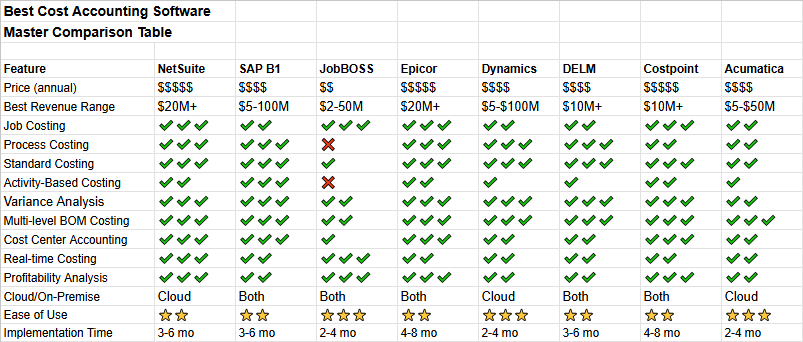
Costing Method Support — Detail
Not all costing method support is equal. Here’s what you need to know beyond the checkmarks:
Job Costing:
NetSuite, Epicor, and Costpoint offer the deepest job costing with real-time WIP visibility, multi-level cost roll-up, actual-to-estimate comparison, and profitability while the job is still open. JobBOSS offers the best job costing for the price in the $2M–$30M range, with a purpose-built workflow from quote to job to invoice. Dynamics 365 and Acumatica offer adequate job costing that works well for manufacturers, where it isn’t the primary method. SAP Business One’s job costing is functional but not as strong as its process and ABC capabilities.
Process Costing:
NetSuite, Epicor, SAP, and DELMIAWorks handle process costing well. DELMIAWorks is the standout for truly continuous and repetitive manufacturing and its machine-cycle-level costing is unique. NetSuite and Epicor handle process costing within a broader ERP context. Dynamics 365 and Acumatica handle basic process costing but struggle with high-volume continuous production. JobBOSS has no meaningful process costing capability.
Standard Costing and Variance Analysis:
All platforms on this list support standard costing, but the depth varies significantly. NetSuite, SAP, Epicor, and Dynamics all offer multi-level variance analysis (material price, material usage, labor rate, labor efficiency, overhead spending, efficiency, and volume). Acumatica and DELMIAWorks cover the essentials but have less drill-down capability. Costpoint’s standard costing is strong within its government-contractor context. JobBOSS offers standard cost comparison (estimated vs. actual) at the job level, which is practically useful but not a traditional standard cost system.
Activity-Based Costing (ABC):
SAP Business One has the most developed ABC module among the options reviewed — full activity definition, cost driver management, and activity-to-product assignment. NetSuite supports ABC through its Advanced Manufacturing module, but requires more configuration. Epicor offers ABC functionality in its Advanced Costing module. Dynamics 365 and Acumatica provide only basic cost center allocation that approximates, but does not fully replace true ABC. JobBOSS and DELMIAWorks offer minimal ABC support. If ABC is central to your costing strategy, SAP Business One or NetSuite are your best choice.
Overhead Allocation Capabilities
Overhead allocation is where most manufacturers get costing wrong and where software makes the biggest difference. Here’s how each platform handles it:
Multiple Allocation Bases:
Enterprise systems (NetSuite, SAP, Epicor, Costpoint) support multiple overhead allocation bases simultaneously. You can allocate some overhead by machine hours, other pools by labor hours, and others by units produced. This is critical for activity-based and departmental costing accuracy. Mid-tier systems (Dynamics, Acumatica, DELMIAWorks) support multiple bases but with less flexibility in pool definition and rate calculation.
Department vs. Plant-Wide Rates:
A plant-wide overhead rate — spreading all manufacturing overhead across all products using a single rate — is the most common source of product cost distortion. All systems on this list support departmental overhead rates. The question is how easy they make it to set up and maintain. NetSuite, SAP, and Epicor handle complex departmental structures with minimal customization. Acumatica and Dynamics require more configuration but are capable. JobBOSS supports department-level rates in a more streamlined, job-shop-oriented way.
Actual vs. Predetermined Rates:
Most cost accounting systems use predetermined overhead rates (set at the start of the period) and then calculate over/under absorption variances at period end. NetSuite and Epicor handle this natively with automated absorption accounting. SAP Business One provides similar capability. Dynamics and Acumatica require more manual setup to achieve the same result. DELMIAWorks uses real-time machine-cost-rate calculation — a different and often more accurate approach for continuous manufacturers.
Machine and Equipment Costing:
For manufacturers with capital-intensive operations, machine cost rates (depreciation, maintenance, energy, tooling amortization per machine hour) are a critical input to product costs. DELMIAWorks handles this best, down to the individual machine cycle. Epicor and NetSuite support work center cost rates with machine-hour allocation. JobBOSS supports machine time costing at the operation level. Dynamics and Acumatica support work center rates but with less granularity.
Variance Analysis Features
Variance analysis is the key tool for using cost accounting to actually improve operations — not just report what happened. The best systems make it easy to drill from a total variance to its root cause.
Drill-Down Depth: NetSuite, SAP Business One, and Epicor offer the deepest drill-down: from total variance summary → by product/job → by cost element (material, labor, overhead) → to individual transactions. This is essential for root cause investigation. Dynamics 365 and Costpoint offer strong drill-down as well. Acumatica and DELMIAWorks are adequate but less granular at the transaction level.
Real-Time vs. Period-End: Most systems calculate variances at period end (month close). NetSuite and Epicor stand out for real-time variance visibility during production — you can see a job trending over budget before it’s complete, allowing corrective action. JobBOSS also provides real-time job-level cost-to-complete analysis. Dynamics and Acumatica calculate variances at production order close rather than in real time.
Variance by Dimension: The most useful variance analysis isn’t just “we have a $50,000 unfavorable material variance” — it’s being able to slice it by product, customer, department, shift, or supplier. NetSuite, SAP, Epicor, and Costpoint all support multi-dimensional variance analysis. Acumatica handles this reasonably well through its dimension framework. DELMIAWorks offers shift-level variance which is a unique capability for 24/7 operations.
Budget vs. Standard: Some manufacturers manage to have both a budget (annual financial plan) and standard costs (engineered product costs). NetSuite, SAP, and Epicor support both simultaneously. Costpoint handles this well in a government-contract context (budget = contract funding; standard = estimated cost at completion). Dynamics supports it through its budget management module. Acumatica handles this, but requires more configuration.
Reporting Quality Comparison
The best cost accounting system in the world is only as useful as its ability to put the right information in front of the right people. Here’s how the platforms compare on reporting:
Out-of-the-Box Manufacturing Reports: Epicor and DELMIAWorks have the strongest pre-built manufacturing report libraries — reflecting decades of manufacturing-specific development. NetSuite’s out-of-the-box reports are broad and solid. SAP Business One has extensive standard reports but they can feel dated. Costpoint’s pre-built reports are excellent for government contracting scenarios. Dynamics 365 has fewer pre-built manufacturing reports but compensates with its Power BI connector. Acumatica and JobBOSS have adequate pre-built reports for their target markets.
Custom Report Building: NetSuite’s SuiteAnalytics and saved searches give power users strong self-service reporting. SAP has Crystal Reports (mature, but steep curve). Epicor’s report designer is powerful but requires IT involvement. Dynamics 365 shines here, and the Power BI integration is genuinely best-in-class for visual analytics. Acumatica’s report designer is solid and more accessible than most. Costpoint’s report tools are adequate but not modern.
Dashboard and KPI Visibility: Real-time manufacturing cost dashboards — WIP by job, variance by department, scrap cost by product line — are increasingly important. NetSuite and Acumatica have the best native dashboards. Dynamics 365 wins for analytics depth via Power BI. Epicor and DELMIAWorks have functional dashboards but dated designs. SAP and Costpoint have dashboards that work but feel less modern.
Executive vs. Operational Reporting: Consider who needs what. CFOs and controllers need roll-up profitability reports and variance summaries. Cost accountants need transaction-level detail and drill-down. Production managers need real-time job and department cost visibility. NetSuite, SAP, and Epicor handle all three audiences well. Dynamics 365 excels at executive/analytical reporting (Power BI) but requires more setup for operational real-time views. JobBOSS is strongest for production-level job reporting and less strong for executive roll-ups.
Integration Ecosystem
Cost accounting doesn’t work in isolation — it needs to receive data from production systems and share results with financial reporting and planning systems. Here’s how each platform approaches integration:
ERP/Accounting Integration:
For systems that are themselves full ERPs (NetSuite, SAP, Epicor, Dynamics, DELMIAWorks, Costpoint, Acumatica), this integration is internal and seamless — cost accounting data and financial accounting data live in the same database. For JobBOSS, integration with QuickBooks or other accounting systems is supported but requires setup and creates some data synchronization overhead.
Shop Floor / MES Integration:
Real-time shop floor data — machine status, labor time, scrap counts — is the fuel that makes cost accounting accurate. DELMIAWorks integrates most tightly (MES functionality is built in). Epicor has its own DNC/MES capabilities. NetSuite integrates with leading MES platforms via API. Dynamics and Acumatica use their open APIs to connect to third-party MES systems. SAP Business One has good MES partner integrations. Costpoint’s MES integration is less developed.
Time Tracking:
Labor cost accuracy depends on employees accurately reporting time against jobs, operations, or projects. All enterprise systems on this list have their own time-collection modules. NetSuite, Epicor, and Dynamics integrate with third-party time systems (Kronos, ADP, etc.) via API. Costpoint has the strongest time tracking (DCAA compliance requires it). JobBOSS includes job-level time capture as a core feature.
Inventory and Procurement:
All full-ERP systems handle this internally. The key differentiator is how well purchase price variances from procurement feed into cost accounting in real time. NetSuite and SAP handle this most cleanly. DELMIAWorks handles material costing particularly well for process manufacturers tracking regrind and rework.
Payroll and HR:
Cost accounting needs accurate labor rates. All platforms integrate with major payroll systems (ADP, Paychex, Paycom), though the depth varies. Costpoint has the deepest payroll integration for GovCon fringe benefit pools. The others typically pull in rate data and handle variance, leaving payroll processing to dedicated systems.
PART 4: IMPLEMENTATION GUIDE
Section 4.1: Setting Up Cost Centers
A cost center is the basic building block of your cost accounting structure — a unit of the business for which you collect and report costs. Getting this structure right before go-live is one of the most important decisions you’ll make. Getting it wrong means months or years of misleading cost data.
Define Cost Centers Before Configuration Begins
Start with your physical and operational reality, not your org chart. Common cost center structures for manufacturers:
- By Department: Fabrication, Welding, Assembly, Finishing, Quality, Shipping. Works well for departmental overhead rate calculation and responsibility reporting.
- By Work Center/Machine Group: CNC Machining, Press Room, Paint Line, Clean Room. Better for machine-hour-based overhead allocation and equipment utilization costing.
- By Process Step: Receiving, Raw Material Storage, Processing, WIP Storage, Finished Goods, Shipping. Useful for process costing and cost-of-conversion analysis.
- By Product Line: Sometimes appropriate for manufacturers with clearly distinct product families sharing few resources.
For most manufacturers, a hybrid approach works best — primary cost centers by major production department, with sub-centers by work center or machine group where overhead rates differ significantly.
Direct vs. Indirect Cost Centers
Separate your cost centers into two categories: direct (production) cost centers where costs are allocated to products, and indirect (support) cost centers like Maintenance, Engineering, and Quality — whose costs must first be allocated to direct cost centers before flowing to products. Configure your system to handle this two-stage allocation correctly; skipping it is a common cause of inaccurate product costs.
Hierarchy and Roll-Up
Design a cost center hierarchy that supports both operational reporting (detailed, by cost center) and executive reporting (rolled up by plant, division, or company). Most enterprise systems support three to four levels of hierarchy. Map this out on paper before entering it into the system.
Common Implementation Mistakes:
- Too many cost centers (creates data entry burden with little analytical benefit)
- Too few cost centers (overhead rates become meaninglessly blended)
- Ignoring support/indirect cost centers (costs appear to vanish)
- Not aligning cost centers with physical operations (forces data to be entered against the wrong center)
Section 4.2: Defining Cost Drivers
Cost drivers are the measurable factors that cause costs to be incurred. Choosing the right cost driver for each overhead pool is the central analytical challenge of implementing cost accounting software — particularly for activity-based costing.
Common Cost Drivers by Activity:
| Activity | Common Cost Driver |
| Machine setup | Number of setups |
| Production runs | Number of production orders |
| Material handling | Number of material moves or pick lines |
| Quality inspection | Inspection hours or number of inspections |
| Machine operation | Machine hours |
| Direct labor supervision | Direct labor hours |
| Purchasing | Number of purchase orders |
| Engineering support | Engineering change orders |
| Shipping/receiving | Number of shipments or receipts |
How to Choose Cost Drivers:
A good cost driver has three properties: it’s causally related to the cost (machine hours actually drive machine-related costs), it’s measurable without excessive effort (the data should already exist or be easy to collect), and it differentiates between your products (if all products use the same amount of the driver, it’s not useful).
For simpler costing, stick with two or three drivers — labor hours for labor-intensive overhead, machine hours for capital-intensive overhead, and units produced for volume-sensitive overhead. This captures 80% of the benefit with 20% of the complexity.
For full activity-based costing, work with your operations team to document each significant activity, estimate its annual cost, identify the best driver, and measure the current driver volume for each product. This is time-consuming but is the foundation of accurate ABC.
Building Driver Data Collection Into Operations
Software can only allocate costs based on the data it receives. If your shop floor doesn’t currently capture machine hours by product, your system can’t use machine hours as a driver, no matter how sophisticated it is. Before finalizing your cost driver choices, confirm that the data infrastructure exists (or can be built) to feed those drivers in real time or at period-end. Shop floor data collection terminals, barcode scanning, and MES integration are common solutions.
Section 4.3: Developing Standard Costs
Standard costs are predetermined estimates of what a product should cost under efficient operating conditions. They’re the benchmark against which actual costs are compared — and they’re only as useful as the rigor that went into developing them.
The Three Components of Standard Cost
Every standard cost has three elements: standard material cost (quantity × price), standard labor cost (hours × rate), and standard overhead cost (driver quantity × overhead rate). Each requires careful development.
Standard Material Costs
Pull your bill of materials (BOM) and verify quantities against actual production records — not engineering specs, which are often idealized. For each material, set the standard price. Use current supplier pricing or the expected price for the coming period, not historical averages that may be stale. Don’t forget to include yield loss (if your process typically uses 10% more material than the BOM quantity, build that into your standard). Consult with purchasing on expected price changes before setting standards for a new period.
Standard Labor Costs
Pull your routings (operation-by-operation labor sequences) and verify run times against actual production records. Engineering estimates are a starting point, but actual time studies are more reliable. Set standard labor rates by department, work center, or labor grade — whichever is most appropriate for your overhead structure. Include setup time in your standard (either as a fixed setup cost per order or amortized into the per-unit rate based on typical run quantities).
Standard Overhead Rates
Calculate overhead rates by dividing budgeted overhead cost by budgeted driver volume for each cost pool. Use your annual budget (or rolling 12-month forecast) as the basis. Recalculate rates at least annually; some manufacturers update quarterly. Be conservative because setting overhead rates too low guarantees under-absorbed overhead and unexpected losses at period end.
First-Year Reality Check
Most manufacturers implementing standard costing for the first time find that their actual costs differ from initial standards by 15–30%. This is normal and revealing. The first year of variance data is some of the most valuable analytical information your business has ever seen. Plan for a standard cost revision at the end of year one once you have a full cycle of actual data.
Section 4.4: Training Requirements
Cost accounting software is only as good as the people using it. Insufficient training is the most common reason implementations fail to deliver promised ROI — not software limitations.
Who Needs What Training
Cost Accountants and Controllers (Advanced): System configuration and maintenance (cost center setup, driver definitions, rate calculation), period-end close procedures (overhead application, variance calculation, WIP reconciliation), report building and analysis, and standard cost revision. Expect 40–80 hours of formal training plus significant self-directed learning.
Production Supervisors and Shop Floor Managers (Intermediate): Job/work order creation and management, labor and material reporting (entering actual costs correctly), real-time job cost review, and variance awareness. Expect 8–16 hours of targeted training focused on their specific tasks.
Finance and Accounting Staff (Intermediate): GL integration, journal entry review, inventory reconciliation, and financial reporting that incorporates cost accounting data. Expect 16–24 hours of training.
Executive Users (Basic): Dashboard navigation, KPI interpretation, and profitability report reading. Expect 2–4 hours — focus on insights, not mechanics.
Training Formats That Work
Role-based training (not generic system training) dramatically improves adoption. Work with your implementation partner to develop training scenarios using your own products, jobs, and cost structures — not the vendor’s demo data. Record training sessions for reference. Build a small internal super-user team (one or two people) who receive advanced training and can support colleagues after go-live.
Plan for Re-Training
System updates, staff turnover, and process changes all create ongoing training needs. Budget for annual refresher training and new-hire onboarding on cost accounting processes as part of your ongoing software investment.
Section 4.5: Go-Live Checklist
Use this checklist to confirm readiness before going live with cost accounting software:
Data Readiness
- [ ] Chart of accounts mapped and validated
- [ ] Cost center hierarchy defined and entered
- [ ] Bills of materials reviewed and corrected (quantities, yields)
- [ ] Routings reviewed and corrected (run times, setup times)
- [ ] Standard costs developed and entered for all active products
- [ ] Overhead rates calculated and entered for each cost pool
- [ ] Opening WIP balances entered and reconciled to GL
- [ ] Inventory balances entered and reconciled to GL
- [ ] Supplier price lists entered (for purchase price variance)
- [ ] Labor rates entered by department/work center/grade
System Configuration
- [ ] Cost accounting periods configured (align with fiscal calendar)
- [ ] Overhead allocation rules configured and tested
- [ ] Variance account mapping confirmed
- [ ] Integration with shop floor/time tracking tested end-to-end
- [ ] Integration with financial accounting (GL) tested
- [ ] User access rights configured by role
- [ ] Period-end close procedures documented and tested
- [ ] Report library reviewed; custom reports built and tested
People Readiness
- [ ] All user training completed and signed off
- [ ] Super-users identified and available for go-live support
- [ ] Period-end close procedure documentation distributed
- [ ] Help desk/support escalation path communicated
Parallel Run (Recommended)
- [ ] Run one full accounting period in parallel (old and new system simultaneously)
- [ ] Reconcile key outputs: COGM, WIP balance, variance totals
- [ ] Investigate and resolve material discrepancies
- [ ] Sign-off from controller/CFO before cutting over fully
PART 5: MAKING YOUR DECISION
Section 5.1: Decision Framework
Choosing cost accounting software is a significant commitment — of budget, time, and organizational energy. Use this structured framework to move from confusion to a confident decision.
Step 1: Identify Your Primary Costing Method
Be honest about how your business actually makes products. If you make custom parts to customer specifications with varying materials and labor, you need job costing. When you run continuous production lines making standardized products in high volume, you need process costing. If you make products in defined batches that move through multiple departments, standard costing with variance analysis is likely your primary tool. In situations where you have a complex operation with high overhead and multiple product lines with very different resource consumption, activity-based costing will give you the most accurate picture.
Many manufacturers use more than one method — for example, job costing for custom work and standard costing for stock items. Make sure the system you choose handles your primary method well and supports the secondary method adequately.
Step 2: Define Your “Must-Haves” vs. “Nice-to-Haves”
Make a written list — not in your head — of the features you absolutely cannot live without versus the features that would be valuable but aren’t dealbreakers. Common must-haves: real-time job cost visibility, multi-level BOM cost roll-up, departmental overhead rates, variance analysis by product. Common nice-to-haves: machine-level cost rates, shift profitability analysis, activity-based cost drivers. Use this list to quickly eliminate vendors that don’t meet your must-haves.
Step 3: Match Vendor to Manufacturing Type and Size
Use this simplified decision tree:
- Government contractor? → Deltek Costpoint (non-negotiable)
- Repetitive/continuous process manufacturer (plastics, food, packaging)? → DELMIAWorks first, then NetSuite
- Job shop / custom make-to-order, under $30M? → JobBOSS, then Acumatica
- Mid-market manufacturer ($5M–$75M), Microsoft shop? → Dynamics 365 Business Central
- Mid-market manufacturer ($5M–$75M), need modern ERP? → Acumatica
- Need activity-based costing as primary method? → SAP Business One
- $20M+ manufacturer needing enterprise ERP with sophisticated costing? → NetSuite or Epicor
Step 4: Evaluate Total Cost of Ownership (5 Years)
Year 1 implementation cost is the most visible number but often not the most important one. Calculate:
- Year 1 total (license + implementation + training + hardware)
- Years 2–5 ongoing costs (subscription/maintenance + support + annual updates)
- Internal cost (staff time for implementation and ongoing administration)
- Hidden costs (customizations, integrations, additional modules)
Compare vendors on 5-year TCO, not just Year 1 license cost. A $50,000 system with a $100,000 implementation often costs more than a $100,000 system with a $50,000 implementation.
Step 5: Demand Demos With Your Own Data
Never make a final decision based on a canned vendor demo. Provide vendors with a representative sample of your real data: three to five products with their actual BOMs and routings, a sample of recent production orders with actual vs. estimated costs, and your current overhead pool structure. Ask vendors to demo how their system would handle your products, your variances, and your reports. Weaknesses in costing depth or reporting flexibility will become immediately apparent.
Section 5.2: ROI Calculator
Before investing in cost accounting software, build the business case. Use this framework to quantify expected ROI:
Benefit Category 1: Discovering and Eliminating Unprofitable Products
Most manufacturers implementing proper cost accounting for the first time discover that 10–25% of their products are unprofitable after accurate overhead allocation. Estimate conservatively:
- Annual revenue from products you suspect may be underpriced or unprofitable: $___
- If cost accounting reveals 15% of those products are unprofitable and you reprice or discontinue them: 15% × revenue × your average margin improvement = annual benefit
Example: $10M manufacturer, $2M in suspect products, margin improvement of 15% on reprice = $300,000/year benefit.
Benefit Category 2: Improving Pricing Accuracy on New Business
Underpriced bids are an invisible profit drain. Better job costing improves bid accuracy:
- Annual revenue from quoted/bid work: $___
- Estimated current bid accuracy (% of jobs that come in within 5% of estimate): ___%
- Benefit of improving bid accuracy by 10 percentage points (fewer loss jobs, better pricing)
Example: $5M in annual bid work, 60% currently accurate, improving to 70% = 10% × $5M × average margin = significant annual benefit.
Benefit Category 3: Cost Reduction Through Variance Analysis
Variance analysis identifies waste, inefficiency, and process problems that would otherwise go unnoticed:
- Annual cost of goods manufactured: $___
- Industry average cost reduction from implementing proper variance tracking: 2–5%
- Conservative estimate: annual COGM × 2% = annual benefit
Example: $8M COGM × 2% = $160,000/year benefit.
Benefit Category 4: Reduced Close Time and Finance Labor
Automating overhead allocation, WIP valuation, and variance calculation typically saves 20–40 hours of finance labor per month:
- Hours saved per month: 30 (conservative)
- Fully loaded hourly cost of finance staff: $65/hour
- Annual benefit: 30 × 12 × $65 = $23,400/year
Total Annual Benefit (Example $15M Manufacturer):
- Product mix improvement: $250,000
- Better pricing on new business: $75,000
- Cost reduction via variance tracking: $120,000
- Finance labor savings: $23,000
- Total annual benefit: ~$468,000
Cost:
- Software (Acumatica, mid-size): $50,000/year
- Year 1 implementation (amortized over 5 years): $15,000/year
- Total annual cost: ~$65,000
ROI: ($468,000 – $65,000) / $65,000 = 620% | Payback period: ~2 months
Even at 25% of these estimates, the ROI is compelling. The key variable is whether your management team has the discipline to act on what the cost accounting system tells them.
Section 5.3: Vendor Evaluation Checklist
Use this checklist when evaluating shortlisted vendors:
Functional Fit
- [ ] Supports your primary costing method (job/process/standard/ABC) natively
- [ ] Handles your BOM complexity (single-level vs. multi-level vs. phantom assemblies)
- [ ] Supports departmental overhead rates (not just plant-wide)
- [ ] Provides real-time or near-real-time job/order cost visibility
- [ ] Variance analysis includes all key variances (material price, usage, labor rate, efficiency, overhead)
- [ ] Reports can be customized without vendor involvement
- [ ] Integrates with your current shop floor/time systems
Vendor Stability
- [ ] Years in business: ideally 10+ years
- [ ] Number of manufacturing customers in your revenue range
- [ ] Number of customers in your specific industry
- [ ] Ownership structure (private, PE-backed, public, recently acquired)
- [ ] Product development investment (new features in last 12 months)
- [ ] Customer retention rate (ask directly; expect 85%+)
Implementation
- [ ] Implementation partner has 3+ references in your industry and size range
- [ ] Fixed-price implementation option available (or clearly scoped)
- [ ] Go-live timeline aligns with your business calendar (avoid year-end implementations)
- [ ] Data migration support included or scoped
- [ ] Training plan is role-specific, not generic
Support and Partnership
- [ ] Support SLA (response time for critical issues; expect 4 hours or better)
- [ ] Support availability (24/7 vs. business hours)
- [ ] User community or forum available
- [ ] Product roadmap shared openly
- [ ] Dedicated account manager (for enterprise contracts)
References
- [ ] Spoke with 3+ references (not vendor-selected; ask for a list and choose randomly)
- [ ] References are in your industry and similar revenue range
- [ ] References asked about: implementation experience, ongoing support quality, specific costing features used, what they wish they’d known
Use this checklist when evaluating shortlisted vendors:
Functional Fit
- [ ] Supports your primary costing method (job/process/standard/ABC) natively
- [ ] Handles your BOM complexity (single-level vs. multi-level vs. phantom assemblies)
- [ ] Supports departmental overhead rates (not just plant-wide)
- [ ] Provides real-time or near-real-time job/order cost visibility
- [ ] Variance analysis includes all key variances (material price, usage, labor rate, efficiency, overhead)
- [ ] Reports can be customized without vendor involvement
- [ ] Integrates with your current shop floor/time systems
Vendor Stability
- [ ] Years in business: ideally 10+ years
- [ ] Number of manufacturing customers in your revenue range
- [ ] Number of customers in your specific industry
- [ ] Ownership structure (private, PE-backed, public, recently acquired)
- [ ] Product development investment (new features in last 12 months)
- [ ] Customer retention rate (ask directly; expect 85%+)
Implementation
- [ ] Implementation partner has 3+ references in your industry and size range
- [ ] Fixed-price implementation option available (or clearly scoped)
- [ ] Go-live timeline aligns with your business calendar (avoid year-end implementations)
- [ ] Data migration support included or scoped
- [ ] Training plan is role-specific, not generic
Support and Partnership
- [ ] Support SLA (response time for critical issues; expect 4 hours or better)
- [ ] Support availability (24/7 vs. business hours)
- [ ] User community or forum available
- [ ] Product roadmap shared openly
- [ ] Dedicated account manager (for enterprise contracts)
References
[ ] References asked about: implementation experience, ongoing support quality, specific costing features used, what they wish they’d known
[ ] Spoke with 3+ references (not vendor-selected; ask for a list and choose randomly)
[ ] References are in your industry and similar revenue range
Use this checklist when evaluating shortlisted vendors:
Functional Fit
- [ ] Supports your primary costing method (job/process/standard/ABC) natively
- [ ] Handles your BOM complexity (single-level vs. multi-level vs. phantom assemblies)
- [ ] Supports departmental overhead rates (not just plant-wide)
- [ ] Provides real-time or near-real-time job/order cost visibility
- [ ] Variance analysis includes all key variances (material price, usage, labor rate, efficiency, overhead)
- [ ] Reports can be customized without vendor involvement
- [ ] Integrates with your current shop floor/time systems
Vendor Stability
- [ ] Years in business: ideally 10+ years
- [ ] Number of manufacturing customers in your revenue range
- [ ] Number of customers in your specific industry
- [ ] Ownership structure (private, PE-backed, public, recently acquired)
- [ ] Product development investment (new features in last 12 months)
- [ ] Customer retention rate (ask directly; expect 85%+)
Implementation
- [ ] Implementation partner has 3+ references in your industry and size range
- [ ] Fixed-price implementation option available (or clearly scoped)
- [ ] Go-live timeline aligns with your business calendar (avoid year-end implementations)
- [ ] Data migration support included or scoped
- [ ] Training plan is role-specific, not generic
Support and Partnership
- [ ] Support SLA (response time for critical issues; expect 4 hours or better)
- [ ] Support availability (24/7 vs. business hours)
- [ ] User community or forum available
- [ ] Product roadmap shared openly
- [ ] Dedicated account manager (for enterprise contracts)
References
- [ ] Spoke with 3+ references (not vendor-selected; ask for a list and choose randomly)
- [ ] References are in your industry and similar revenue range
- [ ] References asked about: implementation experience, ongoing support quality, specific costing features used, what they wish they’d known
For all but the simplest systems on this list, you’ll work with an implementation partner (a consulting firm or value-added reseller) rather than deploying the software yourself. The quality of your partner matters as much as the quality of the software. A great system with a poor partner will underperform; a good system with an excellent partner can exceed expectations.
What to Look for in an Implementation Partner
Manufacturing experience: Your partner should understand manufacturing operations — not just software configuration. Ask about their background: do they have former manufacturing managers, cost accountants, or operations leaders on staff? Can they help you define your cost center structure and cost drivers, or only enter the data you give them?
Industry specialization: A partner who implements 80% job shops will struggle with a process manufacturing implementation. Seek partners who specialize in your manufacturing type. Ask what percentage of their implementations are in your industry.
Reference quality: Request 5–10 references, choose 3 at random, and call them. Ask specific questions: Did the implementation come in on time and budget? How did the partner handle unexpected issues? Do they still use the partner for ongoing support? Would they hire them again?
Ongoing support model: Implementation ends; the system runs for years. Understand how the partner handles post-go-live support. Do they offer managed services? Annual system health checks? Assistance with standard cost updates and period-end close issues?
Red Flags to Watch For
Be cautious if a partner: gives a fixed-price quote without a detailed discovery phase (they haven’t understood your business), can’t provide references in your industry, hasn’t implemented the specific costing modules you need (some partners specialize in financials and avoid manufacturing complexity), proposes a go-live timeline that seems too short (under-resourcing is a common cause of troubled implementations), or is reluctant to put performance expectations in writing.
CONCLUSION
Accurate product costing is not a finance department luxury — it’s a fundamental competitive capability. The manufacturers who know exactly what each product costs to make can price with confidence, pursue the right business, invest in the right processes, and build margins systematically. The ones flying blind on overhead allocation and product profitability are, as the opening scenario showed, sometimes their own worst enemies — pushing their least profitable products and abandoning their most profitable ones.
The software you choose should match where you are and where you’re going. Here’s a final summary of our recommendations:
By Primary Costing Need:
- Best for job costing (job shops, <$30M): JobBOSS² — purpose-built, proven, accessible
- Best for process/continuous costing: DELMIAWorks (process specialists) or NetSuite (enterprise)
- Best for activity-based costing: SAP Business One — the strongest ABC module in the mid-market
- Best for standard costing + variance analysis: NetSuite, Dynamics 365, or Epicor
- Best for government contract costing: Deltek Costpoint — no competition here
By Revenue and Complexity:
- Under $5M: JobBOSS (if job shop) or maximize your existing accounting software first
- $5M–$20M: Acumatica Manufacturing or Dynamics 365 Business Central
- $20M–$75M: Acumatica, Dynamics 365, SAP Business One, or JobBOSS (job shops)
- $75M–$300M: NetSuite Advanced Manufacturing or Epicor ERP
- $300M+: NetSuite, Epicor, or SAP S/4HANA
Best Overall Value:
Acumatica for growing mid-market manufacturers; JobBOSS for job shops
Your Next Steps:
- Identify your primary costing method — job, process, standard, or ABC. This single decision eliminates half the vendors immediately.
- Build your ROI case using Section 5.2. Quantify the annual benefit before your first vendor call — it will make every other decision easier.
- Shortlist two or three vendors that match your manufacturing type, size, and costing method.
- Request demos with your own data — not canned scenarios. Provide your real BOMs, routings, and overhead structure.
- Check references thoroughly — especially references in your industry and revenue range.
- Evaluate total 5-year cost, not just Year 1 license pricing.
- Choose your implementation partner as carefully as your software — they will determine whether you achieve the ROI you’ve calculated or spend a year firefighting a troubled implementation.
The right cost accounting system, properly implemented and actively used, will pay for itself many times over. The companies that hesitate because of implementation cost or complexity are, in effect, choosing to keep paying for the hidden cost of inaccurate costing — mispriced products, poor product mix decisions, and missed cost reduction opportunities — year after year.
The software cost is fixed and visible. The cost of not knowing your true product costs is invisible — and almost always larger.
Download the Cost Accounting Software Comparison Worksheet | Calculate Your Cost Accounting ROI | Get a Personalized Recommendation