Best Excel Alternatives for Manufacturing Financial Reporting
Best Excel Alternatives Compared: Prophix vs Planful vs Jirav Excel is the undisputed grandfather of financial reporting, but even the best legacy tools eventually reach their limits. If your manufacturing finance team is spending days consolidating spreadsheets, chasing down broken formulas, and battling version control issues, you are losing valuable time and money. Complex supply…

Best Excel Alternatives Compared: Prophix vs Planful vs Jirav
Excel is the undisputed grandfather of financial reporting, but even the best legacy tools eventually reach their limits. If your manufacturing finance team is spending days consolidating spreadsheets, chasing down broken formulas, and battling version control issues, you are losing valuable time and money. Complex supply chains and volatile raw material costs require real-time visibility that a static spreadsheet simply cannot provide.
Financial reporting software manufacturing platforms are centralized, automated systems designed to connect supply chain data directly to financial outcomes. Moving away from manual data entry allows your finance team to shift from historical reporting to forward-looking strategy. It bridges the gap between the production floor and the executive boardroom.
Upgrading from Excel is not just a software change; it is a strategic investment in the future of your company. A dedicated platform prevents costly manual errors, accelerates decision-making, and ultimately drives greater profitability. In this guide, we will explore the best Excel alternatives to help you modernize your manufacturing financial reporting.
Top Financial Reporting Software Manufacturing Platforms Compared
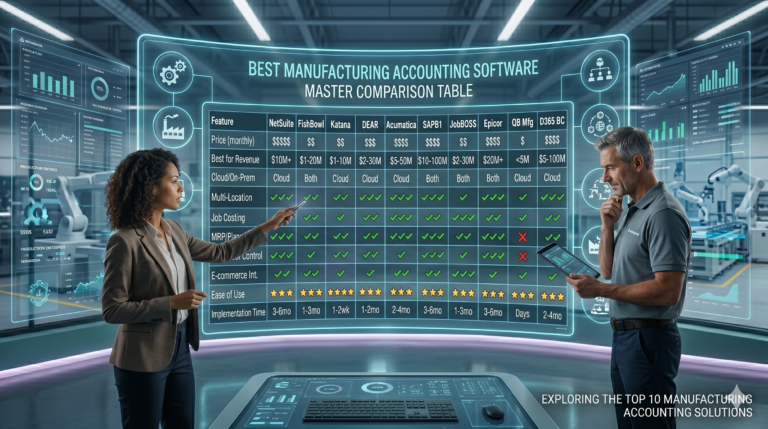
Finding the right alternative to Excel means looking for software built to handle the unique complexities of manufacturing. Let’s evaluate three top-tier platforms based on their features, pricing, and ideal user profiles.
Prophix – Best for Mid-Market ERP Integration
Overview:
Prophix is a robust Corporate Performance Management (CPM) platform designed to handle complex manufacturing environments. It excels at unifying financial and operational data, allowing manufacturers to seamlessly connect their ERP systems directly to their financial models.
Pros and Cons:
- Pros: Outstanding automated consolidations, powerful workflow management, and excellent multi-currency support.
- Cons: Features a steep learning curve for non-technical users and requires a longer initial implementation period.
Value for Money:
While Prophix comes with a premium price tag, the return on investment is substantial for mid-market companies. If your team is currently wasting dozens of hours on the month-end close, the labor savings alone easily justify the upfront cost.
Who This Is For:
This platform is ideal for manufacturers doing $50M+ in revenue with complex, multi-entity supply chains. If you operate multiple plants across different regions, Prophix provides the heavy-duty data consolidation you need.
Planful – Best for Agile Forecasting & Planning
Overview:
Planful is a cloud-based continuous planning platform that turns raw production data into actionable, forward-looking financial insights. It is engineered to help manufacturing finance teams pivot quickly in response to changing supply chain dynamics and material costs.
Pros and Cons:
- Pros: Incredible dynamic scenario planning, fast processing speeds, and a highly collaborative interface.
- Cons: Offers limited custom reporting out of the box and typically requires a dedicated system administrator to maximize its potential.
Value for Money:
The implementation costs for Planful are quickly offset by the massive operational savings it delivers over time. By enabling agile forecasting, the platform helps manufacturers avoid costly overproduction and inventory bottlenecks.
Who This Is For:
Planful is the targeted choice for manufacturers looking to quickly replace manual budgeting processes. It is perfect for finance leaders who want to shift their focus from data gathering to strategic advisory.
Jirav – Best for Cost-Conscious Small Manufacturers
Overview:
Jirav offers a streamlined, lightweight approach to manufacturing reporting and forecasting. It connects directly to popular entry-level accounting systems, providing instant dashboards and automated reporting without the complexity of enterprise-level systems.
Pros and Cons:
- Pros: Highly intuitive interface, blazing-fast deployment, and exceptionally budget-friendly.
- Cons: Lacks deep multi-currency support and is not built to integrate with massive, legacy enterprise ERPs.
Value for Money:
Jirav delivers rapid time-to-value, making it an incredibly smart investment for teams with tighter budgets. The lower price point allows smaller manufacturers to experience automated financial reporting without risking a massive capital outlay.
Who This Is For:
This software is perfect for smaller manufacturers or single-plant operations stepping out of Excel for the very first time. If you need a fast, frictionless upgrade from spreadsheets, Jirav is an excellent starting point.
Buyer’s Guide: Choosing the Right Financial Reporting Software
Selecting the right software requires looking beyond flashy features to understand how the tool will actually function within your daily operations. Here is what you need to prioritize during your software evaluation.
Direct ERP Integration
Seamless integration with your existing manufacturing ERP (like SAP, NetSuite, or Epicor) is absolutely non-negotiable for real-time data accuracy. If your finance team still has to manually export CSV files from the ERP to upload into the new software, you have not solved the core problem.
Direct ERP integration is the automated, continuous flow of operational data from your resource planning system directly into your financial reporting platform. This eliminates manual data dumps, prevents human error, and ensures your financial reports reflect the absolute latest production realities.
Manufacturing-Specific KPI Dashboards
Generic financial software often lacks the specialized tracking required for a production environment. You need a platform that provides out-of-the-box templates designed specifically for manufacturing workflows.
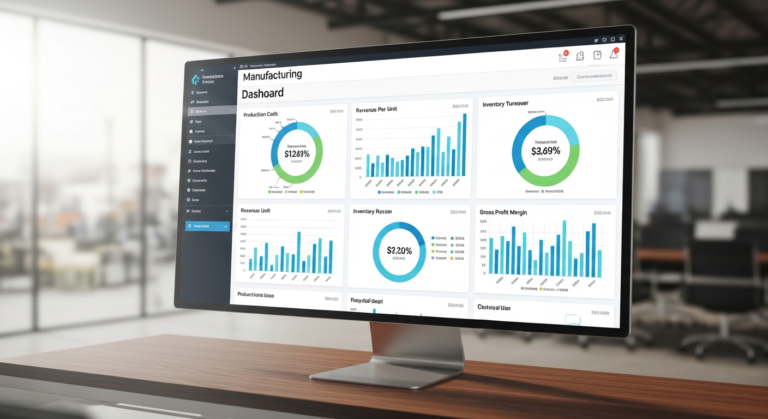
Your software should immediately visualize key metrics such as Cost of Goods Sold (COGS), inventory turnover, and production variance. Having these specialized dashboards ready on day one drastically reduces your implementation time and accelerates user adoption.
Total Cost of Ownership (TCO) vs. ROI
When comparing platforms, never look solely at the monthly subscription cost. You must calculate the Total Cost of Ownership (TCO), which includes licensing, implementation fees, user onboarding, and ongoing training.
Once you have your TCO, weigh it against the platform’s Return on Investment (ROI). Calculate the exact dollar amount saved by eliminating spreadsheet errors, reducing headcount hours during the financial close, and optimizing inventory holding costs.
Essential Manufacturing KPIs Your New Software Must Track
Moving out of Excel gives you the power to monitor complex data points in real-time. Your new financial reporting platform should effortlessly track these three essential manufacturing metrics.
Gross Profit Margin by Product Line
Automated software instantly identifies which specific products are driving your profits and which are draining your resources. Excel fundamentally struggles to calculate this in real time due to constantly fluctuating raw material costs and labor variances.
With dedicated software, you can drill down into individual product lines to see exactly where your margins are shrinking. This allows you to make immediate, data-backed decisions about pricing adjustments or discontinuing unprofitable items.
Operating Cash Flow
The lifeblood of any manufacturing business is its operating cash flow. It dictates your ability to purchase raw materials and keep the lights on. Operating cash flow forecasting is the process of predicting future liquidity based on current production schedules, accounts receivable, and upcoming overhead costs.
Advanced reporting software uses predictive analytics to give you a highly accurate picture of your future cash position. This foresight allows you to confidently manage massive raw material purchases without accidentally tying up necessary daily liquidity.
Inventory Valuation and Turnover
Inventory is essentially frozen cash sitting on your warehouse floor. Tying your inventory metrics directly to your real-time financial reporting prevents dead stock from accumulating.
By continuously tracking inventory valuation and turnover, your new software helps optimize warehouse efficiency and purchasing schedules. It ensures you have exactly enough material to meet production demands without inflating your holding costs.
Frequently Asked Questions
What is the best financial reporting software that manufacturing companies use?
There is no single “best” software, as the ideal choice depends entirely on your company’s size, existing ERP ecosystem, and specific reporting bottlenecks. Mid-market manufacturers often lean toward robust platforms like Prophix, while agile, scaling operations might prefer Planful. Always choose a platform that aligns with your specific operational complexities.
How long does it take to transition from Excel to a dedicated platform?
A realistic timeline for transitioning from spreadsheets to a dedicated financial platform is typically between 4 and 12 weeks. This depends heavily on the cleanliness of your existing data and the complexity of your ERP integrations. While this upfront time investment requires effort, it yields massive long-term efficiency and permanently shortens your month-end close.
Is cloud-based financial software secure for proprietary manufacturing data?
Yes, modern cloud-based financial software is highly secure and generally much safer than passing spreadsheets back and forth via email. These dedicated platforms utilize enterprise-grade encryption and strict role-based access controls to protect your proprietary data. You have complete authority over who can view, edit, or share specific financial models, a feature that shared Excel files simply cannot guarantee.
Verdict: Which Excel Alternative is Best for You?
Leaving Excel behind is a massive step forward for any manufacturing finance team. To help you finalize your decision, here are our top recommendations tailored to your company’s specific needs.
The Top Pick for Maximum ROI
Planful stands out as the overall winner for manufacturers seeking the best balance of dynamic features, ease of use, and pricing. Its incredible scenario planning capabilities allow finance teams to pivot instantly when supply chain disruptions occur. By blending operational agility with robust financial controls, Planful delivers an exceptionally high Return on Investment.
The Top Pick for Enterprise Scale
For complex, multi-plant manufacturers that need heavy-duty data consolidation, Prophix is the undisputed champion. It natively understands the intricate structures of massive enterprise ERPs and handles complex multi-currency consolidations with ease. If your operation requires deep, multi-entity reporting, Prophix provides the power you need to get the job done.
Next Steps to Upgrading Your Tech Stack
It is time to stop wasting precious hours untangling broken spreadsheet formulas. Upgrading your financial reporting software will empower your team to operate faster, smarter, and with absolute confidence in their data.
Take the immediate next step in your purchasing journey today. Reach out to request a personalized demo, start a free trial with a platform like Jirav, or utilize an online ROI calculator to see exactly how much money a dedicated system will save your manufacturing business.