What Is Advanced Manufacturing? Modern Plant Playbook
Advanced Manufacturing: A Financial Playbook for Updated Plants Defining Advanced Manufacturing in a Financial Context Advanced manufacturing is the integration of IoT, AI, robotics, and big data into production workflows. The practical aim is to improve resource allocation, tighten variance control, and increase inventory velocity. From a corporate finance perspective, the operational upgrade also changes…
Advanced Manufacturing: A Financial Playbook for Updated Plants
Defining Advanced Manufacturing in a Financial Context
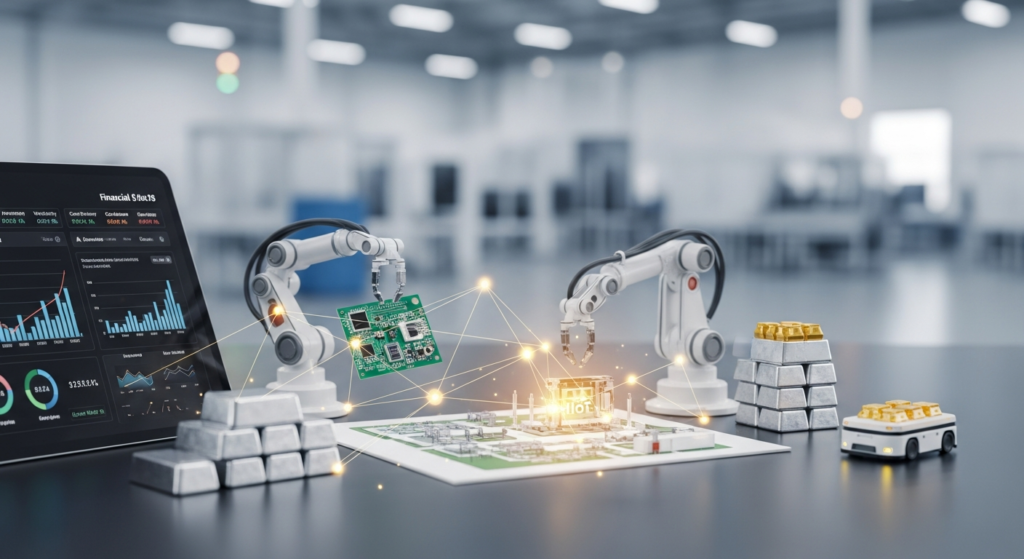
Advanced manufacturing is the integration of IoT, AI, robotics, and big data into production workflows. The practical aim is to improve resource allocation, tighten variance control, and increase inventory velocity. From a corporate finance perspective, the operational upgrade also changes cost behavior.
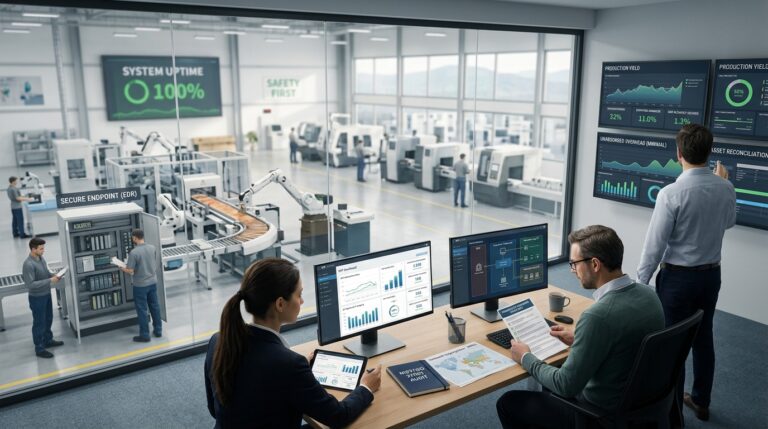
Traditional plants often rely on delayed batch reporting and static standard costing models. The result is opaque labor efficiency variances (LEV) and material usage variances that are not apparent quickly enough to influence the month. Advanced manufacturing digitizes the shop floor and creates a real-time link between the Manufacturing Execution System (MES) and the Enterprise Resource Planning (ERP) General Ledger. That link supports gross margin control and makes overhead absorption rates and supply chain volatility easier to manage.
Capital and Operational Requirements (Inputs)
Implementing advanced manufacturing requires disciplined capital expenditure (CAPEX) planning and close working capital management.
Hardware and Infrastructure Upgrades
- IIoT Sensors: Sensors that stream real-time telemetry from legacy machinery. Depending on unit capitalization thresholds, these may be treated as depreciable assets or expenses as they are incurred.
- Robotics and AGVs: Automated Guided Vehicles and collaborative robots (cobots) shift cost structures from variable direct labor to fixed overhead through depreciation. Higher throughput is then required to achieve optimal machine hour absorption rates.
- Network Infrastructure: Edge computing hardware and upgrades to connectivity are needed to support high-bandwidth data transfer. Useful life assumptions should be assessed carefully for depreciation schedules.
Software and Analytics Platforms
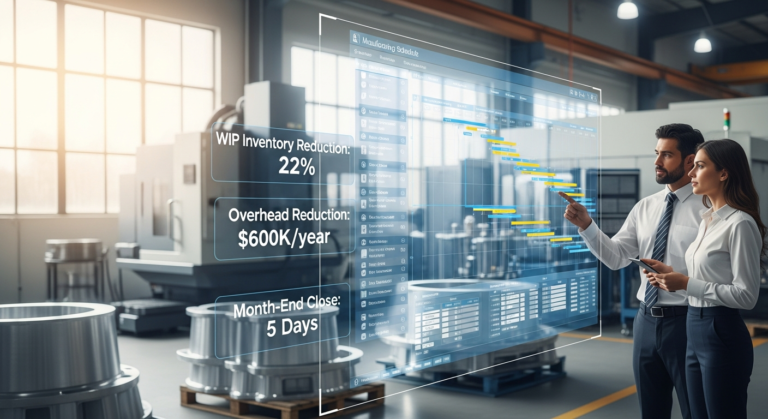
- ERP and MES Integration: Cloud-based software (SaaS) shifts IT expenditure from CAPEX to OPEX. A tightly integrated MES/ERP architecture helps achieve a 5-day month-end close, particularly where WIP (Work in Progress) valuations and BOM (Bill of Materials) rollups are automated.
- Predictive Analytics: Machine learning modules forecast equipment failure. This can reduce maintenance provisions, emergency repair spend, and unabsorbed overhead caused by unplanned downtime.
A Skilled and Adaptable Workforce
- Labor Reclassification: Moving manual operators into digital technician roles requires a fresh review of labor routings in the BOM. Direct labor costs shrink, while indirect engineering and technical support overhead increases.
- Change Management: Financial controllers must budget for training, temporary inefficiency, and idle capacity variances during the transition phase. Track these costs separately.
Implementation Sequence
Step 1: Assess Current Operations and Identify Bottlenecks
Do not deploy capital without first identifying the constraint. Use Time-Driven Activity-Based Costing (TDABC) to audit legacy workflows.
- Action: Analyze standard vs. actual costing variances over the trailing 12 months. Target work centers with the highest unfavorable labor and material usage variances.
- Financial Control: Build a discounted cash flow (DCF) model for the proposed technology. Apply a strict internal hurdle rate, such as a 15% IRR, before approving CAPEX.
Step 2: Establish Digital Connectivity (The IoT Base)
Data silos make it harder to reconcile production activity with inventory and General Ledger balances.
- Action: Install IIoT sensors on critical-path machinery. Centralize data into a controlled primary data set.
- Financial Control: Use real-time inventory tracking to move from disruptive annual wall-to-wall stocktakes to perpetual cycle counting controls. This avoids the multi-day production halts that traditionally reduce overhead absorption for that month.
Step 3: Automate Core Production Processes
Start with processes that can deliver near-term labor efficiency gains or reduce scrap. Material usage variance is often the quickest early evidence.
- Action: Deploy machine vision for automated quality control and cobots for repetitive handling.
- Financial Control: Update BOM rollups immediately upon implementation. If routing times decrease by 20%, standard costs must be re-rolled to reflect the new, lower cost of goods manufactured (COGM). Otherwise, gross margin reporting will be distorted.
Step 4: Optimize Through Predictive Analytics
Reactive maintenance protects individual machines. Predictive maintenance protects throughput.
- Action: Use digital twin technology to simulate product mix changes before execution.
- Financial Control: Reduced downtime means actual machine hours will more closely align with practical capacity. This mitigates volume variances and improves the absorption of fixed manufacturing overhead into inventory.
Discrete Manufacturing Case Study: Aluminum Casting & Machining
Context: $40M turnover aluminum casting facility with 120 employees, processing both raw manufactured castings and purchased-in wholesale components.
Objective: Rationalize two aging $20M turnover sites into one highly automated $40M facility to eliminate redundant overhead and improve gross margins.
The Financial Execution:
-
Site Rationalization: Consolidated operations into the primary facility. High-density automated warehousing and AGVs reduced the required footprint by 40%.
- Result: Captured >$1.4M p.a. in direct cost savings through eliminated duplicate facility leases, duplicated plant management salaries, and inter-company freight.
-
IIoT and Quality Automation: Installed thermal sensors on casting furnaces and machine vision on the machining line to catch porosity defects early.
- Result: Scrap rates dropped from 6.2% to 1.8%. Material usage variances moved from highly unfavorable to favorable within two quarters.
-
Working Capital & Tax: Optimized raw material staging for aluminum ingots using automated FIFO controls, reducing inventory days on hand from 45 to 28. The engineering hours spent developing the automated die-casting extraction process were also documented, supporting a successful $750K R&D/Export tax credit claim.
Cost Variance Impact Matrix (Pre vs. Post Implementation)
| Metric | Pre-Implementation (Legacy) | Post-Implementation (Advanced) | Financial Impact |
|---|---|---|---|
| Direct Labor Variance | $85,000 Unfavorable / mo | $12,000 Favorable / mo | Lower variable COGS; higher GM% |
| Machine Uptime | 76% (Reactive Maintenance) | 94% (Predictive IIoT) | Minimized unabsorbed overhead |
| Month-End Close | 12 Days (Manual WIP count) | 4 Days (MES Auto-reconciliation) | Accelerated reporting & compliance |
Implementation Risks
1. Capitalizing Tech Without a Strategy (The Unfocused Automation Trap)
Engineers often push for robotics that do not address the actual production bottleneck.
- Accounting Shortcut: Apply the Theory of Constraints before approving the spend. If an automated machine increases output at Work Center A, but Work Center B cannot handle the additional flow, the investment has only increased WIP inventory holding costs. No ROI is generated until the finished good is invoiced.
2. Mishandling Software Implementation Costs
Software accounting is often complex, especially where internally developed software costs or SaaS implementation fees are involved.
- Impact: Failing to properly capitalize costs under FASB ASC 350-40 can distort EBITDA and create audit exposure. Expensing implementation costs immediately may damage current-period EBITDA, while inappropriate capitalization risks later adjustments and write-downs.
3. Neglecting Operational Cybersecurity
Connecting legacy Operational Technology (OT) to IT networks without isolating VLANs creates a material operating risk.
- Impact: A ransomware attack on a smart plant can halt the MES and blind the ERP. The financial fallout includes lost revenue and idle facility variances, with delayed deliveries also risking breaches of customer contract terms.
4. Overlooking Supply Chain & FX Integration
Automating the plant while ignoring procurement creates a new constraint outside the factory walls.
- Practical Fix: As production accelerates, component sourcing must match the new velocity. Negotiate improved payment terms, such as 60–90 days, with international suppliers. Use forward contracts where appropriate to lock in raw material standard costs against currency volatility.
Operating an Integrated Manufacturing Plant
An integrated advanced manufacturing plant changes both the balance sheet and the P&L:
- Higher Efficiency and Yield: Real-time variance analysis allows financial controllers to identify and correct yield drops intra-month, rather than waiting for the month-end review.
- Working Capital Optimization: Direct MES-to-ERP data flow supports just-in-time (JIT) scheduling, reducing raw material and WIP inventory and freeing up cash flow.
- Scalability: A modernized, automated cost structure supports higher volumes with fewer step-cost increases. Integrated P&L, balance sheet, and cash forecast models can update monthly, with capacity constraints projecting more accurately as revenues scale.
Frequently Asked Questions
What is the primary financial difference between advanced and traditional manufacturing?
Traditional manufacturing relies on historical data, standard costing buffers, and manual variance allocations. Advanced manufacturing uses real-time data and automation to shift part of the cost base from direct labor into fixed overhead, while improving absorption costing and localizing profitability analysis.
How much does it cost to transition, and how is it funded?
A full replacement is uncommon. A phased approach is standard. Initial IIoT overlays can cost as little as $50K–$100K and are often funded through OPEX budgets or small equipment leases to test ROI. Later robotics or heavy AGV implementations require formal CAPEX budgeting, often financed through equipment loans matched to the asset’s depreciable life. Efficiency gains should be sufficient to cover the debt service.
Is advanced manufacturing only for large, multi-national corporations?
No. I have applied these principles when rationalizing $60m international sites, and I have also used scalable cloud MES solutions to grow a loss-making $4m small manufacturer into a profitable $13m turnover business. SaaS ERPs and modular, off-the-shelf IIoT sensors mean SMEs can deploy advanced manufacturing capabilities with limited upfront infrastructure costs, paying only for the compute and software licenses they consume.