
Manufacturing Web Design: Drive Inbound Leads
Practical Guide to Manufacturing Web Design That Generates Inbound Leads A manufacturing website design should be managed as a capital asset that supports overhead absorption, not merely as a digital brochure. Configured this way, an industrial website functions as an automated front-end sales qualification tool, capturing high-margin Requests for Quotes (RFQs) and feeding your Customer…
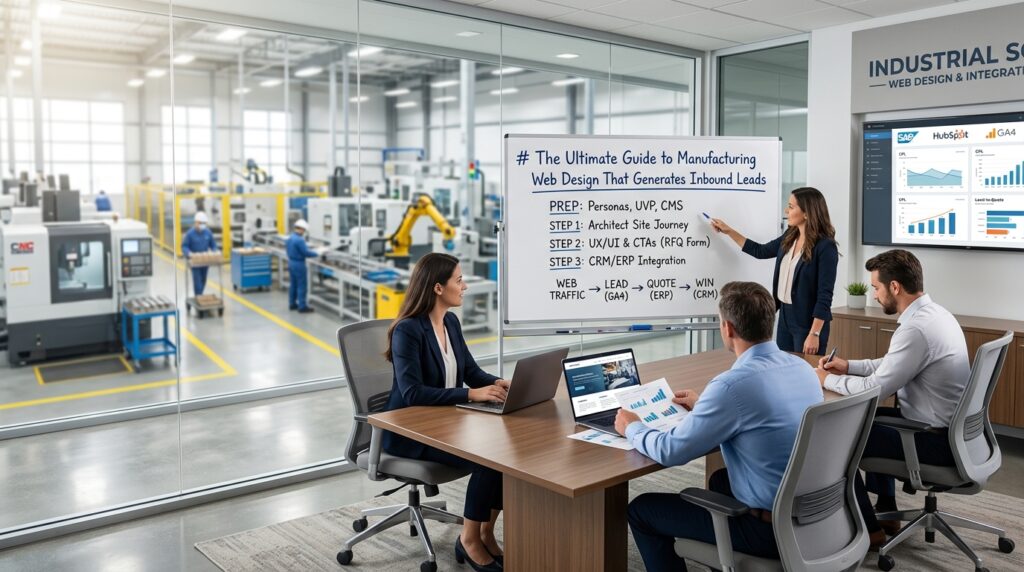
Practical Guide to Manufacturing Web Design That Generates Inbound Leads
A manufacturing website design should be managed as a capital asset that supports overhead absorption, not merely as a digital brochure. Configured this way, an industrial website functions as an automated front-end sales qualification tool, capturing high-margin Requests for Quotes (RFQs) and feeding your Customer Relationship Management (CRM) and Enterprise Resource Planning (ERP) systems. That integration can reduce Selling, General & Administrative (SG&A) expenses and shorten the cash conversion cycle. It also helps your plant maintain target capacity utilization.
Use the deployment plan below as a financial controller and general management checklist.
Inputs to Lock Before Development
Dirty baseline data makes web development projects overrun budgets and create integration problems. Treat this preparation phase with the same rigor as standardizing your Bill of Materials (BOM) or planning an annual physical stocktake.
Profitable Industrial Buyer Personas
Inbound traffic only helps when it avoids unfavorable volume variances from low-margin, small-run orders that disrupt production scheduling. Define your personas based on profitability:
- Target: Procurement managers and lead engineers at OEMs.
- Metric: Analyze historical gross margins by customer cohort. Target personas that historically yield >30% standard margin and require minimal custom engineering support post-sale.
Professional Brand Assets and Facility Visuals
Financial Note: Under ASC 350-40 / IAS 38, certain costs related to generating digital assets and application development can be capitalized. Track contractor hours and asset acquisition costs diligently.
Invest in high-resolution photography of your shop floor, CNC centers, and automated lines. Procurement officers conduct vendor risk assessments remotely; clear visuals of a clean, 5S-compliant facility influence their supplier vetting controls.
A Clearly Defined Commercial Value Proposition (UVP)
Your UVP must translate into financial benefit for the buyer. Avoid generic quality statements. Focus on operational impact: e.g., “Defect rates below 50 PPM,” “JIT delivery capabilities,” or “Vertical integration from aluminum casting to finished machining.” This establishes pricing power and defends standard margins.
A CMS That Supports Manufacturing Data Flows
The CMS must support API integrations with your ERP, such as SAP, NetSuite, or Epicor. For companies distributing wholesaled products alongside manufactured goods, the CMS must handle complex SKU counts, real-time inventory API calls, and standard cost updates without manual web-developer intervention.
Step 1: Architecting the Site Structure for B2B Buyers
Poor site architecture increases search time and drives users to abandon the site.
Mapping the Complex Industrial Buyer’s Journey
B2B procurement involves 3-to-9-month sales cycles with multiple stakeholders. The site structure must provide technical validation for engineers, including specs, tolerances, and drawings, plus commercial validation for purchasing, including certifications and terms.
- Workflow Impact: Properly mapped content reduces the hours your internal estimating team spends answering preliminary technical queries, lowering labor costs in SG&A.
Simplifying the Main Navigation Menu
Structure the navigation hierarchically, similar to a parent-child BOM rollup.
- Capabilities (e.g., Die Casting, CNC Machining)
- Materials (e.g., A380 Aluminum, 316 Stainless)
- Industries Served (e.g., Aerospace, Whiteware)
Planning an SEO-Focused Product and Service Hierarchy
Align your SEO strategy with your most profitable production lines. If labor efficiency variances are highly favorable in your aluminum casting division due to recent automation CapEx, weight your SEO architecture to drive inbound traffic specifically to that capability.
2: Designing the User Experience (UX) and Interface (UI)
Prioritizing Mobile Responsiveness for On-the-Go Procurement
Plant managers and procurement teams frequently research solutions from the factory floor via tablets or mobile devices. A responsive UI prevents drop-off and ensures reliable display of technical PDF downloads and dimensional drawings.
Displaying Trust Signals (ISO Certifications, Compliance)
Supply chain audits require proof of compliance. Display ISO 9001, ISO 14001, ITAR, or RoHS compliance badges. This can clear the first stage of a procurement officer’s vendor exclusion process and accelerate the vendor onboarding workflow.
Creating RFQ-Focused Calls-to-Action (CTAs)
Replace generic “Contact Us” buttons with “Submit RFQ” or “Request Technical Spec.” The CTA must send the user to a structured RFQ form.
Realistic Scenario: Aluminum Casting Discrete Manufacturer
Context: We rationalized operations, merging a $60M business from two sites into one, saving >$1.4M p.a. in fixed overhead. However, we needed to replace lost local volume with national contracts to maintain overhead absorption rates.
Action: We deployed a highly structured RFQ CTA. Instead of a generic email form, the RFQ required dropdown selections for alloy type, estimated annual usage (EAU), and an upload field for CAD/STEP files.
Financial Impact: The data routed via API into our ERP’s estimating module. By standardizing the incoming data, we eliminated the manual data entry bottleneck, reduced quoting turnaround from 4 days to 24 hours, and saved 1.5 Full-Time Equivalents (FTEs) in the estimating department, approximately $110,000 p.a. in OpEx reduction.
3: Developing and Integrating Required Features
Building Searchable Product Catalogs and Spec Sheets
For discrete manufacturers with a mix of fabricated and wholesaled goods, such as window coverings or lawnmowers, the product catalog must pull live data from the ERP item master. Maintaining separate databases creates reconciliation problems and pricing errors.
Integrating Customer Relationship Management (CRM) Software
Web-to-Lead integration is a required internal control. When an RFQ is submitted, it must auto-generate a record in Salesforce or HubSpot, time-stamped for SLA tracking. The result is an auditable pipeline, allowing the CFO to build reliable revenue forecasts based on historical lead-to-close conversion rates.
Configuring Technical Elements for Speed and Security
Treat website security as part of corporate governance. A compromised website can serve as an intrusion vector into the broader corporate network. Ensure SSL encryption, deploy Web Application Firewalls (WAF), and enforce regular penetration testing to mitigate business interruption risks.
Common Mistakes to Avoid in Manufacturing Web Design
Relying Heavily on Generic Stock Facility Photography
Impact: Degrades brand equity and fails procurement audits. Buyers can reverse-image-search stock photos. If they suspect you are a broker rather than a direct manufacturer, you immediately lose margin negotiating leverage.
Burying Contact Information and Complicating RFQ Forms
Impact: High abandonment rates increase Customer Acquisition Cost (CAC). If the form requires information the buyer does not yet have, such as exact shipping weights for unprototyped parts, they will bounce. Keep required fields limited to data necessary for preliminary costing.
Using Overly Technical Jargon Instead of Benefit-Driven Copy
Impact: Engineers care about specs; CFOs and Procurement Managers care about Total Cost of Ownership (TCO). Failing to translate technical capabilities into financial benefits, such as “Our automated gating reduces material waste by 12%, savings passed directly to your unit cost,” alienates the financial decision-maker.
Neglecting Technical SEO and On-Site Search Functionality
Impact: Organic search is the most cost-effective acquisition channel. If standard parts or SKUs cannot be found via on-site search, buyers will default to a competitor. Poor site architecture can also prevent indexing, turning your capital investment in the website into a stranded asset.
Launch Controls for the Lead-Generating System
Treat the website launch with the same systematic rigor as a 5-day month-end close, using a documented checklist and reconciliation at each handoff.
Conducting Pre-Launch Quality Assurance (QA) and Usability Testing
Execute User Acceptance Testing (UAT) across the entire quote-to-cash workflow. Submit test RFQs to ensure data flows cleanly from the web form through the CRM API and into the ERP staging tables without truncating data fields.
Tracking Inbound Leads and Setting Up Analytics Dashboards
Integrate Google Analytics 4 (GA4) with your CRM dashboards. The management team requires real-time visibility into the following matrix:
| Metric | Measurement Source | Financial Implication |
|---|---|---|
| Cost Per Lead (CPL) | Total Digital Marketing Spend / Lead Vol. | Controls marketing SG&A expenditure. |
| Lead-to-Quote Ratio | CRM Pipeline Data | Measures the quality and fit of inbound web traffic. |
| Quote-to-Win Ratio | ERP / Quoting Module | Indicates price competitiveness and standard margin viability. |
| Customer Acquisition Cost (CAC) | Total Sales & Mktg Spend / New Accts | Essential for ROI calculations and LTV benchmarking. |
Implementing a Continuous Conversion Rate Optimization (CRO) Plan
After launch, use A/B testing on landing pages to incrementally improve the RFQ submission rate. Even a 1% increase in conversion rate on high-volume traffic can add material top-line revenue; once fixed plant overheads are fully absorbed, much of that improvement drops to operating profit.
Frequently Asked Questions About Manufacturing Web Design
How much does a custom manufacturing web design project typically cost?
For a $10M–$60M turnover enterprise requiring ERP/CRM integration and complex catalog architecture, expect a CapEx of $40,000 to $85,000+. Note that application development stage costs can typically be capitalized and amortized over the asset’s useful life, often 3-5 years, softening the immediate P&L impact.
What is the average timeline to design and launch an industrial website?
A full build takes 12 to 16 weeks. This timeline relies heavily on the manufacturer’s ability to provide clean master data and approved copy, including accurate BOMs where relevant. Internal delays in data provisioning are the primary cause for schedule overruns.