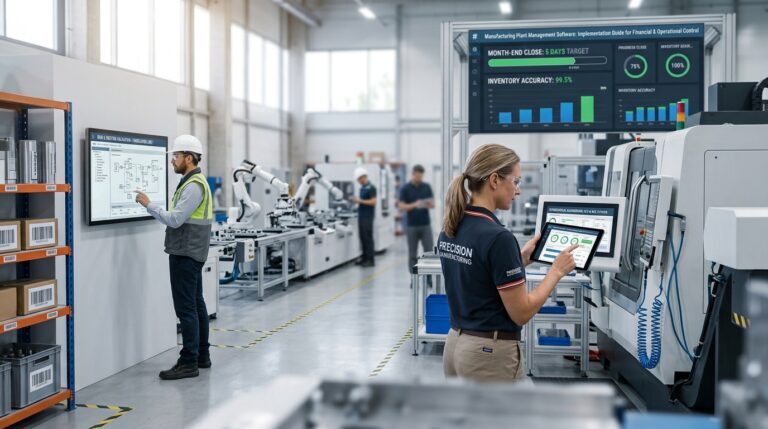
MES Manufacturing Execution Systems: Maximize ROI
MES Manufacturing Execution Systems implementation is both a production control project and a financial and operational control mechanism: it tightens internal controls, exposes work-in-progress (WIP) valuation blind spots, and can increase gross margin measurably. By linking enterprise resource planning (ERP) systems and shop floor SCADA (Supervisory Control and Data Acquisition), an MES captures production data…

MES Manufacturing Execution Systems implementation is both a production control project and a financial and operational control mechanism: it tightens internal controls, exposes work-in-progress (WIP) valuation blind spots, and can increase gross margin measurably. By linking enterprise resource planning (ERP) systems and shop floor SCADA (Supervisory Control and Data Acquisition), an MES captures production data on labor, downtime, scrap, WIP movement, and machine performance.
This guide draws on over 30 years of experience managing accounting, financial modeling, and software implementations for manufacturing facilities ranging from $4M turnarounds to $60M multi-national consolidations. It sets out the executive plan for an MES deployment.
The targets are real-time perpetual inventory control, strict standard costing discipline, and a 5-day month-end close with minimal manual intervention.
What You Need: Preparing for MES Implementation
Clear Manufacturing Goals and KPIs
Financial justification for an MES hinges on baseline metrics. Define current states and target reductions for Direct Labor Efficiency Variances, Cost of Poor Quality (COPQ), and Machine Downtime.
Reliable IT Infrastructure and Shop Floor Hardware
MES requires edge computing, ruggedized floor terminals, and reliable wireless networking. From a CapEx perspective, separate hardware depreciates over 3–5 years, while software licenses are capitalized per ASC 350-40 or treated as OpEx if SaaS.
A Cross-Functional Implementation Team
MES governance should sit with Operations and Finance, with IT responsible for integration, infrastructure, security, and support. The Steering Committee must include the Financial Controller, Production Manager, and IT Director. The Controller’s role is to ensure that data captured on the floor is accurately reflected in the general ledger (GL).
An Existing Enterprise Resource Planning (ERP) System (Optional but Recommended)
An MES must feed into a master financial system. The ERP dictates the standard cost: material, labor, overhead. MES executes the transactions that yield actuals against those standards.
Step 1: Mapping Your Shop Floor Processes
Auditing Current Production Workflows
Standardize the process before automating it. Conduct time-and-motion studies to validate standard cycle times. If your ERP routes estimate a cycle time of 4.5 minutes but actuals average 6.2 minutes, your overhead absorption rates are fundamentally flawed. The result is under-absorbed overhead hitting the P&L at month-end.
Identifying Critical Data Collection Points
Determine where inventory transactions must occur.
- Shortcut: Experienced controllers limit data collection points to critical gating operations to avoid burdening operators. Use automated “backflushing” upon completion of a major sub-assembly to relieve raw materials from the balance sheet using FIFO logic.
Defining the Bill of Materials (BOM) and Routing Specifications
BOM rollups must be exact. An MES executing against a flat or inaccurate BOM will generate large purchase price variances (PPV) and material usage variances. Before migration, reconcile all engineering BOMs to the manufacturing BOMs.
Step 2: Deploying Your MES
Connecting Machines and SCADA Systems for Automated Data Collection
Automate data capture via PLCs to eliminate manual timesheets. This stops “shadow accounting,” in which floor supervisors massage labor hours to hide inefficiencies. Automated machine data records Labor Efficiency Variances (LEV) precisely when they occur.
Integrating the MES with Your Existing ERP
The ERP is the system of record for inventory valuation; the MES is the perpetual tracking engine. The API handshake must validate inventory balances daily to support a rapid 5-day month-end close. If MES-to-ERP sync errors remain unreconciled, the close will stall, and Finance will be forced back into manual journal entries.
Conducting a Pilot Test on a Single Production Line
Realistic Scenario: Discrete Manufacturer (Aluminum Casting)
Context: We piloted an MES on a high-volume aluminum die-casting line for a $40M-turnover division.
- Pre-MES: Scrap was recorded weekly. Bad castings were unknowingly sent to the CNC machining center, incurring an additional $45/hour in direct labor and $60/hour in machine overhead before being scrapped.
- MES Pilot: The MES forced quality sign-offs at the casting cell.
- Financial Impact: We contained the scrap at the raw material stage by melting it back down. This eliminated the downstream absorption of wasted labor and overhead costs. The savings were $12,500 per month on that single routing, immediately visible in our monthly P&L variance reports.
Training Floor Operators and Supervisors
Treat training time as an indirect labor cost or capitalize it as part of the implementation cost where accounting standards permit. Operators must understand that scanning errors directly affect inventory integrity and the company’s bottom line.
Executing a Full-Scale Factory Rollout
Roll out by cost center. During cutover, maintain strict cycle-counting controls so the MES WIP ledger matches the physical floor state.
Common Mistakes to Avoid
- Over-Customizing the Software Instead of Standardizing Processes: Heavy customization creates stranded IT assets and high future upgrade costs. Force the plant to adopt industry-standard workflows built into the MES.
- Neglecting Operator Change Management and Training: If operators bypass the MES, you revert to periodic inventory counting. I have seen plants shut down for 3 days annually for full physical stocktakes ($100K+ in lost overhead recovery) simply because they failed to enforce daily cycle counting in the MES.
- Failing to Cleanse Data Before System Migration: Migrating “dirty” master data, such as incorrect BOMs and obsolete standard costs, into an MES results in garbage variance reports. Finance must audit the top 80% of volume drivers prior to go-live.
- Treating MES as an IT Project Rather Than an Operations Project: When I rationalized two $60M manufacturing sites into one, saving >$1.4M p.a., the integration succeeded because Operations and Finance owned the throughput metrics. IT facilitated the data; Ops drove the labor efficiency.
Frequently Asked Questions (FAQ)
What is the exact difference between ERP and MES?
ERP manages the financial ledger, customer orders, standard costing, and overall inventory valuation. MES handles the shop-floor transactions: operator logins, machine speeds, scrap containment, and WIP transitions. It then feeds actual consumption data back into the ERP to update standard vs. actual variances.
How long does a typical MES implementation take?
A pilot can take 3–4 months; a full rollout typically requires 9–15 months. Financially, expect a payback period (ROI) of 12–18 months post-go-live, driven primarily by scrap reduction and increased labor utilization.
Can small-to-medium-sized manufacturers benefit from an MES, or is it only for enterprise facilities?
Yes. I utilized streamlined shop-floor tracking systems to help grow a $4M loss-making manufacturer into a $13M profitable entity. Modern SaaS MES solutions shift the investment from heavy CapEx to scalable OpEx, making it financially viable for mid-market job shops.
How does an MES improve quality control on the shop floor?
It enforces digital hold codes. If an out-of-spec tolerance is recorded, the MES automatically quarantines the lot. That blocks the WIP from moving to the next cost center and prevents the cost of poor quality (COPQ) from compounding.
Result: Higher Floor Efficiency
Seeing Production Bottlenecks in Real Time
Instead of waiting for month-end variance analysis, plant managers and controllers can view WIP accumulation in real time. That visibility reduces Days Inventory Outstanding (DIO) and frees up working capital.
Achieving Paperless Manufacturing and Accurate Data Logging
Digital traceability is critical for external audits and compliance. Paperless routing records quality assurance sign-offs by logged-in personnel, creating an audit trail for internal controls and external financial auditors.
Reducing Scrap and Downtime While Increasing Throughput
The main financial outcome of an MES implementation is improved Gross Margin. By replacing estimates with actuals, Finance can target cost-down initiatives with precision.
Financial Matrix: Impact of MES Deployment (Based on $40M Discrete Manufacturing Baseline)
| Metric | Pre-MES | Post-MES (Year 1) | Financial Impact (P&L / B/S) |
|---|---|---|---|
| Scrap Rate | 4.2% | 1.8% | $960,000 reduction in Material Yield Variances. |
| WIP Inventory | 18 Days | 11 Days | $770,000 cash flow freed; lower balance sheet inventory. |
| Stocktakes | Annual (3 days) | Daily Cycle Counts | $120,000 saved in lost overhead absorption/plant downtime. |
| Month-End Close | 12 Days | 5 Days | Reduced finance overtime; real-time management reporting. |
Deploying an MES requires capital discipline, strict master data governance, and operational buy-in. When done correctly, it provides the manufacturing floor with reliable cost and throughput data for margin improvement.