Upgrading Legacy Networks: Manufacturing IT Guide
Manufacturing IT consists of the integration of Operational Technology (OT) and Information Technology (IT) infrastructure and is a major capital expenditure requiring rigorous financial oversight. A legacy manufacturing network upgrade affects overhead absorption and standard costing accuracy, with knock-on effects for perpetual inventory integrity. Moving from isolated Programmable Logic Controllers (PLCs) to a unified enterprise…
Manufacturing IT consists of the integration of Operational Technology (OT) and Information Technology (IT) infrastructure and is a major capital expenditure requiring rigorous financial oversight.
A legacy manufacturing network upgrade affects overhead absorption and standard costing accuracy, with knock-on effects for perpetual inventory integrity. Moving from isolated Programmable Logic Controllers (PLCs) to a unified enterprise architecture enables real-time bill of materials (BOM) rollups and continuous cycle counting controls while providing the technical basis for a 5-day month-end close. The following sections set out the financial and operational controls needed to execute this IT/OT modernization.
Realistic Scenario: Discrete Manufacturer (Lawnmowers & Woodfires)
Context: A $35M turnover discrete manufacturing plant with 120 employees operating on legacy isolated PLCs and batch-processed ERP updates.
Objective: Upgrade network infrastructure to enable real-time machine data capture, with a target of reducing labor efficiency variances and downtime.
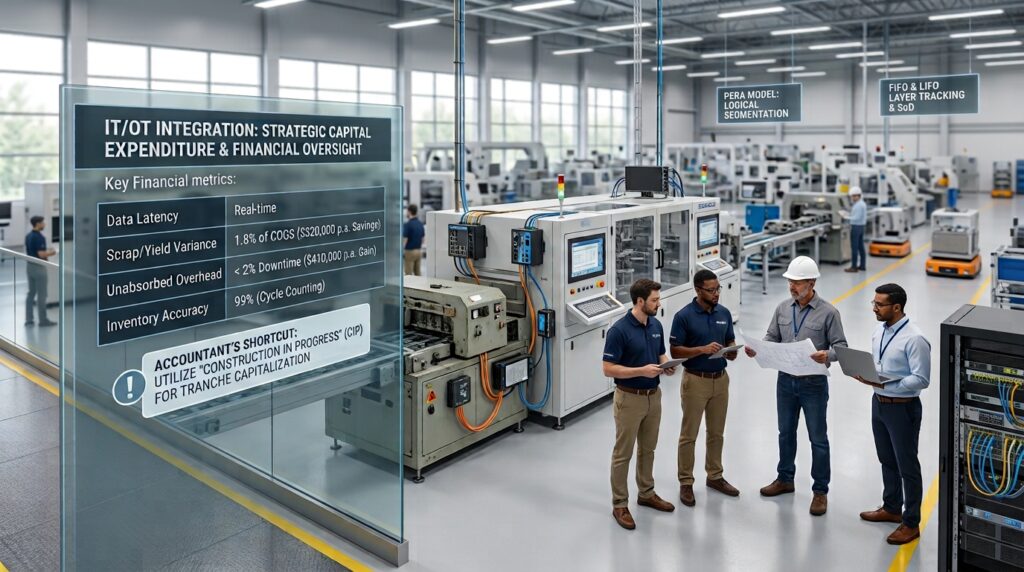
Financial Matrix: Projected Impact of IT/OT Integration
| Metric | Pre-Upgrade (Legacy) | Post-Upgrade (Target) | Financial Impact |
|---|---|---|---|
| Data Latency | 24-hour batch processing | Real-time | Enables 5-day month-end close |
| Scrap/Yield Variance | 4.2% of COGS | 1.8% of COGS | $320,000 p.a. material savings |
| Unabsorbed Overhead | 8% downtime average | < 2% downtime | $410,000 p.a. absorption gain |
| Inventory Accuracy | 88% (Annual Stocktake) | 99% (Cycle Counting) | Reduction in working capital buffer |
Practical Shortcut for Accountants: Do not wait for the project to finish before beginning asset capitalization. Use a “Construction in Progress” (CIP) account. Capitalize freight, installation labor, and hardware in tranches as individual production lines are ready for use, allowing depreciation to begin against the relevant asset base.
What You Need Before You Begin
Complete Fixed Asset Inventory and Reconciliation
Before authorizing network CapEx, reconcile the physical plant layout with the Fixed Asset Register (FAR). Document all legacy machinery and PLCs, along with existing networking hardware.
- Financial Workflow: Identify assets that require immediate impairment or write-off due to network incompatibility. Quantify the net book value (NBV) of legacy switches and cabling to be scrapped.
Cross-Functional Project Team and Capitalized Labor
Assemble network engineers and floor managers, with IT security embedded in the project team.
- Financial Workflow: Under ASC 350-40 (or IAS 38), track internal engineering and IT hours dedicated to application development and installation. Segregate these hours from general operating expenses so they can be capitalized as part of the new network asset, protecting current-period EBITDA.
Modern Hardware, Software, and Procurement Strategy
Specify industrial-grade switches and edge computing devices, plus monitoring software.
- Financial Workflow: Negotiate split procurement. Capitalize the perpetual hardware and edge-server costs, while modeling cloud-based network monitoring software as operational expenditure (OpEx). Source components from suppliers that offer 60-90 day terms, and align cash outflows with project milestones.
Defined Budget and Downtime Allowance (Variance Mitigation)
Establish a CapEx budget and a controlled downtime schedule.
- Financial Workflow: Calculate the standard cost of downtime per hour: direct labor plus fixed manufacturing overhead. Schedule installations during annual shutdowns or low-season production cycles to avoid large unfavorable volume variances that distort product margins.
Step 1: Assessing Your Current Manufacturing IT Requirements
Conducting a Gap Analysis
Evaluate the gap between the current legacy network and future automation targets.
- Financial Workflow: Model the cost of current bottlenecks. If legacy networks delay ERP data feeds, calculate the cost of stockouts and expedited freight charges. This gap analysis forms the basis for the ROI case for board approval.
Mapping Operational Technology (OT) Integration
Determine retrofitting versus replacement requirements for legacy machinery.
- Financial Workflow: Retrofitting existing aluminum casting or stamping machines with network gateways can be cost-effective. For machines that cannot be retrofitted, run a lease-vs-buy analysis to determine whether an outright equipment upgrade yields a better IRR (Internal Rate of Return) than maintaining isolated units.
Evaluating Bandwidth and Latency Needs
Assess data payload requirements for robotics, cameras, and analytics.
- Financial Workflow: Ensure the selected bandwidth infrastructure can process real-time inventory depletion. Accurate, low-latency data feeds are needed for maintaining tight FIFO/LIFO layer tracking and executing timely standard cost revaluations.
2: Designing the Upgraded Network Architecture
Implementing Segmentation and the Purdue Model
Deploy the Purdue Enterprise Reference Architecture (PERA) to separate the enterprise network and DMZ from floor operations.
- Financial/Audit Workflow: Network segmentation is an important IT General Control (ITGC). Physically and logically separating financial ERP systems from OT machinery supports auditor review of access controls and reduces the risk of financial data manipulation through factory floor endpoints.
Selecting Edge vs. Cloud Computing Architectures
Differentiate between local machine control at the edge and historical analytics in the cloud.
- Financial Workflow:
- Edge Computing: Heavy upfront CapEx. Depreciate over 5-7 years. Best for immediate machine efficiency gains.
- Cloud Computing: Subscription-based OpEx. Requires strict contract management to avoid scope creep and unexpected storage fees over the 3-5 year forecast period.
Establishing Strong Cybersecurity Protocols
Design zero-trust networks with strict firewall rules.
- Financial Workflow: Present the cybersecurity architecture to your corporate insurance broker. A documented zero-trust industrial control system (ICS) may reduce cyber-liability insurance premiums, creating a direct cash offset against the project cost.
3: Executing the Phased Implementation
Scheduling Minimal-Disruption Rollouts
Execute upgrades in localized zones or during planned maintenance.
- Financial Workflow: Phase the rollout by cost center. Upgrade high-margin production lines first to accelerate the payback period. Record idle capacity costs strictly as period expenses rather than capitalizing them into inventory overhead.
Deploying and Configuring New Infrastructure
Install Cat6a/fiber optics and ruggedized hardware to withstand physical environments.
- Financial Workflow: Process supplier invoices through three-way matching: PO, receipt of goods, and invoice. For large cabling contracts, approve contractor progress payments against measured completion and reflect the related costs in CIP on the balance sheet.
Running Pilot Tests and Stress Tests
Isolate a single production line and flood the network with simulated data.
- Financial Workflow: Do not transition the pilot line to live production in the ERP until standard costing systems reflect the new, tighter labor and overhead routing times. If the BOM and routings are not updated after the upgrade, the finance team will see large, misleading favorable efficiency variances.
Common Mistakes to Avoid
Siloing IT and OT Departments
- The Mistake: IT dictates security without understanding machine uptime; OT demands uptime without understanding network vulnerability.
- Financial Consequence: Budget overruns due to system clashes and post-installation rework. The controller may have to write off capitalized internal labor that generated no future economic benefit.
Overlooking Legacy Machine Compatibility
- The Mistake: Assuming old process-manufacturing equipment will connect natively to IP networks.
- Financial Consequence: Hidden middleware and protocol converter costs can materially reduce the projected ROI. Always buffer the CapEx budget by 10-15% for unforeseen integration hardware on machines older than 10 years.
Underestimating Physical Environmental Hazards
- The Mistake: Deploying standard enterprise IT switches on a factory floor exposed to metal dust, vibration, and heat.
- Financial Consequence: Accelerated asset failure may require premature write-downs and duplicate capital replacement costs. Enforce procurement policies specifying IP67-rated industrial hardware for the shop floor.
Neglecting Employee Training and Change Management
- The Mistake: Turning on the network but failing to train floor operators on the new digital dashboards.
- Financial Consequence: The projected labor efficiency variances may not materialize. Capital expenditure then yields no improvement in operating cash flow.
Expected Result: A Modern, Connected Manufacturing Network
Real-Time Data Visibility and Analytics
Data streams directly from machine PLCs into the ERP. Finance can move away from backward-looking batch reporting and monitor raw material consumption and waste alongside machine utilization on a continuous basis.
Reduced Unplanned Downtime
Predictive maintenance replaces reactive repairs. Fewer catastrophic failures support a higher and more stable absorption rate for fixed overhead costs, improving the gross margin percentage.
Scalable Network for Future Systems
The unified network prepares the plant for advanced digital twin simulations and automation. Financially, this supports higher throughput and planned site consolidations, such as consolidating two $30M sites into one optimized $60M facility, with reduced execution risk.
Frequently Asked Questions (FAQ)
What are the core Manufacturing IT Requirements for regulatory compliance?
From a financial controller and audit perspective, compliance with frameworks such as SOX and ISO 27001 requires strict network segmentation and automated threat detection, supported by immutable access logs. These controls protect the integrity of production data feeding the financial statements and verify that inventory valuations are not compromised by unauthorized network access.
How long does a full enterprise network upgrade take in a manufacturing plant?
For a mid-market plant with $40M-$60M turnover, expect a 9 to 18-month timeline. The rollout must be phased across fiscal quarters to smooth CapEx cash outflows and ensure localized installation downtime does not breach customer supply contracts or disrupt seasonal working capital cycles.
How do we secure legacy machinery that cannot have its operating system updated?
Legacy assets must be ring-fenced physically and digitally. Use micro-segmentation and unidirectional gateways, also known as data diodes. Production metrics can then flow out to the ERP for standard costing and variance analysis, while external data is blocked from flowing in to the vulnerable, unpatchable operating system. This reduces the risk of malicious damage to the underlying capital asset.