
Mitigating Liability: Manufacturing Insurance Guide
Defining Manufacturing InsuranceManufacturing insurance is a balance-sheet hedge. It transfers high-severity, low-frequency operational risks away from the company’s capital reserves. For the CFO and financial controller, it is a mechanism to smooth P&L volatility and protect working capital against large-loss events, including supply chain breakdowns, product liability claims, and workers’ compensation payouts. The focus here…
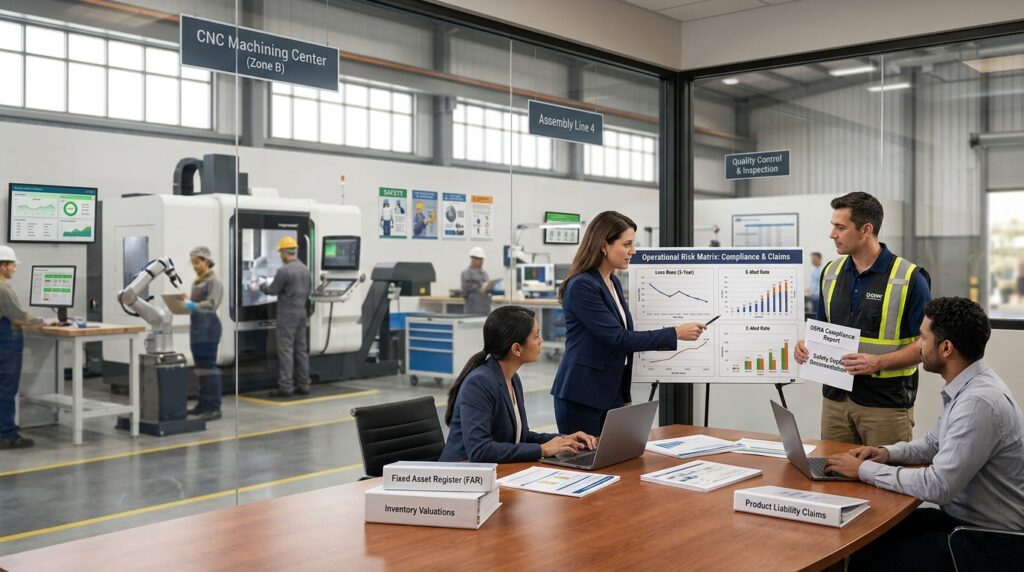
Defining Manufacturing Insurance
Manufacturing insurance is a balance-sheet hedge. It transfers high-severity, low-frequency operational risks away from the company’s capital reserves. For the CFO and financial controller, it is a mechanism to smooth P&L volatility and protect working capital against large-loss events, including supply chain breakdowns, product liability claims, and workers’ compensation payouts. The focus here is practical: using disciplined controls and accurate documentation in carrier negotiations to establish a compliant insurance portfolio that aligns with standard costing realities and operational workflows.
What You Need: Preparation and Documentation
Structuring a cost-effective insurance portfolio requires precise data alignment between the factory floor and the general ledger. Insurers base premiums on exposure metrics; inaccurate data leads to overpayment or material coverage gaps.
Complete Inventory of Equipment and Property
- Fixed Asset Register (FAR): Reconcile the FAR to ensure all physical assets are tagged and valued correctly.
- Valuation Basis: Distinguish between Net Book Value (NBV) and Replacement Cost. Insurance schedules must reflect replacement cost.
- Inventory Valuations: Document raw materials, WIP, and finished goods using accurate BOM rollups and standard costing methodologies including labor and overhead absorption.
Detailed Supply Chain and Revenue Analysis
- Business Interruption (BI) Worksheets: Compile trailing 12-month (TTM) Gross Margin data.
- Supplier Concentration: Quantify revenue at risk if a primary Tier-1 supplier fails.
- Logistics: Document Incoterms for international sourcing to identify where risk of loss transfers, e.g., FOB vs. DDP.
Existing Safety Protocols and OSHA Compliance Records
- Experience Modification Rate (E-Mod/X-Mod): Procure your current workers’ compensation modifier. A rate above 1.0 indicates higher-than-average claims, directly inflating premium accruals.
- Safety CapEx: Document recent capital expenditures on safety upgrades, e.g., machine guarding, ergonomic lifting stations, to negotiate premium credits.
Historical Loss Runs and Past Claims Data
- Actuarial Data: Obtain 3–5 years of loss runs from current carriers.
- Claim Reserves: Analyze open claims to ensure carrier reserves are not artificially inflating your loss ratio, which dictates future renewal rates.
Process for Securing Manufacturing Insurance
The procurement process has to connect each operational risk to specific policy language, limits, deductibles, or exclusions.
Step 1: Identify and Quantify Your Operational Risks
Start with a facility-wide risk audit that maps production from inbound receiving to outbound shipping. Then quantify exposures by calculating the maximum foreseeable loss (MFL) for fire, equipment failure, and product recall. Tie these exposures to your monthly cash flow forecast to determine the minimum working capital required to survive the deductible period.
2: Secure Core Coverages
- Commercial General Liability (CGL): Covers third-party bodily injury and property damage. Ensure the aggregate limit aligns with contractual covenants required by major wholesale customers.
- Commercial Property: Secure “Agreed Value” coverage to waive co-insurance penalties. Sub-limit reviews are critical here, e.g., ensuring adequate limits for molds, dies, and patterns.
- Workers’ Compensation: Mandatory statutory coverage. Implement strict return-to-work programs to control medical claim duration and protect the E-Mod rate.
3: Add Specialized Endorsements
- Product Liability: Needed for discrete manufacturers producing finished consumer goods. Protects against design flaws or manufacturing defects causing injury.
- Equipment Breakdown (Boiler & Machinery): Replaces income and covers repair costs if a critical path machine, e.g., CNC, stamping press, suffers sudden electrical or mechanical failure.
Realistic Scenario: Discrete Manufacturing (Lawnmowers & Woodfires)
Context: A $40M turnover lawnmower manufacturer operating a centralized die-casting and assembly facility.
Incident: A primary aluminum casting CNC machine suffers a spindle failure, halting chassis production for 14 days.
Financial Impact Matrix:
Metric Data Point Lost Production Volume 2,500 units Unit Sale Price $250.00 Standard BOM + Direct Labor $130.00 Lost Gross Margin (BI Claim Basis) $300,000 Expedited Freight (Replacement parts) $15,000 Total Claim Value (Pre-Deductible) $315,000 Practical Shortcut: Experienced controllers do not wait for the adjuster to calculate the BI loss. They immediately isolate the labor efficiency variances and overhead volume variances in the ERP resulting from the unabsorbed overhead during downtime and map these directly to the BI claim worksheet. This accelerates claim settlement from months to weeks.
4: Compare Quotes from Niche Manufacturing Insurance Carriers
Avoid generalist brokers unless they have industrial-risk depth. Use brokers who specialize in manufacturing exposures. Compare quotes by analyzing:
- A.M. Best Rating: Accept only A- or better carriers.
- Deductible vs. Premium Yield: Model the ROI of taking a higher deductible. If increasing the property deductible from $10K to $50K saves $30K in annual premium, and your cycle counting controls and preventative maintenance reduce incident probability, the higher deductible is the mathematically sound choice.
5: Finalize Policies and Implement an Ongoing Risk Management Strategy
After binding, handle the accounting entries:
- Capitalize the annual premium to Prepaid Expenses on the balance sheet.
- Amortize monthly to the P&L.
- Allocate the insurance overhead to work centers. For example, allocate Equipment Breakdown premiums to machine-hour overhead rates, and Workers’ Comp to direct labor overhead rates for accurate standard costing.
Frequent Coverage Errors
In a turnaround scenario or rapid growth phase, insurance is often treated as an administrative afterthought, leading to higher premiums, denied claims, or uncovered losses.
Underinsuring Equipment and Property Replacement Costs
Mistake: Using the accumulated depreciation/NBV from the balance sheet to set coverage limits.
Impact: At a total loss, the policy pays out current market value, leaving a significant cash shortfall to purchase new equipment. Always insure at Replacement Cost.
Ignoring Business Interruption and Supply Chain Vulnerabilities
Mistake: Setting BI limits based on net income rather than Gross Profit.
Impact: Fixed costs, including rent, salaried payroll, and debt service, continue during a shutdown. BI must cover Net Income plus continuing fixed operating expenses. Furthermore, failing to add Contingent Business Interruption (CBI) leaves you exposed if a key international component supplier burns down.
Failing to Update Policies After Facility or Product Line Expansions
Mistake: Expanding a production line or implementing a $1.4M site rationalization without notifying the carrier.
Impact: Carriers can deny claims if the physical plant layout or hazard class changes materially without an endorsement. Reconcile CapEx additions against the insurance schedule quarterly.
Overlooking Cyber Liability in Modern, Connected Smart Factories
Mistake: Assuming property insurance covers ERP lockouts.
Impact: Ransomware attacks on networked PLCs or inventory management systems halt production just as effectively as a fire. Cyber liability is mandatory to cover ransom, forensic IT costs, and resulting business interruption.
Frequently Asked Questions
What is the difference between general liability and product liability in manufacturing?
General Liability (GL) covers incidents occurring on your premises or resulting from your direct operations, e.g., a vendor slipping on your factory floor. Product Liability covers damages or injuries caused by your product after it has been sold and left your control, e.g., a lawnmower blade detaching during consumer use.
How does safety compliance and OSHA history affect my manufacturing insurance premiums?
Insurers use your OSHA recordable incident rate and Workers’ Comp E-Mod as direct multipliers against your base premium. Documented safety controls can drive the E-Mod below 1.0, generating a credit. Conversely, a history of OSHA violations pushes the E-Mod above 1.0, functioning as a penalty surcharge.
Does manufacturing insurance cover international supply chain disruptions?
Standard policies do not. You must specifically negotiate Contingent Business Interruption (CBI) coverage to protect against lost income resulting from physical damage to a supplier’s facility. Note: This typically requires physical damage at the supplier; it does not cover disruptions due to port strikes or geopolitical tariffs.
How often should a manufacturer review and update their insurance policies?
Annually at renewal, but mid-term adjustments are required immediately upon any of the following: a major CapEx deployment, a merger/acquisition, the introduction of a new product category, or entering a new international market requiring different product liability thresholds.
Operating Target: A Compliant and Properly Insured Manufacturing Operation
Reducing Financial Exposure to Liability Claims
When the fixed asset register, standard costing files, and rolling cash flow forecasts agree with the policy limits, insurance becomes a risk-transfer tool rather than an administrative expense. It also reduces the chance that unbudgeted liabilities, whether a $500K equipment failure or a $2M product recall, trigger debt covenant breaches or force liquidation.
Using Compliance Records in Contracts and Financing
Well-structured insurance coverage and documented OSHA compliance are often prerequisites for securing large-scale distribution contracts or international tax credits. These records can support lender underwriting, customer due diligence, and audit review.