
Stop Ransomware with Manufacturing IT Services
Protecting Supply Chains and Financial Operations Against Ransomware Ransomware is an operational, financial, and production risk. It directly threatens cost integrity, working capital, and the utilization of fixed assets. In a manufacturing environment, a compromised Operational Technology (OT) network halts production and immediately creates unfavorable labor efficiency variances and material unabsorbed overhead. Manufacturing IT Services,…
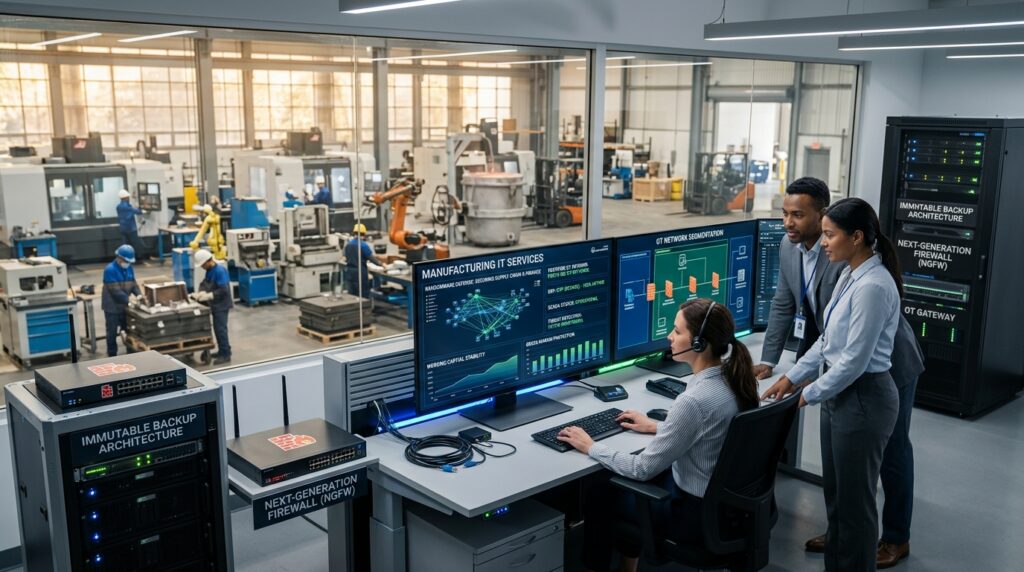
Protecting Supply Chains and Financial Operations Against Ransomware
Ransomware is an operational, financial, and production risk. It directly threatens cost integrity, working capital, and the utilization of fixed assets. In a manufacturing environment, a compromised Operational Technology (OT) network halts production and immediately creates unfavorable labor efficiency variances and material unabsorbed overhead.
Manufacturing IT Services, specialized integrations of IT and OT security, are mandatory internal controls to protect bill of materials (BOM) rollups and perpetual inventory records while keeping production scheduling reliable. The deployment sequence below details these services to protect gross margins and safeguard supply chain continuity.
Scenario: The Financial Cost of a Ransomware Breach in Discrete Manufacturing
Consider a $40M discrete manufacturer producing aluminum cast lawn mowers, operating with 85 employees on a standard absorption costing model. A ransomware execution locks both the corporate ERP, halting financial closes and AP/AR functions, and the SCADA systems controlling the foundry and CNC centers.
Financial Impact Matrix: 48-Hour Downtime
| Cost Category | Daily Run Rate Exposure | 48-Hour Financial Impact |
|---|---|---|
| Direct Labor Idle Time | 60 heads @ $25/hr x 8 hrs = $12,000 | $24,000 Unfavorable Efficiency Variance |
| Unabsorbed Fixed Overhead | $3.6M annual / 240 days = $15,000 | $30,000 Unfavorable Volume Variance |
| Lost Contribution Margin | $40M rev @ 35% CM / 240 = $58,333 | $116,666 Deferred or lost cash flow |
| Expedited Freight Recovery | Raw materials & finished goods | $18,000 Direct hit to Gross Margin |
| Total Immediate Exposure | $188,666 |
Mitigation: An annualized OPEX investment of $60,000 in specialized Manufacturing IT Services can pay for itself if it prevents one 48-hour shutdown.
What You Need to Protect Your Supply Chain: Resource Allocation
Allocate spending across controls, monitoring, recovery, and internal enforcement.
Essential Hardware and Software Tools CAPEX/OPEX
- Next-Generation Firewalls (NGFW): Ruggedized for industrial environments. Capitalize as fixed assets and depreciate over a standard 3-5 year useful life.
- Endpoint Detection and Response (EDR): Deployed across PLCs and HMIs as applicable, plus corporate endpoints. Typically treated as an annual OPEX software license.
- Immutable Backup Servers: Air-gapped storage architecture. Prevents unauthorized modification of standard cost records and routing data.
Manufacturing IT Services Partnerships
- Managed IT Service Provider (MSP): Must possess distinct manufacturing OT expertise. Negotiate Service Level Agreements (SLAs) with strict recovery time objectives (RTOs) tied to financial penalties.
- Security Operations Center (SOC): 24/7 telemetry monitoring to detect anomalous lateral movement before encryption begins.
Internal Team Commitment and Budget
- Budget Allocation: Dedicate 4-6% of the total IT/OT budget specifically to cybersecurity controls.
- Executive Mandate: Plant Managers and the Controller must enforce protocols. A bypassed security control to “speed up production” introduces unacceptable balance sheet risk.
Deployment Sequence for Ransomware Protection
Step 1: Conduct a Full IT/OT Risk Assessment
Start with current exposures before deploying capital.
- Asset Discovery: Reconcile the fixed asset register with a network scan. Map all connected legacy machinery and IoT sensors.
- Vulnerability Mapping: Identify intersections where the corporate LAN interfaces with the shop floor.
- Penetration Testing: Engage your MSP to simulate a breach. Treat this as an internal audit of your digital perimeter.
- Accountant’s Shortcut: Combine the physical IT hardware verification with the annual or quarterly cycle counting schedule to minimize operational disruption.
2: Segregate IT and OT Networks
If an Accounts Payable clerk clicks a phishing link, the CNC machines should keep running.
- Network Segmentation: Deploy VLANs to physically and logically separate corporate ERP/financial data from manufacturing execution systems (MES).
- Demilitarized Zones (DMZs): Route all data passing between external supply chain vendors and internal production lines through a highly restricted proxy layer.
3: Deploy Access Controls and Endpoint Protection
Treat system access with the same rigor as bank signatory rights.
- Multi-Factor Authentication (MFA): Mandatory for all local and remote access.
- Segregation of Duties (SoD): Align IT access rights with financial SoD. Floor operators should only have access to routing and MES interfaces, not BOM cost rollups or vendor master files.
- Automated Patch Management: Schedule ICS firmware updates during planned maintenance windows. Unplanned downtime creates unabsorbed overhead.
4: Establish Immutable Backups and Disaster Recovery (DR) Protocols
Your perpetual inventory and historical transactional data are critical records supporting the balance sheet.
- 3-2-1 Backup Architecture: Three copies, two media types, one offsite/air-gapped.
- Data Prioritization: Ensure nightly encrypted backups cover the ERP SQL databases, proprietary CAD files, and supplier EDI mappings.
- Incident Response Plan (IRP): Document the precise financial and operational workflow in a suspected breach. Designate authorization for emergency plant shutdown to contain lateral spread.
Common Mistakes to Avoid in Manufacturing Cybersecurity
Overlooking Legacy Machinery Impairment Risks
Many plants run highly depreciated but functional legacy equipment, including older injection molders or casting furnaces, on obsolete, unpatchable operating systems such as Windows XP.
- The Mistake: Connecting these directly to the modern network.
- The Fix: Use industrial firewalls to “wrapper” or isolate these machines. If they cannot be secured, account for a potential impairment charge as their operational risk exceeds their net book value.
Viewing Cybersecurity Training as Non-Value-Add Time
- Avoid treating 30 minutes of cybersecurity training as an unnecessary labor variance.
- Most ransomware incidents begin with phishing. Classify bi-annual security training as a necessary compliance cost. It is a minor overhead allocation that mitigates extended downtime.
Failing to Audit the Disaster Recovery Plan
- Do not leave the DR plan as a theoretical document.
- Run a tabletop simulation annually. Practical Shortcut: Schedule DR server restoration tests during the annual physical stocktake when the plant is already down. Reconcile the restored ERP data against the live physical counts to verify data integrity.
End State: A Ransomware-Resilient Supply Chain
The control set should prevent a single compromised endpoint from stopping production or corrupting financial records.
Reducing Downtime and Protecting Margins
Contain threats at the perimeter or inside segmented zones before they become plant-wide shutdowns. That stabilizes labor efficiency variances, preserves overhead absorption, and protects gross margins from expedited freight, lost orders, and recovery costs.
Protecting Supply Chain Valuation
In international manufacturing networks, such as importing components from Asia and assembling domestically, documented controls over vendor data, logistics schedules, and IP give the manufacturer evidence it can use in supplier and customer risk reviews. The CFO may also use reduced operational risk and a stronger cash conversion cycle to support requests for extended payable terms, such as moving from Net 30 to Net 60.
Frequently Asked Questions Executive Finance Perspective
What exactly are Manufacturing IT Services?
Unlike generic IT support, Manufacturing IT Services secure ICS/SCADA systems and IoT-to-cloud ERP connections while keeping standard costing and production databases uninterrupted and uncorrupted by malicious encryption.
Why are manufacturing supply chains frequent ransomware targets?
Attackers price downtime. They know a discrete manufacturer losing $150K per day in unabsorbed overhead and lost margins may calculate that paying a $500K ransom is cheaper than enduring a three-week system rebuild. Manufacturers are targeted because they are financially pressured to pay quickly.
How quickly can a business recover from an attack with these controls?
With immutable backups and rigorous network segregation, Recovery Time Objectives (RTOs) can drop from weeks to hours. Instead of re-entering weeks of lost production data and corrupting FIFO inventory layers in the process, IT restores the air-gapped backup from the previous shift. Operations resume without paying ransom and with minimal disruption to the month-end financial close.