AI Solutions for Manufacturing [Step-by-Step]
Deploying AI solutions for manufacturing robotics changes capital allocation and the way overhead is absorbed into standard costs. Upgrading a facility from traditional mechanization to an automated production system shifts the P&L burden from variable direct labor to fixed depreciation and software amortization. This transition requires rigorous financial control: accurate Bill of Materials (BOM) rollups…
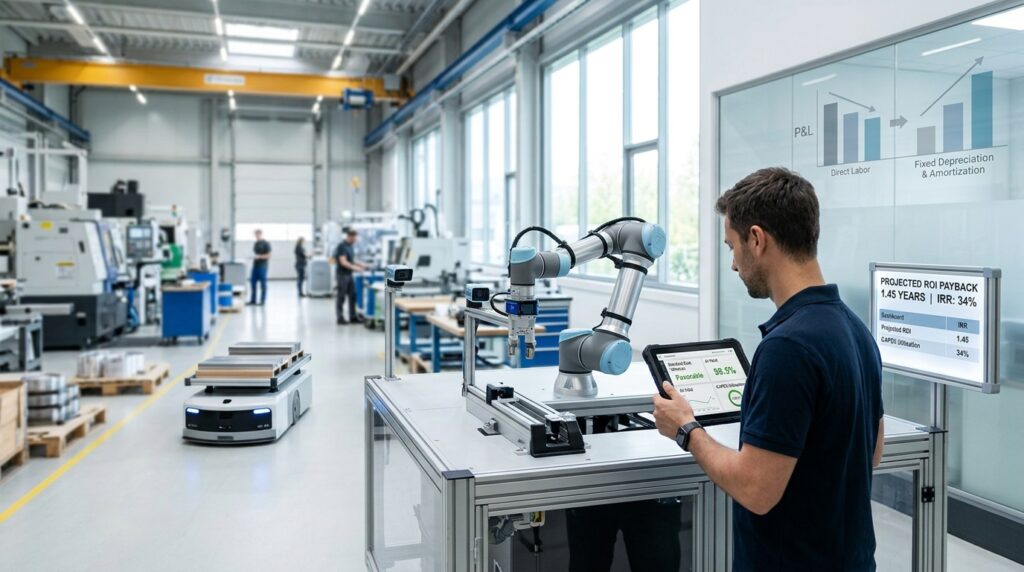
Deploying AI solutions for manufacturing robotics changes capital allocation and the way overhead is absorbed into standard costs. Upgrading a facility from traditional mechanization to an automated production system shifts the P&L burden from variable direct labor to fixed depreciation and software amortization. This transition requires rigorous financial control: accurate Bill of Materials (BOM) rollups and disciplined CAPEX vs. OPEX classification.
This financial and operational execution sequence for implementing AI manufacturing systems reflects controller and CFO practices for scaling operations, rationalizing sites, and maintaining 5-day month-end closes.
Prerequisites for AI-Driven Robotics: The Financial and Data Baseline
Before committing capital to automation, the underlying ERP and operational data must be validated and reconciled. If BOMs, routings, utilization data, or inventory records are wrong, automation will magnify the resulting variances.
Baseline Operational Data
Finance needs a reliable baseline before it can set an accurate ROI hurdle rate.
- Standard Cost Accuracy: Ensure BOMs and labor routings are fully updated. You must know your exact labor efficiency variances and machine utilization rates.
- Downtime and Yield Metrics: Quantify the exact cost of unabsorbed overhead due to machine downtime and the material cost of scrap.
- ERP Integration: AI systems must feed directly into the ERP to automate cycle counting controls and WIP (Work in Process) inventory valuation.
Modernized Robotic Hardware
Evaluate the acquisition of Collaborative Robots (Cobots) or Automated Guided Vehicles (AGVs) using capital budgeting criteria.
- Asset Capitalization: Classify hardware appropriately under property, plant, and equipment (PP&E). Determine useful life for depreciation, typically 5 to 7 years for robotics.
- Lease vs. Buy: Evaluate Robotics-as-a-Service (RaaS) OPEX models against traditional CAPEX purchases, factoring in the company’s current cost of capital and balance sheet leverage.
Sensor and Vision Systems
Vision systems, including high-resolution cameras, LiDAR, and IoT sensors, perform automated quality-control checks and directly affect material yield variances.
- Scrap Reduction: Model the reduction in material usage variances. AI vision systems catch defects at the source, before you add labor costs to already faulty materials.
Dedicated Edge Computing Infrastructure
Localized servers are required for low-latency processing.
- Software Capitalization (ASC 350-40): Delineate between hardware servers (PP&E) and the capitalization of internal-use software and ML algorithms. Preliminary project stage costs must be expensed, while application development costs can be capitalized.
Step 1: Identifying and Preparing Zones for Automation
Conducting a Bottleneck Analysis
Use Theory of Constraints to analyze routings and identify work centers where WIP accumulates.
- Target Selection: Look for work centers consistently generating unfavorable labor efficiency variances or areas requiring high hazard pay.
Defining the Scope of the AI Implementation (Discrete Manufacturing Scenario)
Context: A $35M turnover discrete manufacturer of lawnmowers and woodfires.
Problem: The aluminum casting and post-cast finishing zones suffer from a 6% scrap rate and severe labor bottlenecks, requiring heavy rework and driving up standard costs.
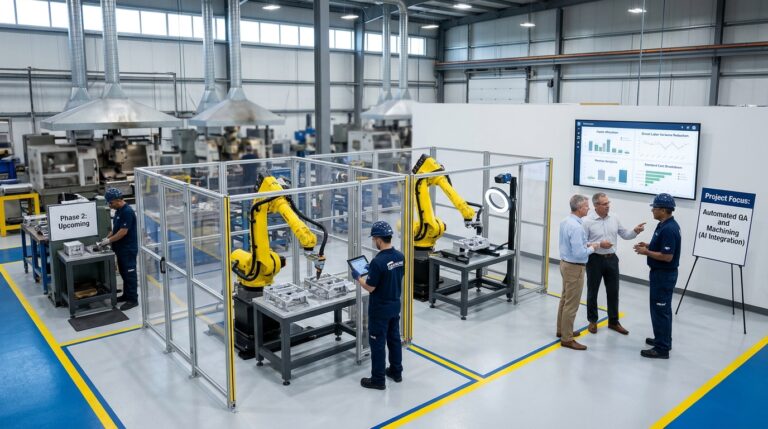
Action: Scope an AI vision inspection and automated deburring cobot cell.
Financial Scenario Matrix:
| Metric | Pre-Automation Baseline | Post-Automation Projection | Variance / Financial Impact |
|---|---|---|---|
| Direct Labor Headcount | 3 Operators / Shift (x2 Shifts) | 1 Supervisor / Shift (x2 Shifts) | Save 4 FTEs ($220k OPEX savings p.a.) |
| Scrap Rate (Yield) | 6% on $2M Material Run | 1.5% | $90k reduction in material usage variance |
| Total CAPEX | N/A | $450k (Hardware + Soft Costs) | Depreciated over 7 years ($64k p.a.) |
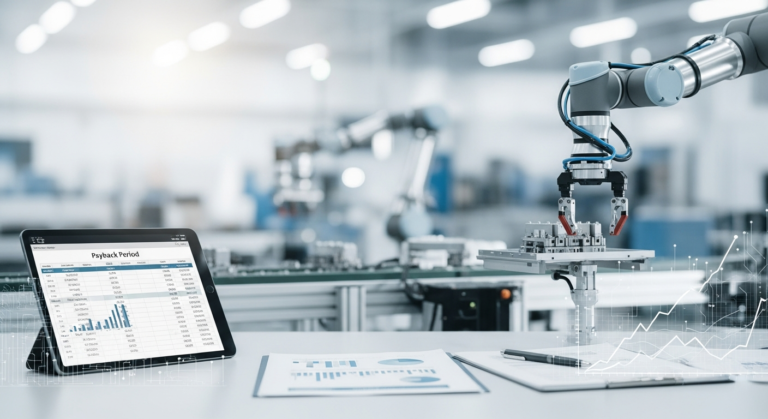
| Payback Period | 1.45 Years (IRR: 34%) |
Creating a Digital Twin
Use the simulation to test parameters before physical deployment and reduce production-floor interruptions during deployment.
2: Integrating AI Systems for Manufacturing
Training the Machine Learning Models
Supervised learning requires human operators to tag defects.
- Cost Allocation: The labor hours spent by engineers and floor staff training the AI must be tracked via specific job codes. These hours should be evaluated for capitalization under software development rules or tracked as a one-off implementation OPEX variance, isolated below Gross Margin so as not to distort standard COGS.
Calibrating Robotic Computer Vision
As the vision systems are calibrated, conduct frequent stocktakes in this specific WIP zone.
- Inventory Valuation: Early misidentifications by the AI may incorrectly scrap good parts or pass bad parts. Keep cycle counting controls highly active during this phase to prevent month-end inventory write-offs.
Launching a Controlled Pilot Run
Run the AI cell alongside standard operations.
- Financial Control: Quarantine the variance accounts for the pilot cell. Do not roll the new machine times into standard BOMs until the pilot proves stable. Premature BOM rollups will artificially lower standard costs and create unfavorable absorption variances at month-end if the robot still requires early-stage troubleshooting.
Target State: Operating an Autonomous Production Line
Scaling Operations to Full Capacity
Once operational efficiency parameters are met, finance must execute a site-wide standard cost update.
- BOM Rollup: Update routings. Direct labor dollars will decrease per unit; however, fixed factory overhead, including depreciation and maintenance contracts, will increase.
- Absorption Costing Shift: Shift overhead absorption drivers from Direct Labor Hours to Machine Hours to ensure accurate product costing.
Activating Predictive Maintenance
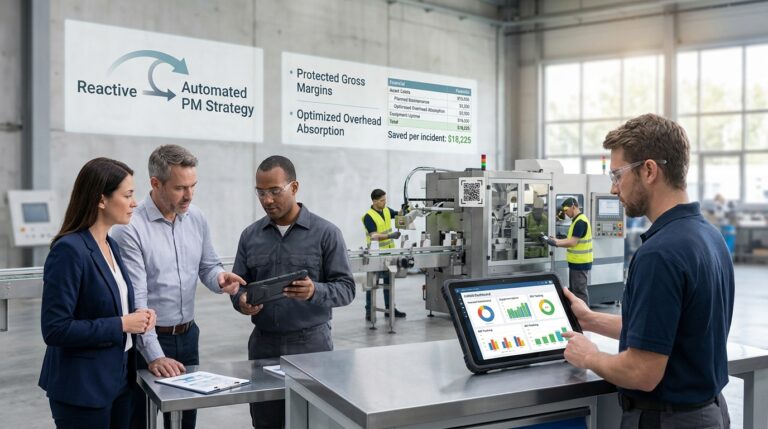
AI-driven predictive maintenance shifts facility upkeep from reactive downtime and emergency freight for parts to scheduled preventative maintenance.
- Spares Inventory: Implement a Min/Max MRP strategy for robotic spare parts. Capitalize critical spares when they meet the criteria; otherwise, hold them in inventory under corporate FIFO/LIFO policy and expense them upon issuance. This stabilizes cash flow forecasting and prevents unabsorbed overhead spikes.
Establishing Continuous Improvement Controls
The AI may reduce cycle times incrementally.
- Kaizen Costing: Institute a quarterly review of standard machine times. Reflect faster cycle times accurately in the ERP, and finance can model capacity for new sales contracts, increasing the factory’s revenue capacity without adding shifts.
Common Mistakes to Avoid
Skipping the Network Infrastructure Upgrade
The Mistake: Treating a $50k factory-wide Wi-Fi 6 upgrade as unnecessary IT OPEX to artificially boost short-term EBITDA. The result is robotic latency and, in this example, $200k in lost production.
The Fix: Treat network infrastructure as an inseparable CAPEX component of the automation project. You cannot run a $450k automated cell on a $200 consumer-grade router.
Overlooking Workforce Upskilling
The Mistake: Firing standard labor without investing in automation technicians, forcing the business to rely on $250/hour external consultants for daily troubleshooting.
The Fix: Model severance costs versus retraining subsidies. In rationalizing a $60M international business from 2 sites to 1, capturing >$1.4M in savings depended on retaining key operators and upskilling them to run the consolidated automated lines. That avoided major productivity dips.
Automating a Broken Process
The Mistake: Applying AI to a physically inefficient workflow. If your material handling is poorly designed, AI will simply generate scrap faster.
The Fix: Lean out the process manually first. Ensure raw material inputs meet tight physical tolerances before introducing them to the AI cell; otherwise, the AI will reject 40% of your raw materials, increasing purchase price variances (PPV) as you expedite sourcing higher-grade components.
Frequently Asked Questions
What are the best use cases for AI systems for manufacturing in robotics?
Financially, the highest ROI is found in repetitive, high-volume tasks in low-margin environments, such as end-of-line palletizing, automated optical inspection, and CNC machine tending. These applications often reduce direct labor requirements and workers’ compensation premiums while stabilizing overhead absorption.
How do AI-powered robots ensure human safety on the factory floor?
Cobots are equipped with force-torque sensors and LiDAR vision. When a human breaches the defined operating envelope, the robot decelerates or halts. Financially, this can reduce liability insurance premiums and mitigate the costs associated with workplace injuries and subsequent OSHA/regulatory audits.
What is the typical return on investment (ROI) timeline for factory automation?
For discrete manufacturers with turnover of $10M to $50M, target a payback period of 12 to 24 months. Lower AI software and cobot hardware prices now support shorter payback periods. If the payback exceeds 36 months, the project is likely over-engineered or scoped too broadly.