Traceability Software for Manufacturing: 5-Step Guide
Traceability software for manufacturing is a specialized digital ledger system that tracks the lifecycle, physical location, and transformation history of materials through the production routing. From a financial and operational controller perspective, it hard-links physical plant workflows to financial sub-ledgers, enabling precise WIP (Work in Progress) valuation, strict lot-control compliance, and granular yield variance analysis….
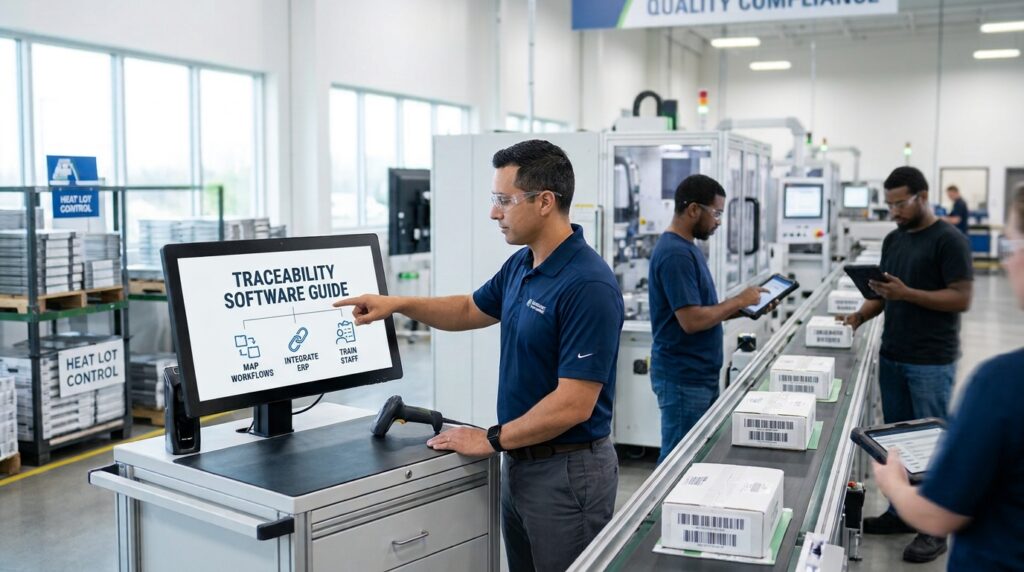
Traceability software for manufacturing is a specialized digital ledger system that tracks the lifecycle, physical location, and transformation history of materials through the production routing. From a financial and operational controller perspective, it hard-links physical plant workflows to financial sub-ledgers, enabling precise WIP (Work in Progress) valuation, strict lot-control compliance, and granular yield variance analysis.
This guide sets out the steps to prepare, deploy, and improve a traceability system. The objective is to move from manual, paper-based batch tracking to automated data capture. That shift reduces exposure to major recall liabilities while tightening cycle counting controls and keeping standard costing models aligned with actual floor conditions.
What You Need Before Implementing Traceability Software
Successful deployment requires matching physical plant logistics with financial reporting requirements. Treat this preparation as a capital project requiring stringent ROI and risk management protocols.
Define Your Tracking Goals and Compliance Requirements
Do not invest in software without defining the regulatory and financial mandates it must serve.
- Regulatory Compliance: Identify specific standards, such as ISO 9001, automotive IATF 16949, or FDA 21 CFR Part 11.
- Financial & Operational Goals: Define objectives such as reducing warranty reserves on the balance sheet, minimizing scrap material variances, accelerating the 5-day month-end close by automating inventory reconciliation, and improving cycle counting accuracy to eliminate annual wall-to-wall stocktakes.
Hardware Prerequisites
Traceability software relies on physical data capture on the factory floor. Categorize these investments under your CAPEX budget and calculate depreciation schedules accordingly.
- Scanners & Sensors: Industrial 2D barcode scanners, RFID antennas at dock doors, and IoT sensors tied to machine PLCs.
- Edge Devices: Ruggedized tablets for machine operators to input scrap codes and downtime reasons, directly impacting labor efficiency variances.
- Network Infrastructure: High-availability Wi-Fi across the plant floor to prevent data packet loss and localized data silos.
A Dedicated Implementation Team
Assign a cross-functional steering committee. A software upgrade impacts finance, warehousing, and factory operations simultaneously.
- Executive Sponsor (CFO/GM): Controls the budget, enforces scope, and demands ROI accountability.
- Floor Manager/Production Lead: Ensures workflows do not increase indirect labor hours or slow down cycle times.
- IT/Systems Lead: Manages ERP integration, API health, and data security.
Step-by-Step Guide to Deploying Traceability Software
Step 1: Map Your Current Supply Chain and Workflows
Before selecting software, execute a physical value stream mapping exercise. Document the exact routing of materials and the corresponding BOM (Bill of Materials) rollups.
- Document Touchpoints: Trace raw material from the receiving dock, including Goods Receipt/AP matching, through primary and secondary processing, to finished goods dispatch.
- Identify Critical Tracking Points (CTPs): Pinpoint where material transformation occurs and overhead absorption is applied. Example: Moving from casting to machining is a CTP where material must be re-identified, and standard labor/overhead costs are absorbed into WIP.
2: Select the Right Software Vendor
Evaluate vendors based on total cost of ownership (TCO) and architectural fit.
- SaaS vs. On-Premise: Cloud-based (SaaS) systems shift costs to OPEX and reduce internal IT headcount requirements. For $10M–$60M turnover businesses, that can reduce upfront cash outlay and internal IT workload.
- Auditability: Ensure the software provides immutable audit trails for cost accounting and external financial audits.
3: Integrate with Existing Systems (ERP and MES)
Traceability software should operate as the execution layer that feeds your ERP rather than as a stand-alone system.
- Master Data Sync: Standardize item masters. The traceability software must pull live BOMs and routings from the ERP.
- Automated Sub-ledger Postings: Configure the integration so that a barcode scan at a CTP automatically triggers inventory backflushing and overhead absorption in the ERP, eliminating manual data entry by accounting staff.
4: Run a Controlled Pilot Program
Avoid an all-at-once rollout; isolate financial and operational risk by piloting a single product line.
- Select a routing with a high volume of purchased-in components or complex sub-assemblies.
- Measure the impact on direct labor efficiency. If scanning adds 30 seconds per cycle, standard costs must be updated, or the workflow must be redesigned.
5: Train Your Floor Staff and Management
System integrity depends on the discipline of the machine operators and material handlers.
- Floor Staff: Train on physical execution, including scanning, exception codes, and damaged barcode procedures. Emphasize that scanning is the job, not an administrative add-on.
- Management: Train controllers and production managers to read dashboard data for real-time purchase price variances (PPV), material usage variances, and FIFO/LIFO layer consumption.
Realistic Scenario: Discrete/Process Hybrid Manufacturer
Context: A $40M turnover aluminum casting and machining business producing engine components for automotive and lawnmower OEMs.
The Event: The OEM reports a major failure in a specific engine block due to porosity in the aluminum. They demand a recall.
Without Traceability (The Old Way):
Accounting and operations spend weeks digging through paper travelers. Unable to isolate the exact production run, the business must recall three months of inventory to be safe.
- Financial Impact: $1.2M in warranty claims, $150K in expedited freight, and a large write-down of finished goods inventory. Margin falls sharply; bank covenants are breached.
With Traceability (The Controlled Way):
The CFO runs a reverse-traceability report based on the failed unit’s serial number.
- Data Matrix: Traceability Audit Output
| Serial No. | Heat Lot (Raw Ingot) | Casting Shift | Machine Center | Operator | QA Approval |
|---|---|---|---|---|---|
| ENG-8832 | H-44092 | Shift 2 (10/14) | CNC-04 | J. Smith | T. Vance |
- The Result: The system reveals that Heat Lot H-44092 was exclusively machined on CNC-04 during Shift 2. The defect was isolated to a single batch of 400 units, not 12,000 units.9
- Financial Impact: Recall is contained to $45,000. The $1.15M saved protects operating profit and maintains OEM trust.
Reaching the Final Result: Improvement and Auditing
Conducting a Mock Recall
Treat the mock recall as an internal control test required for your annual audit.
- Procedure: Randomly select a finished good from the warehouse. Mandate the traceability team to pull the complete genealogy: raw material lots, operator IDs, and machine parameters, within 2 hours.
- Objective: Validate that the team can limit recall exposure and9 support board reporting.
Analyzing Real-Time Data and Reports
Use the captured data to improve standard costing and cash flow.
- Yield Variance Analysis: Compare actual scrap captured at CTPs against the standard scrap allowance in the BOM. Adjust standards quarterly to reflect reality, preventing gross margin surprises at month-end.
- Bottleneck Identification: Use timestamp data between scans to identify queue times, allowing management to balance the line and reduce WIP inventory tying up working capital.
The Final Result: Full Plant-Level Visibility
The goal is a plant where every material movement triggers a corresponding financial transaction. Cycle counting becomes continuous and low-impact. Finance can complete a clean 5-day month-end close with confidence in inventory valuations.
Common Mistakes to Avoid
Overlooking User Adoption on the Factory Floor
Accountant’s Reality: If machine operators bypass the scanners administration the process is clunky, they will write data down and hand it to an admin at the end of the shift. That creates phantom inventory and negative ERP balances, making labor efficiency variances useless.
Fix: Tie supervisor KPIs to real-time scanning compliance, not just production volume.
Choosing Software Without Scalability
Accountant’s Reality: Buying a cheap, isolated tracking module to fix an immediate compliance issue is a sunk cost trap. When you acquire a new site, such as rationalizing two $30M sites into one $60M site, a rigid system will require a total replacement. That wastes CAPEX and disrupts operations.
Fix: Demand open APIs and multi-site capability during vendor selection.
Failing to Standardize Data Formats
Accountant’s Reality: If Supplier A uses 14-digit barcodes and Supplier B uses QR codes, your receiving dock cannot be left to manually interpret them. AP matching will fail. You will overpay for materials or halt production due to “missing” components that are actually sitting on the floor under a different naming convention.
Fix: Force suppliers to adhere to your inbound labeling standards as a strict condition of their payment terms.
Frequently Asked Questions
What is the ROI of traceability software for manufacturing?
ROI is typically realized within 12 to 18 months. It is driven by:
- Reduced Scrap/Rework: Faster identification of upstream defects.
- Labor Savings: Eliminating manual data entry and expediting cycle counting/stocktakes.
- Risk Mitigation: Confining recalls to specific lots rather than entire product lines, saving hundreds of thousands in warranty reserves.
How long does it take to implement a new tracking system?
For a $10M–$50M turnover manufacturing business, a realistic timeline is 3 to 9 months.
- Months 1-2: Workflow mapping and ERP integration.
- Months 3-4: Pilot program and standard cost adjustments.
- Months 5+: Full rollout and training.
Shortcut: Expedite this by cleaning up your master data — BOMs and routings — before the vendor begins implementation.
Can small manufacturers benefit from traceability software?
Yes. Cloud-based systems have made this technology affordable for smaller manufacturers.