Job Costing vs Process Costing for Manufacturers
6 Key Differences Between Job Costing and Process Costing for Manufacturers In modern manufacturing, maintaining healthy profit margins is a constant battle against rising material costs and labor shortages. Facility managers and executives cannot afford to guess when pricing their products. Accurate cost accounting is the critical lifeline that ensures every item rolling off the…
6 Key Differences Between Job Costing and Process Costing for Manufacturers
In modern manufacturing, maintaining healthy profit margins is a constant battle against rising material costs and labor shortages. Facility managers and executives cannot afford to guess when pricing their products. Accurate cost accounting is the critical lifeline that ensures every item rolling off the production line actually contributes to the bottom line.
Cost accounting is the internal financial practice of recording, analyzing, and allocating all production expenses to determine the true cost of manufacturing a product. Within this financial discipline, production facilities generally rely on two primary methodologies to track their expenses. These methods are job costing and process costing.
Understanding the intricacies of job costing vs process costing is essential for accurately pricing products, evaluating operational efficiency, and identifying areas of financial waste. Choosing the wrong method can lead to wildly inaccurate product costs, causing you to either overprice and lose bids or underprice and bleed capital.
This comprehensive guide will explore the fundamental differences between these two systems. We will cover their core definitions, the six major differences between them, and how to choose the right methodology for your unique production floor. Finally, we will answer common frequently asked questions to help you streamline your financial operations.
Understanding the Basics: Defining the Two Methods
Before diving into the complex nuances of how these systems diverge, we must establish a foundational understanding of each. Both methods aim to do the same thing: capture the costs of direct materials, direct labor, and manufacturing overhead. However, the way they gather and assign those costs is fundamentally different.
What is Job Costing?
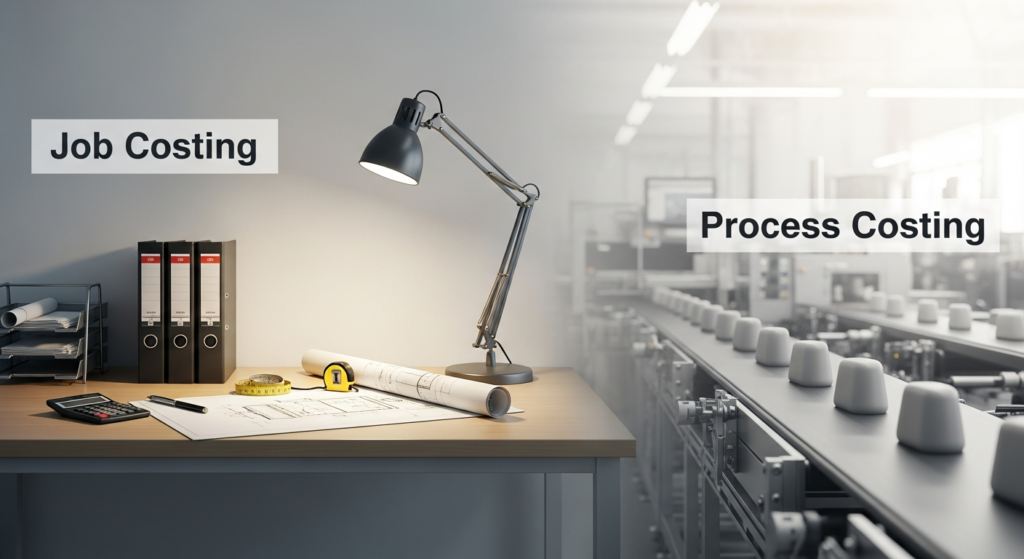
Job costing is an accounting system used to track materials, labor, and overhead costs for distinct, unique, or custom-made products and batches. This methodology relies on the premise that no two orders are exactly alike. Therefore, costs must be meticulously tracked to the specific project at hand.
The defining characteristic of this method is its hyper-focus on the individual order or contract. Because products are built to specific customer specifications, the expenses required to complete them will vary significantly from one job to the next. The system requires rigorous, detailed tracking at the micro-level.
Manufacturing examples that rely heavily on this method include:
- Custom heavy machinery: Building specialized industrial equipment where every unit requires unique engineering.
- Aerospace manufacturing: Producing commercial or private aircraft featuring customized avionics and interior layouts.
- Bespoke furniture: Crafting high-end, made-to-order furniture pieces using highly variable exotic woods and fabrics.
- Specialized tooling: Creating custom molds, dies, and fixtures for other manufacturing operations.
What is Process Costing?
Process costing is an accounting system used to accumulate costs over a specific period for massive quantities of identical, standardized products. Instead of looking at individual items, this system looks at the big picture of a production run. It gathers all the costs incurred during a specific timeframe and averages them out.
The primary characteristic of this method is its focus on production phases or departments rather than individual items. Total costs are averaged over the total number of units produced during that period. This is the only logical way to account for items that are indistinguishable from one another.
Manufacturing examples that utilize this mass-production method include:
- Chemical processing: Blending thousands of gallons of identical industrial solvents or agricultural fertilizers.
- Food and beverage manufacturing: Bottling identical soft drinks or canning massive batches of soup.
- Petroleum refining: Converting crude oil into thousands of barrels of standardized commercial gasoline.
- Paper milling: Producing endless rolls of identical commercial printing paper.
The 6 Key Differences: Job Costing vs Process Costing
While both systems ultimately calculate the Cost of Goods Sold (COGS) and value ending inventory, their operational mechanics are vastly different. Choosing between them dictates how your floor workers track their time, how your warehouse manages inventory, and how your accountants close the books.
Here are the six fundamental differences between the two methodologies.
1. Nature of the Final Product
The most obvious difference between the two systems is the physical nature of the products rolling off your production line. This physical reality dictates the accounting reality. You cannot apply custom tracking to millions of identical items, nor can you average out the costs of highly unique products.
Job Costing:
Products tracked under this system are heterogeneous. They are custom-built, heavily modified, or engineered to meet specific client requirements. Because the final products are distinct, it is logically possible to look at a finished unit and identify exactly which materials went into it.
Process Costing:
Products tracked under this system are homogeneous. They are standardized, indistinguishable from one another, and mass-produced for general inventory. You cannot look at a single gallon of refined gasoline and trace the specific labor hours used to create just that one gallon.
2. Cost Accumulation Focus
Cost accumulation refers to the “bucket” into which a manufacturer drops their tracked expenses. Depending on your system, this bucket might be a physical object, or it might be a location on your factory floor.
Job Costing:
Costs are accumulated by the specific “job,” “batch,” or “work order” number. When a worker pulls raw materials from the warehouse, those materials are checked out against a specific job number. When an employee clocks in, their labor hours are charged directly to that specific project code.
Process Costing:
Costs are accumulated by the manufacturing department, production phase, or process line. Instead of tracking costs to a product, costs are tracked to a process—like the “mixing department” or the “packaging department.” All direct materials and labor consumed by that department over the month are grouped together.
3. Timing of Cost Calculation
Timing is everything in accounting, and these two methodologies trigger cost calculations at very different moments. This impacts how quickly management can review profitability and make strategic pricing adjustments.
Job Costing:
Total costs and unit costs are calculated only after the specific job reaches completion. Throughout the production cycle, costs simply build up in a Work in Progress (WIP) account. It is only when the final quality check is passed and the job is closed that accountants can divide the total cost by the number of units in that specific batch.
Process Costing:
Total and unit costs are calculated strictly at the end of a specific accounting period, such as the end of the month. It does not matter if a production run is currently halfway finished on the factory floor. At the stroke of midnight on the last day of the month, the accounting software takes a snapshot of all departmental costs and divides them by the production volume.
4. Primary Record Keeping and Documentation
The paperwork and digital documentation required for cost accounting form the backbone of your financial audits. The two methods require entirely different sets of ledgers and reports to function properly.
Job Costing:
This method relies heavily on a document known as a “Job Cost Sheet.” This sheet acts as a master ledger for a single order, tracking every nut, bolt, and labor hour applied to the project. It details the direct materials requisitioned, the direct labor tickets submitted, and the specific manufacturing overhead applied to that distinct order.
Process Costing:
This methodology relies on a “Cost of Production Report” generated for each distinct department. This report tracks the costs transferred into the department from previous phases, the new costs added by the current department, and the number of units pushed forward to the next phase. It provides a holistic view of departmental efficiency over a set timeframe.
5. Work in Progress (WIP) Evaluation
Evaluating Work in Progress (WIP) inventory is one of the most challenging aspects of manufacturing accounting. WIP represents the capital tied up in products that are no longer raw materials but are not yet ready for sale. The way these two systems value WIP is radically different.
Job Costing:
WIP evaluation is incredibly straightforward under this method. Your total WIP inventory simply consists of the actual accumulated costs of all the unfinished job cost sheets currently open on the shop floor. If you have three custom machines halfway built, you just add up the exact materials and labor logged into those three jobs to date.
Process Costing:
WIP evaluation is highly complex here, relying on a mathematical concept called “equivalent units of production.” An equivalent unit is a calculation that expresses partially completed products as a smaller number of fully completed units. Because continuous flow manufacturing never truly stops, accountants must estimate the percentage of completion for the goods left on the line at month-end to properly allocate costs.
6. Treatment of Losses and Spoilage
In the real world of manufacturing, things break, materials expire, and human errors occur. How a company accounts for wasted materials and spoiled goods directly impacts the perceived profitability of their operations.
Job Costing:
Normal and abnormal losses are usually absorbed directly by the specific job where the error occurred. If a technician ruins a custom piece of metal during a specific build, the cost of replacing that metal hits that specific job cost sheet. This directly reduces the profit margin of that single customer order, highlighting exactly where the financial leak happened.
Process Costing:
Normal spoilage is simply absorbed by all the good units produced in that department during the period. If a food manufacturer expects to lose 1% of its product to spillage in the mixing vat, the cost of that spilled material is spread out. This ultimately raises the average cost per unit across the board for all successful products passing through that department.
How to Choose the Right Costing Method for Your Facility
Selecting between job costing vs process costing is rarely a matter of preference. It is usually dictated by the operational realities of your production floor and the demands of your customer base. Trying to force the wrong accounting method onto your facility will result in administrative nightmares and distorted financial data.
Here are the key indicators to help you determine which method aligns with your business model.
Indicators Your Facility Needs Job Costing
If your business thrives on customization, this is likely the route you must take. Facilities that rely on job costing typically operate under Make-to-Order (MTO) or Engineer-to-Order (ETO) manufacturing models. They do not start production until a customer signs a contract or submits a specific purchase order.
You need this methodology if there is a high variation in materials and labor from one client order to the next. For example, building a titanium aerospace component requires vastly different resources than building an aluminum one. When variations are this extreme, averaging costs will completely blind you to which projects are actually making money.
Finally, you need this method if profitability must be evaluated on a per-contract basis. Management needs to know if the contract for “Client A” was more profitable than the contract for “Client B.” This granular data empowers sales teams to quote future custom jobs with pinpoint accuracy.
Indicators Your Facility Needs Process Costing
If your business is built on volume, consistency, and economies of scale, process tracking is the answer. Facilities using this method almost exclusively operate a Make-to-Stock (MTS) manufacturing model. They produce goods based on demand forecasts and push them directly to inventory or retail shelves.
You need this methodology if your facility runs continuously, producing identical goods that cannot be physically distinguished. It is administratively impossible—and entirely useless—to track the specific labor minutes spent producing a single bottle of shampoo. You simply need to know what it cost to run the shampoo bottling line for the month.
Furthermore, this is the ideal choice if evaluating departmental efficiency is your primary metric for cost control. By tracking costs per department, managers can easily identify bottlenecks. If the packaging department’s cost-per-unit suddenly spikes, leadership knows exactly where to investigate.
The Hybrid Approach: Operation Costing
What happens if your manufacturing style falls somewhere in the middle? Many modern facilities batch-produce standard items but allow for specific custom variations at the end of the line. For these businesses, a hybrid approach called “Operation Costing” is often the best solution.
Operation costing is a hybrid accounting method that uses process costing to track standard baseline manufacturing, but uses job costing to track custom materials added to specific batches.
A perfect example is standard automotive manufacturing. A factory might use process costing to track the basic assembly of a car frame and engine, as thousands of identical units pass through the line. However, they will use job costing to apply the costs of a premium leather interior and upgraded sound system requested by a specific dealership. This hybrid method offers the best of both worlds without overburdening the accounting department.
The Role of Manufacturing ERPs in Cost Accounting
Decades ago, both of these cost accounting methods relied on manual timecards, paper material requisitions, and massive physical ledger books. Today, relying on manual data entry is a surefire way to introduce human error and cripple your profit margins. Modern manufacturing Enterprise Resource Planning (ERP) software has revolutionized how cost accounting is executed.
Automating Data Capture
The biggest hurdle in accurate cost accounting is getting reliable data from the shop floor to the back office. Modern ERP systems capture real-time shop floor data seamlessly. Using barcode scanners and digital shop floor kiosks, workers can log labor hours and material pulls with a single click.
This instant data capture eliminates the lag time of paper reporting. If you are using job costing, the ERP instantly updates the digital job cost sheet, allowing managers to see if a project is going over budget in real-time. If you are using process costing, the software automatically routes the material costs to the correct departmental production report for month-end processing.
Streamlining Overhead Allocation
Allocating manufacturing overhead (like factory rent, utilities, and supervisor salaries) is historically the most complex part of cost accounting. ERP software streamlines this by allowing you to accurately apply complex Predetermined Overhead Rates (POHR).
Whether you allocate overhead based on machine hours, direct labor dollars, or a complex Activity-Based Costing (ABC) model, the software does the math automatically. This ensures that every product—whether it’s a highly customized piece of machinery or a standardized gallon of chemicals—absorbs its fair share of the factory’s operational burden.
Frequently Asked Questions (FAQ)
Navigating cost accounting frameworks can be daunting for even seasoned manufacturing veterans. Below are answers to some of the most common questions regarding these two methodologies.
Can a single manufacturing company use both job costing and process costing?
Answer: Yes, it is incredibly common for diverse manufacturing enterprises to run both systems concurrently. A company might manufacture custom, high-end products in one facility (requiring job costing) while producing standardized, mass-market sub-assemblies in another facility (requiring process costing). Modern ERP systems are fully capable of handling multiple costing methods across different company divisions.
Which costing method requires more administrative work?
Answer: Job costing generally requires significantly more administrative heavy lifting and rigorous data entry. Because labor, overhead, and materials must be meticulously tracked to individual, unique jobs, floor workers must constantly scan into different work orders. Process costing requires less daily administrative work, as costs are broadly averaged over a department at the end of the month.
How does overhead allocation differ between the two methods?
Answer: In job costing, overhead is applied to specific jobs throughout the month using a predetermined rate based on the specific labor or machine hours consumed by that job. In process costing, overhead is allocated to specific departments. It is then mathematically averaged out over all the equivalent units that passed through that department during the period.
Is standard costing the same as process costing?
Answer: No, standard costing is an entirely different concept. Standard costing is a variance analysis tool that estimates the expected costs of materials and labor before production begins. It is not an alternative to job or process costing; rather, it is applied alongside either method to compare your actual incurred costs against your theoretical, expected costs.
Conclusion
Cost accounting is not just a regulatory requirement; it is a vital strategic tool for survival in the manufacturing sector. By clearly understanding the 6 key differences between job costing and process costing, you can align your financial practices with your physical production reality. Whether you are building bespoke custom machinery or refining thousands of gallons of identical chemicals, choosing the correct methodology ensures your product pricing is based on facts, not guesswork.
Ultimately, whether you are comparing job costing vs process costing, accurate data collection is the ultimate key to protecting your profitability. A costing system is only as reliable as the data fed into it. Relying on outdated software or manual paper tracking will cripple either methodology.
Take the time today to evaluate your current cost accounting frameworks. If you are struggling to identify your true profit margins, it may be time to upgrade your manufacturing ERP software. Contact our team today for a comprehensive consultation on streamlining your shop floor data collection and securing your manufacturing margins for the future.