MES vs. ERP: Which Does Your Factory Floor Need?
Capital allocation toward factory automation requires rigorous financial justification. Deciding between an Enterprise Resource Planning (ERP) system and a Manufacturing Execution System (MES), or integrating both, determines how a business captures COGS and labor efficiency variances while controlling physical plant workflows. As a financial controller and GM who has guided manufacturing businesses through $4M to…
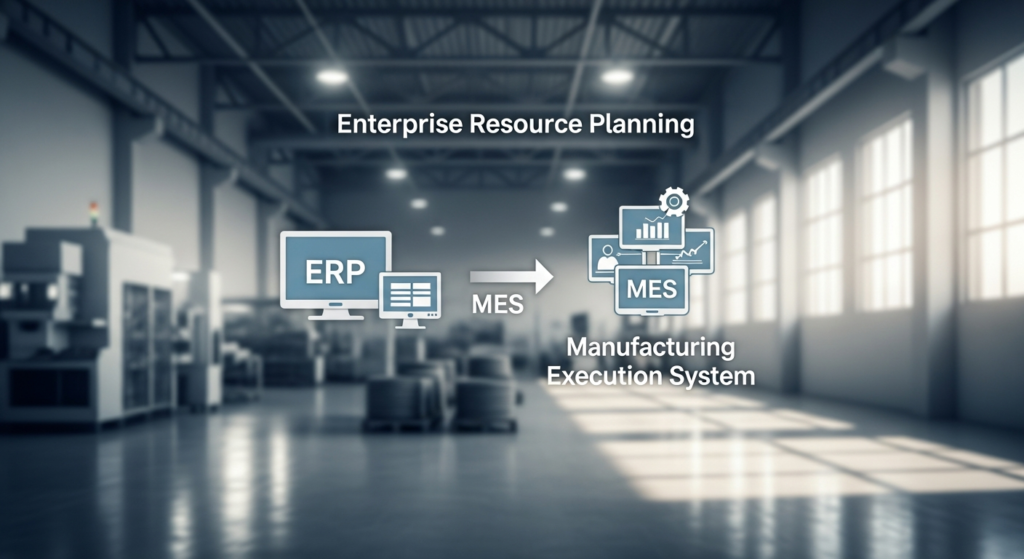
Capital allocation toward factory automation requires rigorous financial justification. Deciding between an Enterprise Resource Planning (ERP) system and a Manufacturing Execution System (MES), or integrating both, determines how a business captures COGS and labor efficiency variances while controlling physical plant workflows. As a financial controller and GM who has guided manufacturing businesses through $4M to $13M turnarounds and $60M site rationalizations, I approach this strictly as an exercise in master data governance and variance analysis, with auditability as the control standard.
Use this framework to decide whether ERP, MES, or both should own each layer of manufacturing data. The goal is to eliminate untracked shop-floor activity and enable a 5-day month-end close while keeping standard costing aligned with shop floor realities.
What You Need to Get Started
Before committing CapEx to software licensing or implementation consulting, document your current operational and financial baseline.
Identifying Your Business and Production Objectives
Define automation objectives in terms of cost control and margin protection. Are you attempting to reduce unfavorable labor efficiency variances, improve overhead absorption, or eliminate manual WIP tracking that delays month-end closing? For a $30M discrete manufacturer, define “better data” in financial terms: reduced inventory shrink and lower cost of quality through scrap data captured at the machine level rather than during a frantic year-end physical stocktake.
Auditing Existing Software and Legacy Equipment
Start with a fixed asset and systems audit: which machines have Programmable Logic Controllers (PLCs) capable of outputting OPC UA data for an MES, and which are legacy analog assets?
- Accounting shortcut: When reviewing legacy equipment, cross-reference the fixed asset register. If an analog machine is fully depreciated and slated for replacement, do not waste integration capital retrofitting it for MES connectivity.
Gathering Input from Key Stakeholders (C-Suite vs. Floor Managers)
Reconcile the inherent conflict between operations and finance. Plant managers prioritize throughput and Overall Equipment Effectiveness (OEE). The CFO and Controller prioritize inventory valuation (FIFO/LIFO), supported by accurate BOM rollups and strict cycle-counting controls. The chosen system architecture must translate physical movements on the shop floor into general ledger (GL) journal entries without manual reconciliation.
Establishing a Baseline for Current Production Metrics (OEE, Cycle Time, Yield)
Quantify current inefficiencies to establish an ROI baseline. If cycle times are poorly tracked, the standard labor rates applied during BOM rollups are likely inaccurate, leading to misstated gross margins.
Discrete Manufacturing Scenario Baseline:
Aluminum Casting & Woodfire Manufacturer ($40M turnover)
- Current Yield: 91% (9% scrap rate, poorly categorized).
- Unfavorable Material Usage Variance: $320K annually.
- Month-End Close: 11 days (due to manual WIP reconciliation).
- Target: Reduce scrap to 4%, eliminate manual WIP counting, achieve 5-day month-end close.
1: Understand the Core Capabilities of Each System
Do not conflate the financial system of record with the operational execution engine.
The Role of ERP: The “Why” and “When” of Manufacturing
The ERP is the financial and macro-planning system of record. It handles Accounts Payable, Accounts Receivable, treasury, FX management for international sourcing, and master production scheduling (MPS).
- Managing supply chains, procurement, and financial data: ERP triggers purchase orders based on MRP logic and supplier lead times, managing negotiated payment terms and calculating landed costs.
- Long-term capacity planning: Determines when product is needed based on customer contract terms and sales forecasts.
- The ERP visibility gap: ERP standard routing assumes perfect execution. It issues materials to WIP and waits for a “finished good” receipt. It does not see machine breakdowns, operator micro-stops, or exact scrap points. It relies on delayed, manual backflushing.
The Role of a Manufacturing Execution System (MES): The “How”
The MES lives on the factory floor. It enforces standard operating procedures (SOPs) and captures granular, sub-second transactional data.
- Executing production orders in real time: Translates the ERP work order into machine-level instructions.
- WIP tracking, genealogy, and quality control: Essential for highly regulated products. Tracks exactly which internationally sourced components (by lot/batch) went into which finished good.
- Automated data collection: Feeds actual machine cycle times and scrap codes directly into the database, replacing paper travelers.
2: Evaluating, Choosing, and Integrating Your Setup
A: When Your Factory Only Needs an ERP
- Profile: A manufacturer under $15M in turnover with low production complexity and standard routing.
- Application: During the turnaround of a $4M fabric knitting business to $13M, we relied solely on a manufacturing ERP with disciplined cost accounting. Operations consisted of straightforward batch processing. Adding an MES would have bloated SG&A. We controlled inventory through strict ERP backflushing at standard cost and implemented rigorous daily cycle counting controls to manage material usage variances.
B: When a Dedicated Manufacturing Execution System (MES) is Required
- Profile: High-volume environments where production is complex and heavily automated.
- Application: Rationalizing two international manufacturing sites into one ($60M turnover, aluminum casting and assembly) required an MES. The consolidation generated >$1.4M p.a. in savings, but it also put much more traffic through the remaining shop floor. An MES was required to sequence complex operations and manage rapid tooling changes while logging exact scrap points in the casting process for immediate rework routing. The ERP could not handle the necessary sub-second data logging without crashing the SQL database.
C: Integrating MES and ERP for Closed-Loop Manufacturing Control
With both systems integrated, ERP master data defines standards and controls; MES actuals feed variance analysis.
Data Flow Matrix: ERP & MES Integration
| Transaction | System of Origin | System of Destination | Financial/Operational Impact |
|---|---|---|---|
| BOM & Routings | ERP (Master Data) | MES (Execution Data) | Establishes standard cost and production targets. |
| Work Order Release | ERP (MRP output) | MES (Dispatch list) | Commits inventory availability; schedules plant floor. |
| Material Consumption | MES (Barcode scan) | ERP (Inventory ledger) | Credits Raw Materials, Debits WIP (Real-time). |
| Scrap / Rework | MES (Operator input/PLC) | ERP (Variance accounts) | Triggers material usage/labor efficiency variance entries. |