Manufacturing IT Support: B2B Vendor Selection Guide
IntroductionManufacturing IT support directly affects overhead absorption, labor efficiency variances, and inventory valuation accuracy. A server outage in a plant can halt Programmable Logic Controllers (PLCs), block real-time Enterprise Resource Planning (ERP) backflushing, and generate thousands of dollars in unabsorbed fixed overhead per hour. This guide covers the financial and operational mechanics of selecting and…

Introduction
Manufacturing IT support directly affects overhead absorption, labor efficiency variances, and inventory valuation accuracy. A server outage in a plant can halt Programmable Logic Controllers (PLCs), block real-time Enterprise Resource Planning (ERP) backflushing, and generate thousands of dollars in unabsorbed fixed overhead per hour. This guide covers the financial and operational mechanics of selecting and onboarding a specialized B2B IT vendor that protects plant-floor workflows and industrial control systems (ICS) while maintaining reliable integration from the shop floor to the general ledger.
Step 1: What You Need (Preparation and Assessment)
Identifying Your Baseline Manufacturing IT Support Requirements
Before approaching vendors, define support requirements in terms of operational uptime and financial reporting. Start with how IT affects your standard costing model. If your cycle counting controls rely on real-time barcode scanning via Wi-Fi, dead zones on the warehouse floor directly cause inventory shrinkage and unfavorable material usage variances. Your baseline should specify 99.9% uptime for localized networks supporting these devices.
Auditing Existing Infrastructure (Hardware, Software, and Plant-Floor Tech)
Conduct an audit that reconciles your physical IT infrastructure against the Fixed Asset Register (FAR).
- Hardware: Identify aging servers running legacy SCADA software. Fully depreciated assets on the FAR often represent single points of failure.
- Software: Map the data flow from physical PLCs to the ERP. Document whether each license is an OpEx subscription or CapEx perpetual license, including renewal dates, payment timing, and upgrade rights.
- Workflow: Assess how production reporting impacts the 5-day month-end close. Any latency in data transfer delays the finalization of work-in-progress (WIP) and finished goods inventory valuations.
Gathering Key Stakeholder Input (Operations, Plant Managers, C-Suite)
Siloed IT decisions can increase downtime, reporting delays, and margin leakage. Collect input from each function:
- Plant Manager: Prioritizes machine hour utilization and minimal idle time.
- Financial Controller: Needs accurate Bill of Materials (BOM) rollups, timely ERP transaction posting for FIFO/LIFO integrity, and reliable labor efficiency variance tracking.
- Warehouse Manager: Depends on WMS (Warehouse Management System) latency controls and handheld scanner reliability.
Establishing a Realistic Budget and Transition Timeline
Segment your budget into capital expenditures (CapEx) for hardware upgrades and operating expenses (OpEx) for managed services. Transition timelines must align with accounting periods. Schedule system cutovers and vendor transitions outside the critical 5-day month-end close window and annual physical stocktake.
2: Sourcing and Evaluating Potential IT Vendors
Defining the Ideal Vendor Profile (Niche Expertise, Location, Scale)
Require a vendor with manufacturing workflow experience. An IT provider accustomed to law firms may miss why a label printer on a packaging line is a mission-critical device. Target vendors with demonstrated scale in discrete or process manufacturing, capable of supporting multi-site environments, especially if you plan future site rationalizations to realize cost savings.
Researching and Shortlisting B2B IT Providers with Manufacturing Experience
Screen vendors based on their ability to support legacy systems alongside Industry 4.0 initiatives. Shortlist providers who explicitly mention experience with ERPs such as SAP, Epicor, or NetSuite, as well as SCADA systems and shop-floor hardware.
Crafting and Distributing the Request for Proposal (RFP)
An RFP should request granular, unbundled pricing. Avoid opaque managed service quotes.
- Required Pricing Matrix:
- Per-user helpdesk support ($/month).
- Per-server infrastructure monitoring ($/month).
- Hourly rate for out-of-scope emergency on-site support.
- One-time transition and onboarding fees, separated into capitalizable and expensed categories where applicable.
Conducting Initial Consultations and Capabilities Presentations
Use these sessions to test whether the vendor understands production priorities. Ask how they handle an outage during a continuous production run. They should go beyond data restoration and prioritize restoration of plant-floor PLCs to minimize scrap and material usage variances.
3: Vetting Vendors Against Your Specific Needs
Assessing Technical Capabilities (ERP, SCADA, ICS, and IIoT Integration)
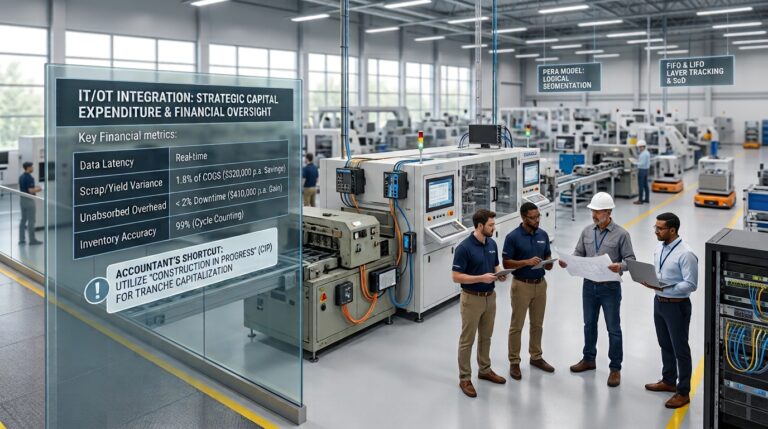
The vendor must show experience integrating IT (Information Technology) and OT (Operational Technology). Poor integration delays data inputs, forcing finance to use estimated absorption costing rates rather than actuals and skewing the P&L. They must also be capable of supporting Industrial Internet of Things (IIoT) sensors that feed live production data into financial dashboards.
Evaluating Cybersecurity and Industry Compliance Standards (NIST, CMMC, ISO)
A ransomware attack on a manufacturing plant results in immediate zero-revenue days while fixed costs, including rent, depreciation, and salaried labor, continue to accrue. Vetted vendors must enforce NIST or ISO 27001 standards. If you are manufacturing goods for defense or certain federal supply chains, CMMC compliance is required to avoid contract termination.
Reviewing Service Level Agreements (SLAs) and Guaranteed Response Times
SLAs must carry financial penalties for non-compliance.
Standard SLA Penalty Matrix:
| Priority Level | Description | Target Response | Target Resolution | Financial Penalty for Breach |
|---|---|---|---|---|
| P1 (Critical) | Plant-floor network down; production halted. | < 15 Minutes | < 2 Hours | 5% credit on monthly recurring revenue (MRR) per hour over target. |
| P2 (High) | ERP module offline; shipping delayed. | < 1 Hour | < 4 Hours | 2% credit on MRR per hour over target. |
| P3 (Normal) | Individual user hardware issue; no line stoppage. | < 4 Hours | < 24 Hours | Non-financial; reviewed in Quarterly Business Review (QBR). |
Validating Disaster Recovery and Business Continuity Protocols
Review the vendor’s Recovery Time Objective (RTO) and Recovery Point Objective (RPO). For a $40M manufacturer running a 24/5 operation, an RPO of 24 hours means losing an entire day of WIP routing data. That can undermine inventory valuation accuracy and require days of manual reconciliation. Mandate an RPO of < 1 hour for critical ERP databases.
4: Common Mistakes to Avoid
Prioritizing Lowest Cost Over Manufacturing-Specific Expertise
Why low-cost vendors can increase margin risk. Selecting a vendor on price alone can lead to prolonged line stoppages. The $1,000 saved on monthly IT retainers is quickly exceeded by an unfavorable labor efficiency variance when 30 direct laborers stand idle for two hours: $1,500+ in unabsorbed labor alone, plus lost margin on unproduced goods.
Ignoring Scalability and Industry 4.0 Readiness
When rationalizing a $60m international manufacturing footprint from two sites to one, with savings of >$1.4m p.a. in fixed overheads, IT infrastructure must handle the consolidated data volume. Vendors that cannot architect scalable cloud environments or hybrid networks will delay consolidation efforts.
Overlooking 24/7 Plant-Floor Support Capabilities
If your discrete manufacturing operation runs a second shift or weekend overtime to clear a backlog, IT support must match those hours. A vendor working 9-to-5 Monday to Friday cannot support a multi-shift plant.
Failing to Check Industry-Specific References and Case Studies
Request manufacturing-specific references. Ask to speak with a Financial Controller or Plant Manager at an existing manufacturing client of similar size, for example $30M to $60M turnover, to verify the vendor’s impact on uptime and ERP stability.
5: Frequently Asked Questions
What are the core Manufacturing IT Support Requirements I should look for?
Look for OT/IT convergence expertise, rapid onsite dispatch capabilities for physical hardware failures, reliable ERP administration, and strict internal controls over network access to prevent unauthorized changes to BOMs or supplier payment routing.
How long does the B2B IT vendor selection process typically take?
For a $10M to $60M manufacturer, expect 60 to 90 days. A typical sequence is 30 days for internal audits and RFP drafting, 30 days for vendor pitches and technical vetting, and 30 days for contract negotiation and SLA finalization.
Should a manufacturing facility choose a local IT vendor or a national provider?
If your facility relies heavily on onsite infrastructure, such as physical servers and localized ICS hardware, or needs frequent plant-floor troubleshooting, a local or regional provider with guaranteed 1-hour onsite dispatch is usually stronger than a national provider that subcontracts remote hands.
How do we handle the transition from our old IT provider to the new one?
Run a parallel system transition. Lock down all administrative access from the outgoing vendor except for specific transition personnel. Schedule the final cutover for mid-month, avoiding both the week prior to and the week of month-end close to protect financial reporting integrity.
6: Final Result (Making the Decision and Onboarding)
Conducting the Final Vendor Review and Cultural Fit Assessment
The vendor’s account managers need working knowledge of plant and finance terminology. If they miss terms like “throughput,” “yield,” or “standard cost,” they may misprioritize support tickets.
Navigating Contract Negotiation and Finalizing SLAs
Negotiate contract terms, not only price. Negotiate improved payment terms, such as Net 45 or Net 60, to align with your receivables cycle and improve working capital. Ensure all SLA matrices are legally binding, and include a “no-fault out” clause with a 60-day notice period if performance KPIs are consistently missed.
Executing a Controlled, Phased Onboarding Process
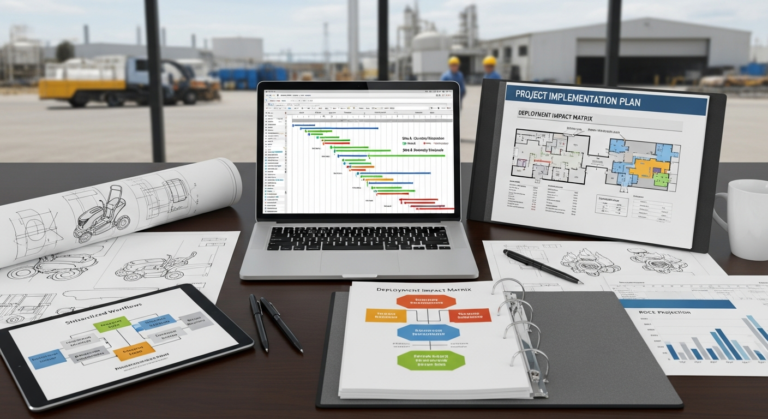
- Phase 1: Network discovery and documentation; update the IT asset register.
- Phase 2: Deployment of new endpoint detection and response (EDR) agents.
- Phase 3: Full helpdesk cutover.
- Shortcut for Accountants: Ensure the transition costs are properly coded. Hardware replacements should be capitalized and depreciated, while onboarding consulting fees may need to be expensed depending on current GAAP/IFRS interpretations.
Establishing KPIs to Measure Long-Term Partnership Success
Realistic Scenario: Aluminum Casting (Discrete Manufacturer)
Context: A $40m turnover business with 80 employees, operating a high-energy intensive aluminum casting plant.
In this environment, an IT failure that drops the SCADA system monitoring furnace temperatures immediately halts production.
- Financial Impact: At a standard plant overhead absorption rate of $800/hour, a 4-hour outage creates a $3,200 unfavorable overhead volume variance before considering scrapped material from temperature drops or idle labor.
To manage this risk, establish strict KPIs reviewed monthly during management meetings alongside the P&L:
- System Availability vs. Scheduled Production Hours: Target >99.9% uptime during shifts.
- Mean Time to Resolution (MTTR) for P1 Tickets: Must remain under 2 hours.
- IT Spend as a % of COGS: Tracked monthly to ensure IT costs scale logically with production volume, rather than becoming excessive fixed overhead.
Treat vendor performance as a monthly operational and financial control, not a background IT expense.