Optimize Manufacturing Operations & Infrastructure With MES, ERP, Maintenance & Project Management Tracking Software
IntroductionManufacturing operations and infrastructure function as a highly integrated financial control environment. The synchronization of Manufacturing Execution Systems (MES), Enterprise Resource Planning (ERP), Maintenance, Project Management, and Tracking Software directly governs standard costing accuracy, inventory valuation, and fixed overhead absorption. Drawing on three decades of experience scaling discrete and process manufacturers—including orchestrating a $4M loss-making…

Introduction
Manufacturing operations and infrastructure function as a highly integrated financial control environment. The synchronization of Manufacturing Execution Systems (MES), Enterprise Resource Planning (ERP), Maintenance, Project Management, and Tracking Software directly governs standard costing accuracy, inventory valuation, and fixed overhead absorption.
Drawing on three decades of experience scaling discrete and process manufacturers—including orchestrating a $4M loss-making entity to a $13M profitable operation and rationalizing a $60M multi-national footprint to save >$1.4M annually—this guide details the technical and financial integration of a modern industrial tech stack. The objective is strict cost control, real-time variance analysis, and the facilitation of a rigorous 5-day month-end close.
What You Need (Prerequisites for System Integration)
Baseline Operational Data
System integration fails when underlying master data is polluted. Before deploying capital on software, finance and operations must scrub existing data.
- Bill of Materials (BOM) Accuracy: Ensure multi-level BOMs accurately reflect current component usage.
- Routings and Cycle Times: Base standard labor hours and machine overhead application rates on time-studied actuals, not legacy estimates. Inaccurate routings generate phantom labor efficiency variances.
Cross-Functional Implementation Team
A successful rollout requires financial oversight to ensure internal controls and operational expertise to ensure shop-floor viability. The implementation team must include the Financial Controller, Plant Manager, IT Lead, and key shop-floor supervisors.
Defined Budget and Timeline Parameters
Classify software expenditures accurately under GAAP/IFRS. Distinguish between capitalizable costs (e.g., perpetual software licenses, direct implementation labor) and OPEX (e.g., SaaS subscriptions, user training). Map implementation milestones to avoid delaying financial audits or tax filings.
IT Infrastructure and Cloud Capabilities
Downtime in manufacturing tech stacks results in unabsorbed fixed overhead. Assess server latency, Wi-Fi coverage across the physical plant (crucial for barcode scanners in high-density warehousing), and data redundancy protocols.
Realistic Scenario: Improved reporting & Tech upgrades (Discrete Manufacturing – Custom Window Fashion making Various types of Blinds)
Context: Create accurate Bills of Materials, establish timely financial reporting, build supplier and customer confidence, and implement internal controls and software upgrades (bar-coding and scanning) to track materials movement from warehouse through work in progress to finished goods.
Challenge: Operating on fragmented legacy ERP with limited WIP tracking, resulting in significant negative inventory balances and a 12-day month-end close.
Solution Matrix:
| System Layer | Financial Function | Operational Function | Post-Implementation Impact |
|---|---|---|---|
| ERP | BOM rollups, AP/AR, GL, Standard Costing | Procurement, MRP runs, Master Scheduling | Reduced the month-end close to 5 days. |
| MES | Capturing actual labor/machine hours | Real-time shop floor scheduling & routing | Eliminated 8% labor efficiency variance noise. |
| Tracking | Perpetual WIP valuation (FIFO) | Barcode scanning for cycle counts | Replaced annual physical count with cycle counting. |
Step 1: Establishing the Core Business and Production Systems
Implementing or Upgrading Your ERP
The ERP is the financial ledger of truth. When upgrading or implementing, focus on how the system handles inventory valuation (Standard Costing vs. Moving Average/FIFO).
- Practical Shortcut: Map the chart of accounts specifically to track material purchase price variances (PPV) and freight-in separately. When sourcing international components to improve margins, isolating PPV and freight ensures accurate landed-cost calculations and prevents margin erosion in wholesale product categories.
Deploying the MES (Manufacturing Execution System)
An MES converts the ERP’s production orders into physical shop-floor commands. Financially, it is the engine for actual cost capture. Operators logging into the MES generate the direct labor hours and machine hours used for absorption costing.
- Configure the MES to automatically trigger material backflushing only upon verified completion of routing steps. Premature backflushing inflates WIP and misaligns sub-ledger balances.
Bridging the Gap Between ERP and MES
The ERP and MES must share a bi-directional API.
- Top-Down: ERP pushes master production schedules, standard BOMs, and raw material availability to the MES.
- Bottom-Up: MES pushes actual yields, scrap rates, and labor hours back to the ERP.
- Control point: Reconcile the MES production clearing account to the ERP WIP account daily to catch integration failures before month-end.
Step 2: Integrating Specialized Operational Tools
Setting Up Predictive and Preventive Maintenance Systems
Maintenance software (CMMS) is critical for managing asset lifecycles and mitigating unabsorbed overhead caused by machine downtime.
- Link CMMS inventory modules to the ERP to track MRO (Maintenance, Repair, and Operations) inventory.
- Capitalize major overhauls tracked in the CMMS that extend the useful life of heavy machinery (e.g., aluminum die-casting machines, fabric cutting machines), updating depreciation schedules accordingly in the ERP Fixed Asset register.
Standardizing Project Management Protocols for Manufacturing
Deploy PM tools for capital expenditure (CAPEX) projects and R&D.
- Tax Strategy: Rigorous time-tracking and material isolation within PM software directly support R&D tax credit claims. In a prior aluminium casting business, isolating export-focused R&D project costs within the PM tool provided the audit trail necessary to secure a $750K tax credit.
Deploying Tracking Software for Materials and WIP (Work in Progress)
Real-time tracking software (RFID or barcode scanning) eliminates the black hole of WIP.
- Implement strict cycle counting controls. Classify inventory using ABC analysis (A-items counted weekly, C-items bi-annually). This eliminates the costly full-plant shutdown for annual physical stocktakes and maintains perpetual inventory accuracy above 98%.
Step 3: Executing the Rollout and Training
Conducting Pilot Testing on the Shop Floor
Never execute a hard cutover. Run a discrete product line (e.g., a specific blind-type model) through the legacy system and the new MES/ERP concurrently. Compare the resulting material usage variances and labor efficiency variances. Reconcile any divergence before scaling.
Standardizing User Training and SOPs
Operator error on the shop floor manifests as financial variance in the GL. Standard Operating Procedures (SOPs) must enforce strict rules for scrap logging, rework ticketing, and shift-end labor reconciliations.
- Practical Shortcut: Create laminated, single-page “cheat sheets” for MES terminal operations. If operators cannot execute a transaction in under 15 seconds, they will bypass the system.
Establishing a Feedback Loop for System Adjustments
Review variance accounts (Labor, Overhead, Material) during the first three 5-day month-end closes. Consistently high unabsorbed overhead or unfavorable labor variances indicate that standard routings in the ERP do not match physical shop-floor realities dictated by the MES. Adjust standard costs quarterly during the first year of rollout.
Common Mistakes to Avoid
Treating ERP and MES as Isolated Silos
Allowing operations to run the MES without financial integration with the ERP results in dual data entry, mismatched WIP valuations, and a bloated month-end close process that relies heavily on offline Excel reconciliation.
Neglecting End-User Adoption in Project Management Rollouts
If maintenance engineers or project managers fail to log MRO parts consumption or contractor hours into the system, actual costs are under-reported, resulting in unexpected P&L hits when supplier invoices clear Accounts Payable.
Overcustomizing Tracking Software Out of the Box
Custom code breaks during routine software updates. Experienced controllers adapt internal workflows to match standard software functionality, not vice versa. Over-customization destroys ROI via perpetual IT consulting fees.
Ignoring Post-Implementation Maintenance and Updates
Static systems die. Standard machine-hour rates, labor rates, and overhead application bases must be recalculated annually to reflect current utility costs, negotiated supplier pricing, and foreign exchange (FX) impacts on imported raw materials.
Final Result: A Fully Optimized Manufacturing Ecosystem
Achieving Real-Time Data Visibility Across All Departments
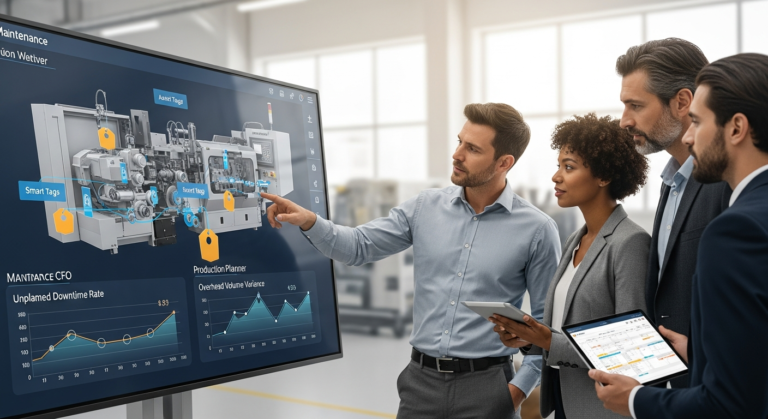
With tight API integrations, the CFO can generate a reliable mid-month flash P&L, operations can view real-time OEE (Overall Equipment Effectiveness), and sales can confidently quote lead times based on accurate WIP data.
Improved Uptime and Asset Utilization
Predictive maintenance integrated with production scheduling minimizes unplanned downtime, directly improving Return on Assets (ROA) and ensuring fixed plant overhead is fully absorbed into inventory standard costs.
Scalable Infrastructure Ready for Industry 4.0
By rationalizing disparate systems into a unified ERP/MES architecture, the business establishes a data foundation that integrates advanced robotics, automated guided vehicles (AGVs), and machine-learning forecasting models. The result is a robust financial model (P&L, B/S, Cash flow) that updates monthly with high fidelity.
Frequently Asked Questions
What is the fundamental difference between an ERP and an MES?
The ERP manages the business logistics (financial ledgers, order-to-cash, procure-to-pay, standard costing, MRP). The MES manages physical shop-floor execution (machine-level routing, real-time yield tracking, operator labor logging). The ERP answers “what and when,” while the MES answers “how and right now.”
How does Tracking Software improve overall equipment Maintenance?
Tracking software monitors the physical consumption of MRO (Maintenance, Repair, and Operations) inventory. When integrated with a CMMS, it automatically triggers purchase requisitions for critical spare parts (e.g., specific bearings or lubricants) when minimum reorder points are breached, preventing prolonged machine downtime due to stockouts.
Can robust Project Management tools reduce manufacturing downtime?
Yes. During major CAPEX installations or plant retrofits (e.g., site consolidations), PM tools synchronize contractor schedules, internal engineering resources, and production downtime windows. This prevents capital projects from bleeding into active production shifts, safeguarding overhead absorption targets.
In what order should these operational systems be implemented?
- ERP (Core Ledger & Master Data): Establish the financial and inventory foundation.
- MES (Shop Floor Control): Digitize physical production and integrate it into the ERP.
- Tracking/WIP Software: Layer in real-time barcode/RFID scanning for perpetual inventory accuracy.
- Maintenance/PM Tools: Deploy specialized tools once the core production and financial data streams are stabilized.