Using Manufacturing Financial KPIs To Align Factory Floor Results
15 Essential Financial KPIs Every Manufacturer Should Track Running a successful manufacturing operation requires more than just keeping the assembly line moving. To truly thrive, leadership must keep a close eye on the financial metrics that dictate long-term sustainability. Atomic Definition: Manufacturing financial KPIs (Key Performance Indicators) are quantifiable metrics used to evaluate a manufacturing…

15 Essential Financial KPIs Every Manufacturer Should Track
Running a successful manufacturing operation requires more than just keeping the assembly line moving. To truly thrive, leadership must keep a close eye on the financial metrics that dictate long-term sustainability.
Atomic Definition: Manufacturing financial KPIs (Key Performance Indicators) are quantifiable metrics used to evaluate a manufacturing company’s financial performance, operational efficiency, and overall economic health.
When leaders track these specific metrics, they gain unprecedented visibility into the business. Tracking manufacturing financial KPIs bridges the critical gap between the factory floor and the balance sheet. It allows plant managers and CFOs to align operational goals with financial outcomes.
Consistently monitoring these metrics empowers manufacturing leadership to:
- Identify hidden production bottlenecks before they impact the bottom line.
- Control overhead costs by pinpointing exactly where capital is leaking.
- Optimize cash flow to ensure payroll, suppliers, and debts are always covered.
- Make data-driven decisions regarding equipment upgrades and capacity expansion.
Let’s explore the 15 essential financial KPIs that every forward-thinking manufacturer must track.
1. Profitability & Margin KPIs
Profitability metrics are the ultimate scorecard for your manufacturing business. They help manufacturers understand if their pricing, purchasing, and production strategies are actually generating bottom-line value.
Consistently high production volume means very little if your margins are too thin to sustain growth. These four KPIs provide a clear picture of your actual money-making capabilities.
1. Gross Profit Margin
Atomic Definition: Gross profit margin is the percentage of revenue remaining after deducting the direct costs associated with manufacturing your goods.
- Formula: ((Total Revenue – Cost of Goods Sold) / Total Revenue) x 100
- The Focus: This metric serves as the baseline indicator of your production efficiency and pricing strategy. If your gross profit margin is shrinking, it means your raw materials or direct labor costs are rising faster than your prices.
Tracking this metric helps manufacturers determine if they need to renegotiate supplier contracts or raise prices. It also highlights inefficiencies on the factory floor that may be inflating the Cost of Goods Sold (COGS). A healthy gross margin is required to cover all other operating expenses downstream.
2. Net Profit Margin
Atomic Definition: Net profit margin measures the percentage of total revenue that translates into actual profit after all expenses, taxes, and interest are deducted.
- Formula: (Net Income / Total Revenue) x 100
- The Focus: While gross margin looks purely at production, net margin looks at the entire business. It shows how much of every dollar earned actually drops to the company’s bottom line.
This KPI is crucial because it accounts for administrative costs, marketing, debt servicing, and taxes. A manufacturer might have a fantastic gross margin but a terrible net margin if their overhead is bloated. Investors closely watch net profit margin to gauge overall corporate health and efficiency.
3. Operating Profit Margin
Atomic Definition: Operating profit margin evaluates how much profit a company makes from its core operations before interest and taxes are applied.
- Formula: (Operating Income / Total Revenue) x 100
- The Focus: This metric details how well a manufacturer controls both variable and fixed overhead costs. It sits directly between gross and net margin, providing a window into administrative and operational efficiency.
By stripping out interest and taxes, managers can evaluate the true profitability of their daily operations. It answers a vital question: Is the core business model actually profitable? Improving this metric often involves reducing administrative bloat, optimizing warehouse leases, or cutting utility costs.
4. EBITDA (Earnings Before Interest, Taxes, Depreciation, and Amortization)
Atomic Definition: EBITDA is a measure of a company’s overall financial performance that strips out debt financing, tax burdens, and non-cash accounting expenses.
- The Focus: EBITDA is heavily relied upon in the manufacturing sector to evaluate core operational profitability. Because manufacturing is incredibly capital-intensive, depreciation on heavy machinery can artificially deflate net income.
Looking at EBITDA removes the distortion of heavy capital investments and historical debt. It allows leadership to compare their operational efficiency directly against competitors, regardless of how the companies are financed. Furthermore, banks and private equity firms use EBITDA as the primary metric when valuing a manufacturing business for loans or acquisitions.
2. Cash Flow & Liquidity KPIs
A manufacturer can be highly profitable on paper but still face bankruptcy if they run out of cash. Liquidity metrics determine your ability to purchase raw materials, maintain payroll, and survive unexpected supply chain disruptions.
Understanding cash flow is about timing. You need to know exactly when cash enters the business and when it leaves.
5. Operating Cash Flow (OCF)
Atomic Definition: Operating cash flow measures the exact amount of cash generated purely from a company’s regular manufacturing and business operations.
- The Focus: OCF answers a critical survival question: Are your core operations generating enough actual cash to maintain and grow the business? It removes the noise of external financing, investments, or loans.
If OCF is consistently negative, the manufacturer is burning through its cash reserves and will eventually require external funding. Tracking OCF highlights the difference between booked revenue (sales made on credit) and actual cash in the bank. It is the lifeblood metric for daily factory survival.
6. Current Ratio
Atomic Definition: The current ratio is a liquidity metric that compares a company’s short-term assets to its short-term liabilities.
- Formula: Current Assets / Current Liabilities
- The Focus: This ratio highlights the importance of having enough short-term assets to cover immediate debts. A ratio of 1.0 means you have exactly enough assets to pay off liabilities over the next 12 months.
Most manufacturers aim for a current ratio between 1.5 and 2.0 to ensure a safe buffer. If the ratio drops below 1.0, the business is at serious risk of defaulting on supplier payments or loans. Conversely, a ratio that is too high might indicate that capital is being hoarded rather than reinvested into new machinery.
7. Quick Ratio (Acid Test)
Atomic Definition: The quick ratio measures a company’s ability to meet its short-term obligations using only its most liquid assets, completely excluding inventory.
- Formula: (Cash + Cash Equivalents + Accounts Receivable) / Current Liabilities
- The Focus: For inventory-heavy manufacturers, the current ratio can sometimes present a falsely optimistic view of liquidity. The quick ratio provides a much stricter test of financial health by stripping out inventory.
In a crisis, raw steel or half-assembled widgets cannot be instantly liquidated to pay the electric bill. By focusing only on cash and receivables, the quick ratio reveals your true emergency safety net. A quick ratio of 1.0 or higher is generally considered excellent in the manufacturing sector.
8. Cash Conversion Cycle (CCC)
Atomic Definition: The cash conversion cycle measures the number of days it takes a company to convert its investments in raw materials and inventory back into cash from sales.
- Formula: Days Inventory Outstanding + Days Sales Outstanding – Days Payable Outstanding
- The Focus: This metric tracks the complete timeline of your capital. It starts the moment you pay a supplier for raw materials and ends the moment a customer pays you for the finished goods.
A shorter CCC is always better because it means your cash is tied up for less time. Manufacturers can improve this metric by turning over inventory faster, collecting client invoices quicker, or negotiating longer payment terms with their own suppliers. Optimizing the CCC dramatically reduces the need to rely on expensive short-term bridge loans.
3. Efficiency & Asset Management KPIs
Manufacturing requires massive investments in facilities, specialized machinery, and raw materials. Efficiency and asset management KPIs focus on how well you utilize these physical assets to generate revenue.
Idle machines and dead stock represent trapped capital. These metrics ensure every asset is pulling its own weight.
9. Inventory Turnover Ratio
Atomic Definition: The inventory turnover ratio calculates how many times a manufacturer has sold and replaced its entire inventory over a specific period.
- Formula: COGS / Average Inventory
- The Focus: This metric helps manufacturers find the perfect balance between holding enough stock to meet demand and tying up capital in dead stock. A low turnover ratio often points to overproduction, obsolescence, or weak sales.
Conversely, a ratio that is too high might indicate inadequate inventory levels, leading to stockouts and lost business. Top-tier manufacturers use this KPI to fine-tune Just-In-Time (JIT) production schedules. Regular tracking ensures your warehouse doesn’t become a graveyard for unsold capital.
10. Return on Assets (ROA)
Atomic Definition: Return on assets measures how efficiently a company uses its physical and financial assets to generate net income.
- Formula: Net Income / Total Assets
- The Focus: Manufacturing is a highly capital-intensive industry, making ROA a critical metric. It tells leadership exactly how much profit is being generated by the machinery, vehicles, and facilities on the balance sheet.
If a company heavily invests in a new robotic assembly line, the ROA should theoretically increase as production becomes more efficient. A declining ROA suggests that the company is over-investing in assets that aren’t yielding proportional financial returns. It is the ultimate test of heavy equipment utilization.
11. Return on Investment (ROI) & Return on Equity (ROE)
Atomic Definition: ROI measures the financial return of a specific capital expenditure, while ROE measures the profitability generated from shareholder equity.
- The Focus: Evaluating these metrics is crucial when planning massive capital expenditures, such as opening a new factory or upgrading to smart-factory IoT systems. ROI helps managers justify individual project costs by comparing the expected profit to the initial spend.
ROE, on the other hand, is a broader metric that looks at how effectively leadership is using the owners’ or investors’ funds to grow the business. Both metrics demand that financial capital is never spent on a whim. They enforce a culture where every dollar deployed must have a clear path to generating a profitable return.
12. Asset Turnover Ratio
Atomic Definition: The asset turnover ratio evaluates a company’s ability to use its assets to drive top-line revenue rather than bottom-line profit.
- Formula: Net Sales / Average Total Assets
- The Focus: While ROA looks at net income, the asset turnover ratio looks strictly at sales volume. It gauges the sheer productivity of your manufacturing footprint.
A higher ratio indicates that your plants and equipment are working at maximum capacity to push products out the door. If this ratio drops, it could indicate machine downtime, supply chain bottlenecks, or softening market demand. It is a vital health check on overall manufacturing velocity.
4. Cost Control & Production Economics KPIs
To improve margins, you must have an uncompromising grip on your factory floor expenses. Cost control KPIs detail the granular metrics that trace expenses directly to production.
By tracking these numbers, manufacturers can price their products competitively without accidentally sacrificing their margins.
13. Cost of Goods Sold (COGS)
Atomic Definition: Cost of Goods Sold represents the total direct costs accumulated in the production of the goods sold by a company.
- The Focus: COGS is the foundational metric of manufacturing economics. It breaks down the direct costs strictly attributable to production, including raw materials, parts, and direct factory labor.
It deliberately excludes indirect expenses like marketing, shipping, and administrative salaries. Tracking COGS rigorously allows managers to see the immediate financial impact of raw material price hikes or supply chain shortages. Keeping COGS low without compromising product quality is the most direct path to higher profitability.
14. Manufacturing Cost Per Unit
Atomic Definition: Manufacturing cost per unit calculates the exact total expense required to produce one single unit of a product.
- Formula: Total Manufacturing Costs / Total Units Produced
- The Focus: This KPI provides incredible granularity, allowing sales teams to price products competitively while guaranteeing a profit margin. It blends both variable costs (materials) and fixed costs (factory rent, machine depreciation) into one unit figure.
Tracking this at a granular level highlights the concept of economies of scale. As production volume increases, the fixed costs are spread across more units, driving the cost per unit down. If this metric suddenly spikes, leadership immediately knows there is an efficiency or material cost issue on the line.
15. Maintenance Costs as a Percentage of Total Expenses
Atomic Definition: This metric measures the total cost of repairing and maintaining equipment as a percentage of overall manufacturing operating expenses.
- Formula: Total Maintenance Cost / Total Manufacturing Expenses
- The Focus: Equipment breakdowns can derail entire production schedules and destroy profitability. This KPI highlights the financial impact of your maintenance strategy.
Relying on reactive maintenance (fixing things only when they break) usually causes this metric to surge due to emergency part orders and forced downtime. Shifting to preventative or predictive maintenance stabilizes these costs. Tracking this percentage helps plant managers justify budgets for better tools, maintenance software, and dedicated repair technicians.
5. Best Practices for Implementing a KPI Reporting System
Knowing which manufacturing financial KPIs to track is only half the battle. The real challenge lies in actively and accurately monitoring them.
Transitioning from theoretical knowledge to an active tracking system requires the right tools, processes, and benchmarks. Here is how leading manufacturers successfully implement KPI reporting.
Utilizing ERP and Financial Dashboards
The days of tracking complex manufacturing financials on disparate, manually updated Excel spreadsheets are over. Manual entry is highly prone to human error and creates massive data silos between departments.
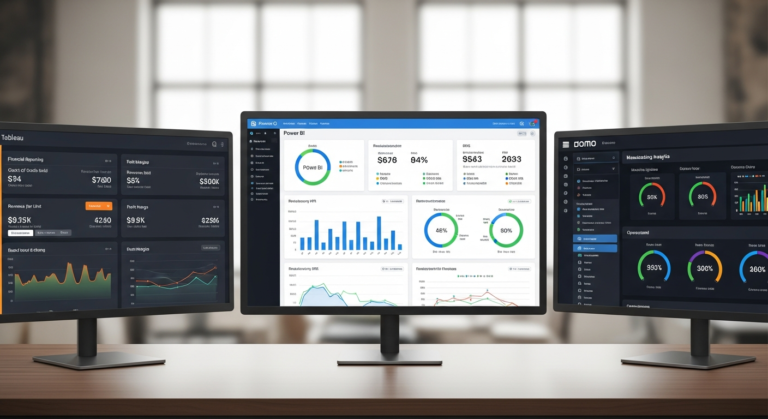
Manufacturers must shift toward automated Enterprise Resource Planning (ERP) systems. ERPs consolidate financial data, supply chain metrics, and production figures into a single, unified dashboard. This gives CFOs and plant managers instant access to the visual data they need to make rapid decisions.
Modern financial dashboards allow users to set automatic alerts when a KPI drops below a safe threshold. This transforms financial tracking from a backward-looking historical review into a proactive management strategy.
Ensuring Data Accuracy and Timeliness
A KPI is only as valuable as the data used to calculate it. If your financial software is running on week-old production numbers, your decision-making will always be lagging.
It is critical to integrate shop-floor data collection systems with your financial software in real-time. Utilizing IoT sensors on machinery and barcode scanners in the warehouse ensures that inventory and production data are instantly fed into the financial system.
This level of integration ensures that data is accurate, timely, and free from manual manipulation. Real-time data allows leadership to pivot production schedules or pause purchasing the moment a financial red flag appears.
Setting Industry Benchmarks
Tracking your KPIs in a vacuum limits their usefulness. To truly understand your company’s financial health, you must compare your internal metrics against broader industry standards.
A 10% net profit margin might be incredible for an automotive parts supplier, but terribly low for a specialized medical device manufacturer. Utilize industry trade associations, financial reports from publicly traded competitors, and consulting data to establish realistic benchmarks.
Setting these benchmarks gives your team concrete goals to aim for. It also helps contextualize your financial performance when communicating with investors, board members, or potential lenders.
6. Frequently Asked Questions
Understanding the nuances of manufacturing financial KPIs can be complex. Here are answers to some of the most common questions managers and stakeholders ask.
What is the difference between operational and financial KPIs in manufacturing?
Operational KPIs measure physical performance on the factory floor, while financial KPIs measure the economic outcomes of that performance.
For example, Overall Equipment Effectiveness (OEE) is an operational metric that tracks machine availability and production speed. Conversely, EBITDA is a pure financial metric that tracks monetary profitability. Ultimately, strong operational KPIs drive efficiency, which naturally produces stronger financial KPIs on the balance sheet.
How often should a manufacturer review their financial KPIs?
The review cadence depends heavily on the specific metric and its impact on immediate survival.
Cash flow metrics, daily production costs, and manufacturing cost per unit should be reviewed on a daily or weekly basis. This allows managers to correct course before small leaks become massive losses. Higher-level metrics like Return on Assets (ROA) and EBITDA are best reviewed monthly or quarterly to assess long-term strategic progress.
Which manufacturing financial KPIs are most attractive to investors and lenders?
External stakeholders are primarily concerned with your ability to generate cash and manage debt.
Investors heavily scrutinize EBITDA because it reveals your core operational profitability without accounting noise. Lenders focus deeply on Free Cash Flow and liquidity ratios (like the Current Ratio) to ensure you can safely service new loan payments. Additionally, Debt-to-Equity ratios are critical for proving that the business is not dangerously over-leveraged.
How does the Cash Conversion Cycle impact manufacturing profitability?
The Cash Conversion Cycle (CCC) directly impacts profitability by determining how much working capital is tied up in the supply chain.
A shorter CCC frees up working capital much faster. When cash is returned to the business quickly, the manufacturer doesn’t have to rely on costly short-term borrowing to fund daily operations. Avoiding interest payments on credit lines instantly improves net profitability and creates a more self-sustaining business model.