How to Analyze Manufacturing COGS & Maximize Profit
The Ultimate Guide: How to Analyze Manufacturing COGS for Maximum Profitability To effectively scale a production business, you must know exactly how much it costs to produce your products. Without a clear picture of your operational expenses, scaling becomes a risky guessing game rather than a strategic move. Manufacturing Cost of Goods Sold (COGS) is…

The Ultimate Guide: How to Analyze Manufacturing COGS for Maximum Profitability
To effectively scale a production business, you must know exactly how much it costs to produce your products. Without a clear picture of your operational expenses, scaling becomes a risky guessing game rather than a strategic move.
Manufacturing Cost of Goods Sold (COGS) is the total of all direct costs attributable to the production of the goods sold by a company. This crucial metric includes material costs, direct labor, and manufacturing overhead.
When you analyze manufacturing COGS, you unlock deep insights into your operational efficiency, pricing strategies, and overall profitability. Understanding these numbers allows you to pinpoint financial leaks and double down on highly profitable product lines. This step-by-step guide will walk you through exactly how to dissect, calculate, and optimize these costs for a healthier bottom line.
What You Need Before You Begin
Before you can accurately analyze manufacturing COGS, you must gather the correct data and tools. Having a clear, organized financial picture is the foundational step in this process. Skipping this preparation phase will only lead to skewed numbers and poor business decisions.
Accurate Inventory Records
You need precise beginning and ending inventory counts for the period you are analyzing. Without these exact numbers, your cost calculations will immediately fall off track. Be sure to document all three distinct phases of your physical inventory:
- Raw materials: Unprocessed goods, components, and commodities ready for production.
- Work-in-process (WIP): Partially finished goods currently sitting on the production floor.
- Finished goods: Completed, fully assembled products ready for customer sale.
Financial and Production Reports
Next, gather all relevant financial documentation from your accounting team. You need a complete, transparent view of your money coming in and going out. Pull the following key documents before starting your analysis:
- General ledger and your most recent income statements.
- Direct labor timecards, timesheets, and payroll summaries.
- Automated reports from your Enterprise Resource Planning (ERP) or accounting software.
A Defined Costing Method
Determine which inventory valuation method your business uses, as this directly impacts your entire COGS calculation. You must remain consistent with your chosen method to maintain accurate historical data over time. Common inventory valuation methods include:
- FIFO (First-In, First-Out): Assumes the oldest inventory items purchased are the ones sold first.
- LIFO (Last-In, First-Out): Assumes the newest inventory items purchased are the ones sold first.
- Standard Costing: Assigns a predetermined, expected baseline cost to materials, labor, and overhead.
Step 1: Break Down the Components of Manufacturing COGS
To effectively analyze manufacturing COGS, you must separate it into its three primary pillars. This allows you to see exactly where your money is flowing during the physical production process. Breaking down these costs is essential for identifying specific areas of financial waste.
Quantifying Direct Materials
Direct materials are the raw commodities and physical components that ultimately become part of your finished product. You must calculate the total cost of everything directly used to create the physical items you sell. This typically includes:
- Raw natural commodities (e.g., raw timber, steel, cotton fabric).
- Sub-assemblies or hardware purchased from third-party vendors.
- Essential consumer packaging that houses the finished good.
Calculating Direct Labor
Direct labor is the total compensation paid to employees who are physically involved in assembling or manufacturing the product. This explicitly does not include floor managers, maintenance staff, or administrative teams sitting in the office. To calculate this accurately, track the following:
- Hourly wages of front-line assembly line workers and machine operators.
- Shift differentials, overtime pay, and performance bonuses for production staff.
- Associated employee benefits, health insurance, and employer payroll taxes.
Allocating Manufacturing Overhead
Manufacturing overhead includes all the indirect costs tied to running and maintaining your production facilities. These are the unavoidable expenses required to keep the factory running safely, even though they aren’t physically built into the product. Common manufacturing overhead costs include:
- Factory rent, lease payments, or facility mortgage payments.
- Utilities, such as electricity, gas, and water required to run heavy machinery.
- Equipment depreciation, machinery maintenance, and facility repairs.
- Indirect labor, such as floor supervisors, janitors, and quality control inspectors.
Step 2: Calculate and Analyze the Data
Once your components are accurately categorized, it is time to run the numbers and interpret what they mean for your business. Gathering the raw data is only half the battle. Now, you must turn those numbers into an actionable financial narrative.
Applying the Basic COGS Formula
Calculating your total costs requires a simple but powerful accounting equation. The COGS formula is: Beginning Inventory + Purchases (and production costs) – Ending Inventory = COGS.
Ensure all direct materials, direct labor, and manufacturing overhead are factored into your “production costs” variable. For example, if your beginning inventory was $50,000, your production costs were $100,000, and your ending inventory is $40,000, your total COGS is $110,000.
Conducting Variance Analysis
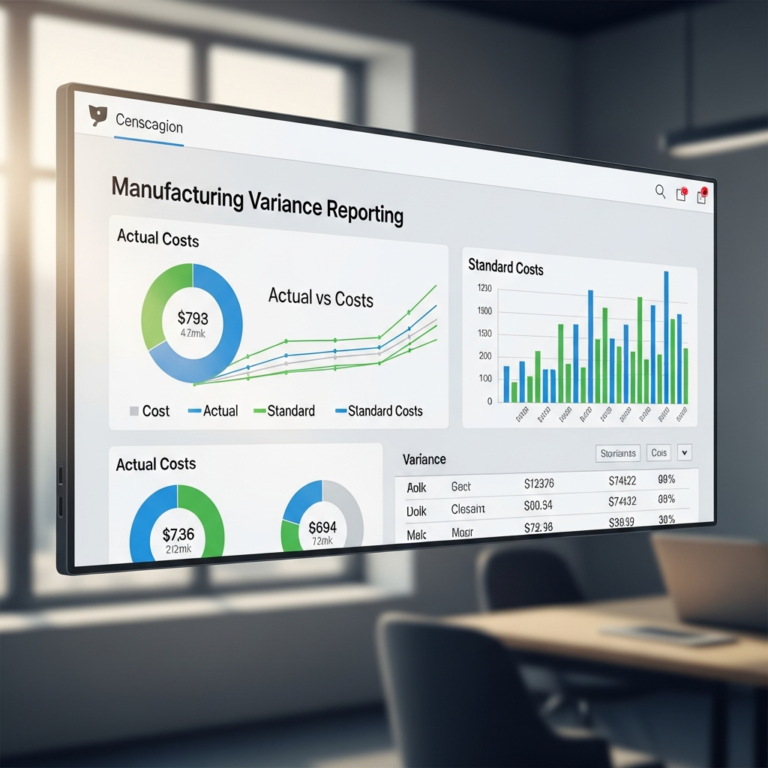
Variance analysis is the process of comparing your actual production costs against your standard, projected, or historical costs. This critical step reveals whether you are spending more or less than you initially budgeted for the quarter.
Identify whether your variances are favorable (costing less than expected) or unfavorable (costing more than expected). Drill down into the data to see if the discrepancy is driven by:
- Price variances: Did raw materials cost more from the supplier than expected?
- Quantity variances: Did production require more physical materials than planned?
- Efficiency variances: Did direct labor take longer than standard time expectations?
Tracking Profit Margins Over Time
Gross margin is the percentage of total revenue remaining after you deduct the cost of goods sold. You calculate this essential metric by dividing your Gross Profit by your Total Revenue, then multiplying by 100.
Track how fluctuations in your COGS directly impact this profit margin month-over-month. If your COGS continually rises but your product pricing stays the same, your profit margins will rapidly shrink.
Common Mistakes to Avoid
When business owners analyze manufacturing COGS, small accounting errors can lead to massive strategic missteps. Accuracy is the lifeblood of reliable financial forecasting and business planning. Watch out for these frequent operational pitfalls to keep your ledgers clean.
Misclassifying Operating Expenses as COGS
Operating Expenses (OPEX) are the indirect costs of running your overall business, completely separate from physical product production. Never include administrative expenses, marketing costs, software subscriptions, or sales commissions in your COGS.
Mixing these two categories together will artificially inflate your perceived production costs. This mistake often leads to unnecessarily overpricing your products and losing vital market share to competitors.
Failing to Update Standard Costs
If your accounting team uses standard costing, you must consistently update your material prices and labor rates to reflect current market conditions. The global economy fluctuates rapidly, and your standard costs must reflect today’s inflationary reality.
Relying on outdated standard costs renders your variance analysis completely useless. If your baselines are wrong, your pricing strategy and profit projections will inherently be flawed.
Ignoring Scraps and Spoilage
Spoilage refers to raw materials or finished goods that are ruined, wasted, or rendered unsellable during the manufacturing process. Failing to account for wasted materials leads to highly inaccurate inventory valuations on your balance sheet.
Always track scrap rates and defective products as a standard part of your material costs. Knowing your exact waste percentage helps you identify malfunctioning machinery or poorly trained staff members.
Final Result: Leveraging Insights for Profitability
The final step is translating your complex analysis into actionable business strategies. Raw data has no inherent value until it is applied to real-world operations. The ultimate goal is to use your newly uncovered insights to aggressively drive growth.
Optimizing Procurement and Supplier Relations
Use your direct materials data to ruthlessly optimize how you purchase commodities. When you know exactly what materials you use, how much you need, and when you need them, you gain incredible negotiating power.
Take these proactive procurement steps to reliably lower your material COGS:
- Negotiate better bulk volume rates based on highly accurate annual projections.
- Research and qualify alternative suppliers to leverage competitive pricing in the market.
- Lock in long-term vendor contracts to stabilize your costs against market inflation.
Streamlining Production Efficiency
Address unfavorable labor and overhead variances by focusing intensely on the factory floor. Abnormally high COGS often points directly to operational bottlenecks that need immediate fixing.
Improve your overall production efficiency by taking the following steps:
- Invest in targeted employee training to speed up complex assembly times.
- Upgrade, repair, or replace legacy machinery that continually slows down production runs.
- Re-organize the factory floor layout to minimize unnecessary worker movement and material transport.
Adjusting Pricing Strategies
With a highly accurate understanding of your true production costs, you can completely overhaul your pricing models. You no longer have to guess what your products are financially worth to your business.
You can confidently adjust your retail or wholesale pricing to ensure you are consistently hitting your target profit margins. If your COGS has permanently increased due to market conditions, raising prices is a necessary, data-backed step to survive.
Frequently Asked Questions
What is the difference between COGS and operating expenses?
COGS includes only the direct, unavoidable costs of physically producing a good, such as raw materials, factory labor, and factory overhead. These costs tie directly to the volume of product you create.
Operating expenses (OPEX) are the indirect costs related to running the general business operations. These overhead costs include marketing campaigns, corporate office rent, legal fees, and executive salaries.
How often should I analyze manufacturing COGS?
For most manufacturing businesses, a deep monthly analysis is highly recommended. This rhythm aligns perfectly with standard accounting cycles, month-end reconciliations, and financial close periods.
Analyzing monthly allows you to catch unfavorable variances incredibly early. This empowers you to adjust production workflows or pricing models before they severely impact your quarterly profitability.
What is the best software to analyze manufacturing COGS?
While basic spreadsheets can work for very small operations, they quickly become a liability as your production volume scales. Manual data entry is highly prone to human error and lacks real-time visibility.
Growing manufacturers should utilize ERP systems or advanced accounting tools to automate the process. Industry standard software includes:
- QuickBooks Enterprise for mid-sized, growing manufacturers.
- Oracle NetSuite for highly complex, multi-facility operations.
- Specialized MRP (Material Requirements Planning) software for real-time cost tracking directly on the factory floor.