The Manufacturing Month-End Close Checklist
12-Step Monthly Financial Close Process for Manufacturers (Checklist) Closing the books at the end of the month is a universal accounting practice, but for manufacturing companies, it is a uniquely complex beast. Unlike service-based businesses that simply tally up payroll and software expenses, manufacturers must account for physical materials, moving production lines, and heavy machinery….

12-Step Monthly Financial Close Process for Manufacturers (Checklist)
Closing the books at the end of the month is a universal accounting practice, but for manufacturing companies, it is a uniquely complex beast. Unlike service-based businesses that simply tally up payroll and software expenses, manufacturers must account for physical materials, moving production lines, and heavy machinery.
Atomic Definition: The manufacturing month-end close is a systematic accounting procedure that production companies use. At the end of each reporting period, they must finalize financial data, verify physical and digital inventory, allocate manufacturing overhead, and ensure accurate financial statements.
A specialized close is critical for manufacturers because of the intricate nature of their operations. Financial teams must navigate complex Cost of Goods Sold (COGS) calculations, subjective Work in Process (WIP) valuations, tricky supply chain accruals, and standard-costing variances. Without a tailored process, margins become murky, and operational inefficiencies can go unnoticed.
This article introduces a structured, 12-step checklist designed to streamline your accounting cycle. By following this guide, you will reduce closing time, eliminate costly errors, and gain crystal-clear visibility into your manufacturing margins.
Preparing for the Manufacturing Month End Close
A smooth financial close does not start on the first day of the new month; it begins in the final days of the current period. Proper preparation prevents the frantic scramble for data that plagues so many accounting departments.
Establishing Clear Cut-Off Procedures
Without a definitive finish line, transactions will bleed over between months, ruining the accuracy of your financial statements. Establishing strict cut-off times ensures that your data represents a frozen moment in time.
- Set Hard Deadlines: Define exact, non-negotiable cut-off times for shipping out finished goods, receiving inbound raw materials, and entering production floor data.
- Communicate Broadly: Ensure that warehouse managers, shipping clerks, and procurement officers know exactly when the financial window closes.
- Halt Inventory Movements: Freeze all inventory movements in your ERP or MRP system during the primary reconciliation period to prevent moving targets.
Aligning Production and Accounting Teams
The month-end close often highlights a massive disconnect between the shop floor and the back office. Bridging this gap is essential for gathering accurate, timely financial data.
- Assign Liaisons: Designate a point person on the production floor who is responsible for communicating with the finance department.
- Enforce Documentation Submission: Ensure all material requisitions, scrap reports, and employee timesheets are submitted and approved before day one of the close.
- Conduct Pre-Close Meetings: Hold a brief check-in meeting a few days before month-end to identify any unusual transactions, large unexpected expenses, or pending shipments.
The 12-Step Manufacturing Month-End Close Checklist
To maintain sanity and accuracy, break your close process down into four distinct phases. This logical flow ensures that foundational numbers (like inventory) are finalized before dependent numbers (such as COGS) are calculated.
Phase 1: Inventory Management & Costing
Inventory is the lifeblood of any manufacturing operation. Getting these numbers right is the single most important part of your financial close.
Step 1: Execute Cycle Counts / Physical Inventory Adjustments
Your systemic records are only as good as the physical reality on your warehouse floor. Discrepancies between the two can severely distort your balance sheet.
- Conduct Physical Counts: Reconcile the physical inventory on the floor with the system records inside your ERP.
- Focus on High-Value Items: Prioritize counting critical raw materials and expensive components first using an ABC inventory classification method.
- Post Adjustments: Investigate significant variances immediately and post the necessary inventory adjustments to align the system with reality.
Step 2: Reconcile Work in Process (WIP) and Finished Goods
Not all inventory sits neatly in a warehouse bin; much of it is actively being transformed on the assembly line.
Atomic Definition: Work in Process (WIP) refers to partially finished goods that are still on the production floor at the end of an accounting period, requiring estimation of their completion percentage.
- Estimate Completion: Work with floor managers to accurately verify the completion percentage of goods still on the manufacturing line.
- Capture Direct Costs: Ensure that all direct materials and direct labor consumed by these WIP items are properly recorded in the ledger.
- Transfer Finished Items: Systematically move completed items out of the WIP account and into the finished goods inventory account.
Step 3: Calculate and Apply Overhead Allocations
Overhead can make or break a manufacturer’s profitability, but applying it accurately requires strategic calculations.
Atomic Definition: Overhead allocation is the process of distributing indirect manufacturing costs—like factory rent, utilities, and maintenance—to produced units based on specific drivers like machine or labor hours.
- Tally Indirect Costs: Gather all factory-related indirect expenses for the month, including supervisor salaries, equipment maintenance, and facility utilities.
- Determine the Base: Choose an appropriate allocation base, such as total machine hours used or total direct labor hours for the period.
- Apply the Rate: Multiply this overhead rate by the actual hours worked to apply these costs to your WIP and finished goods.
Step 4: Finalize Cost of Goods Sold (COGS)
With inventory counting and overhead calulation complete, you can finally calculate the true cost of what you sold during the month.
Atomic Definition: Cost of Goods Sold (COGS) represents the direct costs attributable to the production of the goods sold by a company, including material, labor, and applied overhead.
- Use the Standard Formula: Calculate COGS by adding Beginning Inventory to Total Manufacturing Costs (Materials + Labor + Overhead), then subtracting Ending Inventory.
- Verify Sales Alignment: Ensure that the COGS recorded perfectly matches the specific units of finished goods actually shipped and billed to customers.
- Lock Costing Data: Once verified, lock these cost figures in the ERP to prevent accidental back-dated changes.
Phase 2: Core Accounting Reconciliations
With the manufacturing-specific hurdles cleared, the focus shifts to standard, fundamental accounting practices. These steps ensure your cash and credit accurately reflect your business activities.
Step 5: Reconcile Accounts Payable (AP) and Accounts Receivable (AR)
Cash flow management relies entirely on knowing exactly who owes you money and who you owe. Precision here prevents paying for goods you never received.
Atomic Definition: Three-way matching is an accounts payable control process that verifies the purchase order, receiving report, and supplier invoice all perfectly align before issuing payment.
- Perform Three-Way Matching: Match every inbound supplier invoice to its corresponding purchase order and physical receiving report.
- Review Aging Reports: Pull AR aging reports to ensure all complete customer shipments from the month have been properly invoiced.
- Clear Unapplied Cash: Identify and assign any unapplied customer payments sitting in the system to their respective invoices.
Step 6: Complete Bank and Cash Reconciliations
Bank reconciliations act as the ultimate truth-teller for your accounting department. If cash does not tie out, nothing else matters.
- Match Ledgers to Statements: Compare your internal cash ledgers line-by-line with external statements from your financial institutions.
- Account for Transit Items: Identify and document any deposits in transit or outstanding checks that have not yet cleared the bank.
- Investigate Discrepancies: Immediately research any mysterious bank fees, unauthorized withdrawals, or missing deposits, and post adjusting entries.
Step 7: Record Depreciation and Fixed Asset Reconciliation
Manufacturers are incredibly asset-heavy. Facilities, heavy machinery, and specialized tooling continuously lose value over time, which must be systematically recorded.
Atomic Definition: Depreciation is the accounting method of allocating the cost of a tangible fixed asset over its useful physical life.
- Update the Asset Register: Ensure any new machinery purchased or old equipment scrapped during the month is recorded in the fixed asset register.
- Calculate Monthly Depreciation: Run depreciation schedules for all heavy machinery, equipment, vehicles, and factory facilities.
- Post Depreciation Expense: Record the depreciation expense to the general ledger, ensuring factory equipment depreciation is properly categorized under manufacturing overhead.
Phase 3: Accruals, Prepaids, and Journal Entries
Cash rarely changes hands at the exact moment a service is rendered or a good is consumed. Phase three ensures your financial statements reflect reality, regardless of cash flow timing.
Step 8: Calculate Manufacturing-Specific Accruals
Because supply chains are complex, manufacturers frequently incur expenses well before an invoice arrives. Accruals capture these hidden obligations.
Atomic Definition: Accruals are adjustments made before finalizing financial statements to record revenues earned or expenses incurred that have not yet been exchanged in cash.
- Freight Accruals: Post estimated accruals for inbound shipments of raw materials and outbound freight deliveries that occurred, but haven’t been billed by the carrier.
- Payroll Accruals: Calculate and accrue factory payroll for days worked at the end of the month that will not be paid until the following month.
- Warranty Reserves: Estimate and set aside warranty reserves based on historical defect rates for the finished goods sold during the period.
Step 9: Post Standard Journal Entries and Amortize Prepaids
Not all expenses are incurred in the month they are paid. Prepaid expenses must be spread out evenly to prevent massive, misleading spikes in your income statement.
- Amortize Insurance: Record the monthly portion of your prepaid annual factory insurance premiums.
- Expense Software Subscriptions: Amortize prepaid annual licenses for your ERP, CAD software, or shop floor management systems.
- Post Recurring JEs: Execute any standard, recurring monthly journal entries required by your specific corporate accounting policies.
Step 10: Clear Suspense Accounts and Intercompany Transactions
Complex manufacturing operations often use temporary accounts or shuffle resources between different physical plants. These must be zeroed out before closing.
Atomic Definition: Intercompany transactions are financial exchanges between different legal entities, branches, or subsidiaries operating within the same parent corporate group.
- Empty Suspense Accounts: Investigate any unassigned costs temporarily parked in suspense accounts and reclassify them to their proper expense categories.
- Reconcile Intercompany Balances: Ensure that inventory transferred from Plant A to Plant B is properly recorded, and the intercompany balances offset to zero.
- Handle Transfer Pricing: Verify that appropriate transfer pricing rules were applied to intercompany movements to satisfy tax and compliance requirements.
Phase 4: Review, Variance Analysis, and Reporting
The final phase transforms raw accounting data into actionable business intelligence. This is where controllers and CFOs analyze performance and finalize the books.
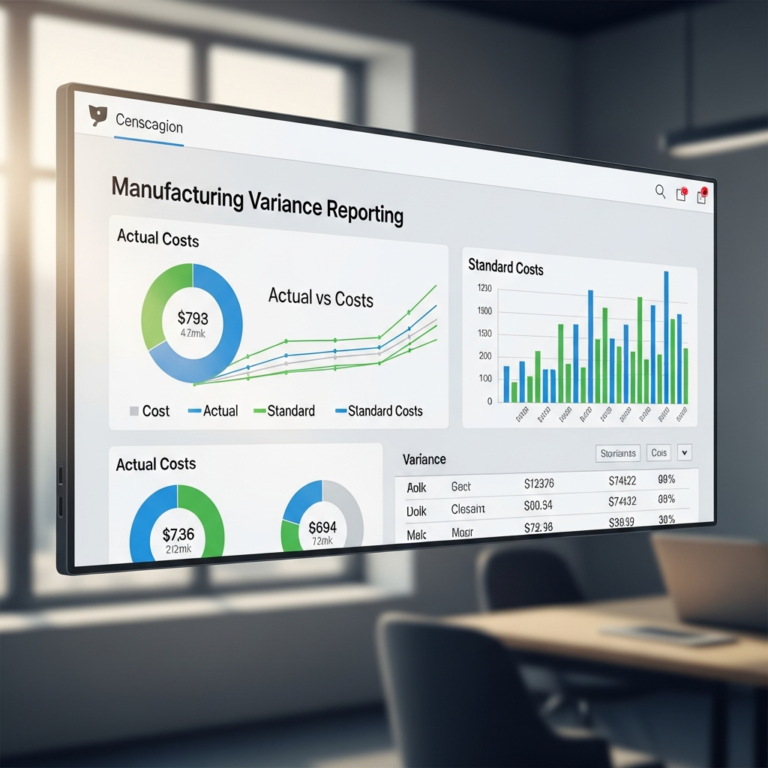
Step 11: Conduct Cost Variance Analysis
For manufacturers using standard costing, variance analysis acts as a diagnostic tool for factory efficiency. It highlights exactly where production deviated from expectations.
Atomic Definition: Cost variance analysis is the practice of comparing actual incurred production costs against predetermined standard costs to identify operational inefficiencies.
- Purchase Price Variance (PPV): Analyze differences between the standard cost of raw materials and the actual price paid to suppliers, identifying inflation or purchasing issues.
- Material Yield Variance: Review whether the factory consumed more raw material than expected to produce a given number of units (indicating excessive scrap or waste).
- Labor Rate Variance: Compare the standard expected labor cost against actual payroll data, uncovering issues like excessive overtime or utilizing higher-paid workers for basic tasks.
Step 12: Generate and Review Final Financial Statements
The culmination of the 12-step process is the production of the financial statements. These documents inform leadership, investors, and lenders about the health of the company.
- Produce Core Reports: Generate the Income Statement (P&L), Balance Sheet, and Statement of Cash Flows.
- Conduct Executive Review: Have the Controller or CFO conduct a final, high-level analytical review to spot unusual margin fluctuations or balance sheet anomalies.
- Lock the Period: Once all reviews are approved, officially lock the accounting period in your ERP to prevent any further journal entries or alterations.
Common Challenges in the Manufacturing Month End Close
Even with a perfect checklist, manufacturers face unique, systemic hurdles. Acknowledging these challenges is the first step toward building a more resilient accounting team.
Inaccurate Inventory Valuation
Inventory represents one of the largest assets on a manufacturer’s balance sheet. When valuation goes wrong, the entire financial picture is distorted.
- ERP vs. Reality: Addressing discrepancies between pristine ERP data and actual, messy floor counts is a constant battle. This often requires tedious root-cause analysis to figure out why the system drifted from reality.
- The Scrap Problem: Unrecorded scrap, rework, or spoilage silently eats away at the bottom line. When floor workers fail to log scrapped materials, the system assumes those assets still exist, artificially inflating inventory value.
- Fluctuating Material Costs: Volatile supply chains make it difficult to maintain accurate standard costs. Rapidly changing prices for steel, lumber, or electronic components require constant revaluation to prevent massive end-of-month variances.
Delayed Data from the Shop Floor
Accounting moves at the speed of data. If the shop floor operates via paper routing slips and manual data entry, the finance team is forced to wait.
- Lagging Consumption Data: How lagging data entry for raw material consumption delays the entire financial close process is a tale as old as time. If a job is finished on Friday, but the paperwork isn’t entered until Tuesday, the weekend month-end close is severely compromised.
- Missing Timesheets: Tracking direct labor relies entirely on workers clocking in and out of specific production jobs accurately. Missing or inaccurate timesheets force accountants to guess or spend hours chasing down floor supervisors.
- Paper-Based Bottlenecks: Relying on physical clipboards means paperwork can get lost, stained, or misread. Transitioning to digital, tablet-based floor reporting is often the only way to cure this bottleneck.
Complex Overhead Allocation Methods
Overhead is inherently subjective. Deciding how to spread indirect costs across diverse product lines causes endless headaches for manufacturing controllers.
- Dynamic Production Environments: Overcoming the difficulties of updating overhead absorption rates in dynamic production environments requires constant vigilance. If production volume suddenly drops, standard overhead rates will fail to absorb actual fixed costs, leading to under-absorption.
- Choosing the Wrong Driver: Allocating overhead based entirely on direct labor hours is increasingly inaccurate in highly automated facilities. Shifting to machine hours or Activity-Based Costing (ABC) is more accurate but much harder to maintain.
- Cost Creep: Factory rent, electricity, and indirect supervisor salaries rarely stay static. Failing to frequently audit and adjust the total overhead pool results in wildly inaccurate COGS calculations over time.
Essential Manufacturing KPIs to Review Post-Close
The close process isn’t just an exercise in compliance; it generates the data necessary to run the business. Once the books are locked, executives should immediately review these key performance indicators.
Gross Profit Margin by Product Line
Looking at overall company profitability is rarely enough. Manufacturers must understand exactly which products are paying the bills.
Atomic Definition: Gross profit margin by product line is a profitability metric that reveals the percentage of revenue remaining for a specific product category after deducting the direct costs of producing it.
- Identify Winners and Losers: Analyzing which specific SKUs or product categories are driving profitability helps executives double down on success. Conversely, it highlights resource-draining products that may need price hikes or discontinuation.
- Monitor Pricing Strategies: Comparing current margins against historical data ensures that rising material or labor costs are being appropriately passed on to the customer.
- Evaluate Cost Reductions: It allows management to see if recent factory efficiency initiatives actually translated into real financial savings at the product level.
Inventory Turnover Ratio
Cash trapped in a warehouse cannot be used to grow the business. Keeping inventory moving is vital for manufacturing survival.
Atomic Definition: Inventory turnover ratio is a financial metric showing how many times a company has sold and replaced its total inventory over a specific period.
- Prevent Obsolescence: Measuring how efficiently the factory is cycling through its raw materials and finished goods is critical to preventing obsolete, dead inventory.
- Optimize Purchasing: A low turnover ratio indicates over-purchasing or slowing sales, prompting procurement teams to slow down inbound raw material orders.
- Improve Cash Flow: High turnover means cash is moving quickly from raw material purchases back to collected customer payments, greatly easing working capital constraints.
Yield Variance and Scrap Rates
Efficiency on the factory floor directly dictates financial success. Tracking waste is the fastest way to spot broken processes.
Atomic Definition: Yield variance measures the difference between the actual amount of finished product generated from a batch of raw materials versus the expected, standard amount.
- Evaluate Process Efficiency: Evaluating the efficiency of the production process by tracking the amount of wasted material per production run holds floor managers accountable.
- Identify Machinery Issues: A sudden spike in scrap rates often points to poorly calibrated machinery or failing equipment that requires immediate maintenance.
- Assess Training Needs: Consistently negative yield variances on specific shifts may indicate that newer employees require better training on material handling and machine operation.
Frequently Asked Questions
How long should a manufacturing month end close take?
The duration of the month-end close varies wildly depending on the size of the company and their level of technological maturity.
- Industry Benchmarks: Historically, a standard manufacturing close takes between 5 to 7 business days.
- Best-in-Class: However, best-in-class organizations utilizing modern ERPs and automated workflows can routinely achieve a 3-day close.
- The Goal: The ultimate goal is to reduce the time spent compiling data so that the finance team can spend more days actually analyzing the results.
What is the difference between a traditional close and a continuous close in manufacturing?
The modern accounting world is slowly abandoning the frantic month-end sprint in favor of a more balanced, ongoing approach.
- Traditional Close: A traditional close relies on batching tasks. Accountants wait until the month ends to begin reconciling accounts, counting inventory, and posting accruals.
- Continuous Close: A continuous close represents a shift from batching tasks to processing reconciliations and leveraging automation continuously throughout the month.
- The Benefit: By validating data daily (e.g., daily cycle counts, daily bank recs), the continuous close drastically reduces the workload required on day one of the new month.
Which ERP features are most critical for speeding up the month-end close?
Your team is only as fast as the software they use. Legacy systems force manual workarounds, while modern ERPs automate the heavy lifting.
- Automated Three-Way Matching: Systems that automatically flag discrepancies between POs, receipts, and invoices save accounts payable teams days of manual auditing.
- Real-Time WIP Tracking: ERPs integrated with shop-floor barcode scanners or IoT devices provide real-time updates on WIP, eliminating the need to manually walk the floor to estimate completion percentages.
- Automated Overhead Distribution: Advanced software can automatically calculate and distribute overhead costs to active jobs based on daily recorded machine hours, completely removing complex, error-prone spreadsheet calculations.