Manufacturing Efficiency Ratios Link Shop Floor to Boardroom
5 Key Manufacturing Efficiency Ratios You Should Monitor Running a profitable manufacturing business requires more than just keeping the assembly line moving. You need a crystal-clear understanding of how well your resources are being transformed into actual profit. This is where manufacturing efficiency ratios come into play. Manufacturing efficiency ratios are quantifiable metrics that measure…

5 Key Manufacturing Efficiency Ratios You Should Monitor
Running a profitable manufacturing business requires more than just keeping the assembly line moving. You need a crystal-clear understanding of how well your resources are being transformed into actual profit. This is where manufacturing efficiency ratios come into play.
Manufacturing efficiency ratios are quantifiable metrics that measure how effectively a manufacturing company utilizes its operational assets, inventory, and labor to produce goods and generate revenue. By tracking these numbers, you create a vital link between the physical activity on the shop floor and the financial statements reviewed in the boardroom. Connecting operational data to financial reporting is crucial for evaluating overall business health.
Without this connection, it is incredibly difficult to identify hidden waste, justify new equipment purchases, or drive continuous improvement. When finance and operations speak the same language, the entire organization benefits from smarter, data-driven decisions.
In this comprehensive guide, we will break down the top five efficiency ratios that your finance and operations teams must track. You will learn exactly how to calculate them, understand their financial impact, and discover best practices for reporting on them effectively.
Why Tracking Manufacturing Efficiency Ratios is Critical for Financial Health
Many manufacturers struggle because their financial and operational departments operate in isolated silos. Accountants look at spreadsheets, while plant managers look at machine output. Tracking efficiency ratios bridges this divide, ensuring both teams are working toward the exact same goals.
Bridging the Gap Between Operations and Finance
Efficiency ratios act as a universal translator for your manufacturing business. They successfully translate physical production activity—like machine run times and material usage—into tangible financial outcomes. This shared visibility is essential for holistic business growth.
When operations can prove their efficiency using financial terms, it becomes much easier to secure budgets for facility upgrades or new hires. Conversely, when finance teams understand the operational metrics behind the numbers, they can set more realistic budgets.
To successfully bridge this gap, teams should look at metrics that provide a complete picture of the production cycle.
- Cost visibility: Ratios reveal the true cost of production delays.
- Resource allocation: Capital can be directed to the highest-performing product lines.
- Goal alignment: Compensation and bonuses can be tied to metrics that benefit both departments.
Identifying Bottlenecks and Reducing Waste
Efficiency ratios are the ultimate diagnostic tools for spotting operational bottlenecks. Tracking these metrics highlights idle assets, supply chain delays, and excess material waste before they cripple your margins. This aligns perfectly with the principles of lean manufacturing.
If a specific ratio suddenly dips, it acts as an early warning system. Management can investigate the production line to see if a machine requires maintenance or if a supplier is delivering sub-par materials. Identifying these issues early prevents minor hiccups from turning into major financial losses.
Furthermore, a relentless focus on waste reduction directly benefits your bottom line. You can identify specific areas of waste by tracking:
- Idle time: Machines running without producing goods.
- Scrap materials: Raw materials ruined during the production process.
- Overproduction: Manufacturing more products than the market currently demands.
Enhancing Profit Margins and Cash Flow Forecasting
There is a direct correlation between high manufacturing efficiency and the ability to free up working capital. When your facility produces goods faster and with fewer errors, your cost per unit drops significantly. This automatically widens your profit margins without requiring a price increase for your customers.
Additionally, highly efficient operations lead to highly predictable output. Predictability is the cornerstone of accurate cash flow forecasting. When finance teams know exactly how long it takes to turn raw steel into a sellable product, they can accurately predict when cash will hit the bank.
This improved cash flow forecasting allows companies to be proactive rather than reactive.
- Debt reduction: Extra working capital can be used to pay down high-interest loans.
- Strategic reinvestment: Freed-up cash can fund research and development for new product lines.
- Supplier negotiations: Predictable cash flow allows you to negotiate better bulk rates or early-payment discounts with vendors.
The 5 Key Manufacturing Efficiency Ratios
To get a comprehensive view of your operational and financial health, you need to track the right data. While there are dozens of metrics you could monitor, a select few provide the highest strategic value. Here are the top five manufacturing efficiency ratios you should be tracking.
1. Inventory Turnover Ratio
Inventory is often a manufacturer’s largest operational asset, but it is also a massive liability if it sits unsold. The Inventory Turnover Ratio measures how many times a company has sold and replaced its inventory over a given period.
Atomic Definition: The Inventory Turnover Ratio calculates the number of times a company’s inventory is sold and replaced over a specific time period.
Formula: Cost of Goods Sold (COGS) / Average Inventory
To calculate this, you divide your Cost of Goods Sold by your Average Inventory (which is usually the beginning inventory plus ending inventory, divided by two). A higher ratio generally indicates strong sales and highly efficient inventory management. A lower ratio suggests overstocking, obsolete products, or a sudden drop in market demand.
Financial Impact:
This ratio indicates the exact speed at which raw materials and finished goods are converted into actual sales. Monitoring this prevents capital from getting tied up in dead stock taking up valuable warehouse space.
When your Inventory Turnover Ratio is optimized, the financial benefits are substantial:
- Reduced holding costs: Less money spent on warehousing, utilities, and inventory insurance.
- Lower risk of obsolescence: Products are sold before they expire, rust, or become outdated.
- Increased liquidity: Cash is quickly freed up to cover payroll, utilities, and immediate operational expenses.
2. Asset Turnover Ratio
Manufacturing is a highly capital-intensive industry, requiring heavy investments in facilities, robotics, and complex machinery. The Asset Turnover Ratio tells you how well those expensive investments are paying off.
Atomic Definition: The Asset Turnover Ratio measures the value of a company’s sales or revenues generated relative to the value of its total assets.
Formula: Net Sales / Average Total Assets
You calculate this by dividing your Net Sales by your Average Total Assets. A ratio of 1.5, for example, means that for every dollar invested in assets, the company generates $1.50 in sales. This metric is closely watched by investors and lenders to gauge management’s efficiency.
Financial Impact:
This ratio explains how effectively the company is using its heavy machinery, facilities, and equipment to generate revenue. If a company invests millions in a new automated assembly line, this ratio should ideally increase. If the ratio drops, it means the new equipment is underutilized and failing to generate proportional sales.
Tracking Asset Turnover helps finance teams make crucial decisions regarding future expenditures.
- Divesting idle assets: Identifying equipment that should be sold off to recoup cash.
- Justifying expansions: Proving that current assets are maxed out, making the financial case for a new facility.
- Evaluating maintenance: Showing how frequent machine breakdowns are negatively impacting total revenue generation.
3. Overall Equipment Effectiveness (OEE)
While OEE is deeply rooted in daily shop-floor operations, it is undeniably one of the most vital metrics for long-term financial health. It provides a comprehensive picture of how well your manufacturing equipment is running compared to its maximum potential.
Atomic Definition: Overall Equipment Effectiveness (OEE) is a standard metric that measures the percentage of manufacturing time that is truly productive.
Formula: Availability × Performance × Quality
To find your OEE, you multiply three distinct factors. Availability measures planned versus actual run time (accounting for breakdowns). Performance measures the actual running speed against the theoretical maximum speed. Quality measures the percentage of good parts produced versus defective ones.
Financial Impact:
Although rooted in operations, financial teams use OEE to evaluate the Return on Investment (ROI) on capital expenditures (CAPEX) for new machinery. If a million-dollar machine has an OEE of only 50%, the company is losing massive amounts of potential revenue.
Improving OEE is often the fastest way to increase factory profitability without spending a dime on new equipment.
- Unlocking hidden capacity: Getting more product out of existing machines delays the need for expensive new purchases.
- Reducing labor costs: Efficient machines require less overtime pay for workers trying to meet quotas.
- Maximizing energy usage: Machines that run efficiently waste less electricity and natural gas per unit produced.
4. First Pass Yield (FPY)
Producing goods quickly means nothing if those goods are defective. First Pass Yield measures the efficiency and quality of your production process simultaneously. It tracks how many products pass through the manufacturing process perfectly the very first time, without requiring rework or ending up as scrap.
Atomic Definition: First Pass Yield (FPY) is the percentage of manufactured products that meet quality standards on the first attempt without needing rework or repair.
Formula: Good units produced / Total units entering the process
If you start with 1,000 units of raw material and 900 perfectly finished products come off the line without any intervention, your FPY is 90%. This metric forces teams to look beyond raw speed and focus heavily on process accuracy. It is a vital health check for your quality control protocols.
Financial Impact:
A high FPY lowers the Cost of Poor Quality (COPQ), drastically reducing scrap material costs and expensive rework labor. Every time a product has to be pulled off the line for repairs, you are paying double the labor for a single sale.
The financial drag of a low First Pass Yield can devastate profit margins in several ways.
- Wasted materials: Scrapped products mean raw materials were paid for but yielded zero revenue.
- Rework labor: Paying skilled technicians to fix mistakes drains your payroll budget quickly.
- Warranty claims: A low FPY usually correlates with a higher rate of defective products reaching the customer, resulting in costly returns.
5. Return on Net Assets (RONA)
If you had to present only one metric to a board of directors, RONA is an excellent candidate. This ratio brings together the operational reality of the plant floor with the ultimate goal of the business: generating profit. It evaluates how effectively an organization utilizes its fixed assets and net working capital to create net income.
Atomic Definition: Return on Net Assets (RONA) is a financial metric that calculates how well a company uses its fixed assets and working capital to generate net income.
Formula: Net Income / (Fixed Assets + Net Working Capital)
To calculate RONA, you divide your Net Income by the sum of your Fixed Assets and Net Working Capital. A higher RONA indicates that management is doing an exceptional job of squeezing profit out of the company’s available resources. It is widely considered the ultimate litmus test for manufacturing executive performance.
Financial Impact:
RONA is the ultimate metric for manufacturing financial reporting, showing executives exactly how well the plant’s assets are generating bottom-line profit. It strips away the noise of daily operations and focuses purely on capital efficiency.
Focusing on RONA helps leadership teams optimize the entire business structure.
- Capital allocation: RONA helps pinpoint which facilities or divisions are generating the best returns, guiding future investment.
- Executive compensation: Many modern manufacturers tie executive bonuses directly to RONA improvements.
- Shareholder communication: A strong RONA proves to investors that their capital is being stewarded wisely and effectively.
Best Practices for Integrating Ratios into Financial Reporting
Calculating these efficiency ratios is only the first step. To truly benefit from them, you must integrate them seamlessly into your daily management and financial reporting routines. Doing so requires the right technology, clear communication, and proper context.
Utilizing ERP and BI Tools for Real-Time Data
The days of managing a manufacturing plant on disparate, manual spreadsheets are over. Relying on manual data entry leads to outdated information, human error, and a critical lack of visibility. To calculate metrics like OEE and FPY accurately, you need a single source of truth.
It is incredibly important to abandon manual spreadsheets in favor of integrated Enterprise Resource Planning (ERP) and Business Intelligence (BI) software. These tools automatically pull data directly from machine sensors, inventory scanners, and accounting ledgers. This creates a live, automated ecosystem of reporting.
Real-time data empowers leaders to make decisions while problems are happening, not weeks later during a month-end review.
- Automated data capture: Eliminates human data entry errors and frees up administrative time.
- Live visibility: Managers can see if a machine’s OEE is dropping in real-time and intervene immediately.
- Historical trend analysis: BI tools can track years of data to identify seasonal trends or long-term machinery degradation.
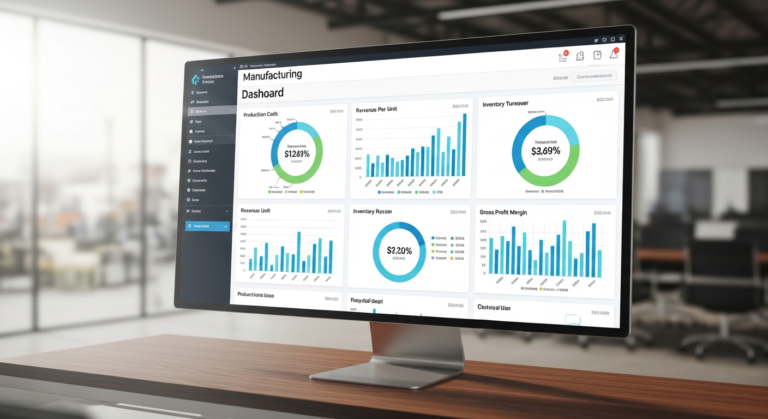
Creating Role-Specific KPI Dashboards
While total transparency is great, flooding your team with irrelevant data will cause confusion. A plant floor supervisor does not need to see the company’s Return on Net Assets on an hourly basis. Likewise, a CFO does not need to receive push notifications every time a machine has a two-minute fault.
Segment your reporting by creating role-specific KPI dashboards. Plant managers should see daily operational metrics like OEE, FPY, and machine downtime. Meanwhile, executives and finance teams should be presented with high-level financial overviews like RONA, Asset Turnover, and total working capital.
Tailoring the view ensures that every team member can focus on the metrics they directly control.
- Floor Workers: Real-time production targets, quality alerts, and daily scrap rates.
- Plant Managers: Weekly OEE, First Pass Yield trends, and labor utilization rates.
- C-Suite & Finance: Monthly Inventory Turnover, Asset Turnover, and RONA.
Establishing Context with Industry Benchmarks
An efficiency ratio is just a number until you give it context. A 75% OEE might sound fantastic to a new plant manager, but it might be terribly low for your specific sector. Ratios mean nothing in a vacuum; you must evaluate them against reality.
It is critically important to compare your internal metrics against standard manufacturing industry benchmarks. Utilize resources like the National Association of Manufacturers (NAM) or analyze competitors with similar NAICS codes to find baseline averages. This comparison tells you whether you are leading the pack or falling behind.
Benchmarking provides realistic goals for your teams to strive toward.
- Setting realistic KPIs: Avoid demotivating staff with impossible goals by targeting industry-standard top-quartile performance.
- Identifying competitive advantages: If your Inventory Turnover is double the industry average, you have a distinct operational advantage to leverage.
- Guiding strategic pivots: If you continuously lag behind benchmarks despite your best efforts, it may be time to overhaul your production processes.
Common Pitfalls to Avoid When Measuring Manufacturing KPIs
Even with the best intentions and the most advanced software, companies frequently mismanage their efficiency ratios. Falling into these common traps can lead to wasted effort and severely misguided business strategies. Keep an eye out for these frequent pitfalls.
Measuring Too Many Ratios at Once
Modern BI software makes it incredibly easy to track hundreds of different data points simultaneously. However, presenting leadership with a 50-page dashboard of metrics usually leads to absolute “analysis paralysis.” When everything is treated as important, nothing is treated as important.
Companies should focus on a few high-impact metrics first, establishing a strong baseline before expanding. Start with the five ratios listed in this guide. Once your team has mastered improving these core metrics, you can begin tracking secondary or tertiary data points.
Siloing Financial and Operational Data
Data accuracy suffers massively when finance teams and plant floor managers refuse to communicate. If operations uses one system to track scrap and finance uses another to track material costs, the final reports will inevitably conflict. This creates a culture of finger-pointing rather than problem-solving.
Leadership must force collaboration to ensure data consistency across the organization.
- Cross-departmental meetings: Mandate a weekly brief where finance and operations review the exact same dashboard.
- Unified software: Ensure both teams are pulling their data from the exact same ERP instance.
- Shared definitions: Ensure everyone agrees on how a metric like “downtime” is formally defined and measured.
Focusing Solely on Efficiency over Quality
It is incredibly tempting to focus all your energy on speeding up the assembly line to improve your Asset Turnover Ratio. However, this is a dangerous game. Speeding up production without adjusting your quality control will inevitably destroy your First Pass Yield.
There is a massive risk in prioritizing speed and efficiency at the direct expense of product quality. Faster production lines often lead to higher scrap rates, more warranty claims, and damaged brand reputation. Always balance efficiency ratios (like turnover) with quality ratios (like FPY) to ensure sustainable, profitable growth.
Frequently Asked Questions (FAQ)
What is the most important efficiency ratio for a manufacturer?
The answer depends heavily on your specific business model and current challenges. However, Inventory Turnover and Overall Equipment Effectiveness (OEE) are universally critical for balancing cash flow and capacity. If you manage your inventory well and keep your machines running smoothly, overall profitability naturally follows.
How often should we review our manufacturing efficiency ratios?
The review cadence should be dictated by the nature of the metric. Operational metrics like OEE and FPY should be monitored daily or weekly to catch immediate floor-level issues. Conversely, financial-leaning ratios like RONA and Asset Turnover are best reviewed monthly or quarterly during executive strategy meetings.
How do manufacturing efficiency ratios differ from profitability ratios?
Efficiency ratios and profitability ratios look at two different stages of business success. Efficiency ratios measure how well you use your resources, assets, and labor to produce goods. Profitability ratios (like Gross Profit Margin or Net Profit Margin) measure the actual bottom-line financial gain generated from the sale of those goods.
Can small-scale manufacturers benefit from tracking these KPIs?
Absolutely. Tracking these KPIs is not just for massive, enterprise-level corporations. Scaling businesses deeply need these baseline metrics to justify future investments in new equipment or expanded facilities. Without this data, securing a small business loan or private investment for expansion is incredibly difficult.