Inventory Software for Manufacturers Compared
Comparing Fishbowl vs Cin7 vs Katana Inventory Software Navigating the Manufacturing Inventory Software Landscape Manufacturing inventory software is a digital ecosystem that tracks raw materials, work in progress, and finished goods while syncing directly with your accounting and sales channels. Upgrading to this technology is a critical milestone for any growing maker. Managing a scaling…
Comparing Fishbowl vs Cin7 vs Katana Inventory Software
Navigating the Manufacturing Inventory Software Landscape
Manufacturing inventory software is a digital ecosystem that tracks raw materials, work in progress, and finished goods while syncing directly with your accounting and sales channels. Upgrading to this technology is a critical milestone for any growing maker.
Managing a scaling manufacturing business on basic spreadsheets is a recipe for disaster. Basic accounting add-ons quickly buckle under the weight of complex production schedules, leading to stockouts, production bottlenecks, and blind spots in your cash flow. To remain competitive, you need a system built specifically for the factory floor.
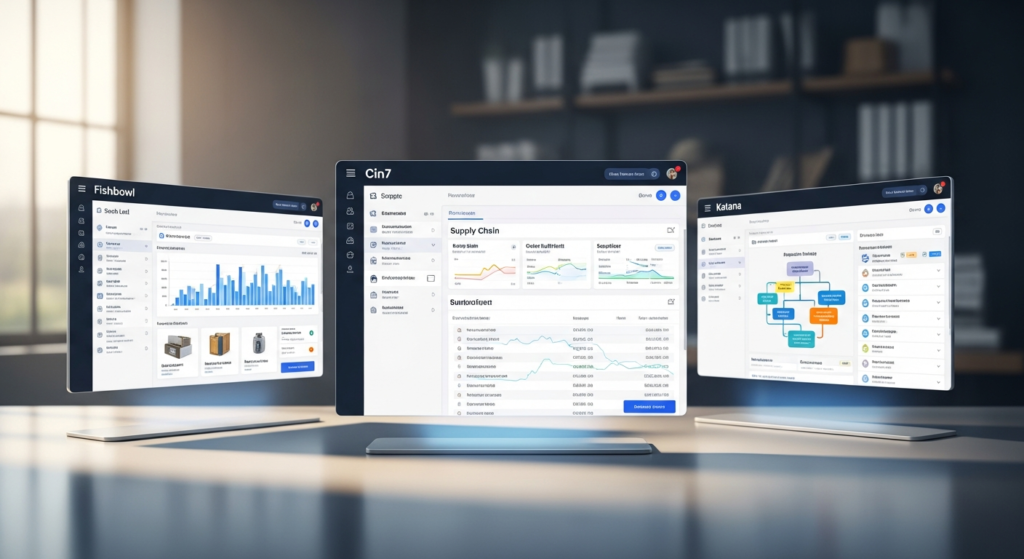
Choosing the right platform, however, can feel overwhelming with so many options on the market. This comprehensive manufacturing inventory software comparison breaks down the top three market leaders: Fishbowl, Cin7, and Katana. By the end of this guide, you will be equipped to make a confident, ROI-driven purchasing decision that perfectly aligns with your operations.
The Contenders: Pros, Cons, and Value for Money
Let’s take a closer look at the heavyweights in the manufacturing software space. Each platform brings a distinct approach to inventory control, production management, and overall business value.
Fishbowl: The QuickBooks Powerhouse
Fishbowl is a highly customizable, desktop-class inventory solution renowned for its deep, historical ties to the QuickBooks ecosystem. It acts as an advanced bridge, adding heavy-duty manufacturing and warehouse capabilities to your existing accounting software.
Pros:
- Unmatched, bi-directional QuickBooks syncing that keeps your financial ledgers flawlessly aligned with your warehouse operations.
- Advanced barcode scanning technology that streamlines warehouse picking, packing, and receiving while drastically reducing manual entry errors.
- Deeply customizable work orders and Bills of Materials (BOM) designed to handle highly complex assembly routing.
Cons:
- A steeper learning curve that requires dedicated time and resources for staff training and adoption.
- An older, more traditional user interface that lacks the sleek, modern polish of newer cloud-based applications.
- Higher upfront implementation costs and potential server requirements if you choose to host the software locally.
Value for Money:
Fishbowl shines for established companies willing to invest in a long-term, heavy-duty solution. It allows you to build a powerful on-premise or hosted system without the burden of paying premium, ongoing SaaS fees per user.
Cin7 (Core & Omni): The Omnichannel Giant
Cin7 bridges the gap between manufacturing and multi-channel retail with its robust suite of operational tools. It functions as a hybrid inventory and Point-of-Sale (POS) system specifically designed for product sellers who manufacture their own goods.
Pros:
- A native B2B portal that empowers wholesale customers to browse catalogs and place orders directly into your system.
- Built-in Electronic Data Interchange (EDI) for seamless, compliant transactions with major big-box retailers.
- Extensive e-commerce integrations that centralize sales data from Amazon, Shopify, WooCommerce, and more.
Cons:
- A complex pricing structure that can scale up quickly as you add additional users, integrations, and premium features.
- The manufacturing features can sometimes feel secondary to its incredibly robust retail, distribution, and POS capabilities.
Value for Money:
Cin7 delivers high ROI for businesses heavily focused on multi-channel retail and wholesale operations. It is well worth the investment when your inventory tracking needs to span seamlessly from the assembly line directly to the retail shelf.
Katana: The Visual Cloud MRP
Katana offers a modern, cloud-first approach to Material Requirements Planning (MRP) for the agile manufacturer. Material Requirements Planning (MRP) is a system used to calculate the materials and components needed to manufacture a product on time.
Pros:
- An extremely intuitive, color-coded visual interface that makes production scheduling and task management a breeze.
- Real-time master planning that instantly highlights inventory risks, material shortages, and delayed purchase orders.
- Flawless, plug-and-play integrations with modern tech stacks, including Shopify, Xero, and QuickBooks Online.
Cons:
- Lacks some of the legacy enterprise features and deep customizations required by massive, traditional manufacturing plants.
- Essential warehouse tools, like barcode scanning and multi-location management, are gated behind their higher-tier pricing plans.
Value for Money:
Katana offers outstanding value for modern, growing makers and direct-to-consumer (D2C) brands. It is the absolute go-to choice for teams looking for rapid deployment, zero hardware costs, and immediate workflow visibility.
Who This Is For: Matching the Software to Your Operations
Not every software is built to support every type of business model. Here is how to match the unique strengths of these platforms to your specific daily operations.
Who Should Choose Fishbowl
Fishbowl is the undisputed champion for mid-market, traditional manufacturers. It is the ideal choice if your back-office relies heavily on QuickBooks Desktop or Enterprise and you refuse to migrate away from it.
This software is best for operations that require rigorous batch tracking, expiration date management, and highly complex Bills of Materials. If your factory floor relies on intricate, multi-stage production phases with sub-assemblies, Fishbowl can easily handle the heavy lifting.
Who Should Choose Cin7
Cin7 is the perfect fit for omnichannel manufacturers who act as both makers and aggressive sellers. It is ideal if you are distributing products via big-box retailers, private B2B portals, and multiple e-commerce storefronts simultaneously.
You should choose Cin7 if you need a singular system that acts as both a light ERP and a retail management hub. By choosing this omnichannel giant, you eliminate the need to staple a third-party POS or EDI tool onto your manufacturing software.
Who Should Choose Katana
Katana was built from the ground up for small to mid-sized modern manufacturers, D2C brands, and craft makers. It is highly recommended for visual thinkers who want a clean, drag-and-drop interface instead of staring at endless spreadsheets.
Choose Katana if you want zero implementation headaches, ultimate cloud flexibility, and real-time shop floor control. It is by far the easiest system to roll out to an agile production team without disrupting daily output.
Buyer’s Guide: Evaluating Your Next Inventory Investment
Buying inventory software is a major strategic move that will impact your business for years to come. Consider these critical operational factors before signing a contract or starting a data migration.
Assessing Accounting Integrations
Your manufacturing software must communicate flawlessly with your financial ledger. A bi-directional sync with QuickBooks, Xero, or Sage is absolutely non-negotiable for growing businesses.
A bi-directional sync means data flows back and forth between two systems, ensuring both platforms always reflect the most current information. This constant communication is vital for calculating accurate Cost of Goods Sold (COGS). It also ensures total tax compliance by keeping your inventory asset values perpetually updated on your balance sheet.
Analyzing Production Control and BOM Flexibility
The heart of any successful manufacturing system is how efficiently it handles the Bill of Materials (BOM). A Bill of Materials is a comprehensive list of raw materials, sub-assemblies, and quantities required to build a finished product.
You must evaluate how each platform handles multi-level BOMs, where a component itself requires its own dedicated sub-assembly. Look for software that supports auto-assembly triggers, which automatically create work orders when finished goods stock dips below minimum levels.
Additionally, you must assess their work-in-progress (WIP) tracking capabilities. You need granular, real-time visibility into exactly where materials are tied up on the shop floor at any given moment.
Implementation Time vs. Total Cost of Ownership (TCO)
Do not make the mistake of only looking at the monthly subscription fee; you must consider the hidden costs of onboarding. Total Cost of Ownership (TCO) includes software fees, implementation consultants, hardware upgrades, and staff training time over the lifespan of the software.
Cloud platforms like Katana often boast frictionless, self-guided setups that can have you running in a matter of days. This rapid deployment significantly lowers your initial TCO and minimizes costly operational downtime.
Conversely, legacy systems like Fishbowl usually require consultant-led implementation and sometimes dedicated local servers. While this requires a larger upfront investment of time and capital, the long-term payoff in deep customization can be highly lucrative for complex operations.
Frequently Asked Questions
What is the most cost-effective manufacturing inventory software for a small business?
For smaller operations, cloud-based software like Katana generally offers the most cost-effective starting point. It provides a lower barrier to entry with predictable, tiered monthly pricing and absolutely zero hardware requirements.
Desktop software like Fishbowl might have steeper upfront costs for initial licenses and professional setup. However, it can sometimes be more cost-effective over a decade since you aren’t forced to pay a premium SaaS fee per user every single month.
Can these platforms handle multi-warehouse inventory?
Yes, all three platforms are fully equipped to manage inventory across multiple geographic locations. Multi-warehouse inventory management is the ability to track, transfer, and fulfill stock across several distinct physical facilities.
Fishbowl offers incredibly granular location tracking, allowing you to monitor items down to the specific bin or shelf level. Cin7 excels at intelligently routing e-commerce orders to the warehouse closest to the customer, while Katana makes internal stock transfers highly visual and easy to execute.
Do I need an ERP, or is manufacturing inventory software enough?
An Enterprise Resource Planning (ERP) system is an all-in-one software suite that manages entire business operations, including HR, payroll, and CRM, alongside inventory.
Dedicated inventory and MRP tools (like Fishbowl, Cin7, and Katana) are usually more than enough for small to mid-sized manufacturers. They integrate seamlessly with your existing accounting and sales tools, keeping your tech stack costs much lower than a full-scale ERP.
Upgrading to a massive ERP like NetSuite is only necessary when you have hundreds of employees, complex global tax requirements, and the budget to support a six-figure implementation. Stick to manufacturing inventory software to avoid costly over-purchasing.
The Verdict: Which Software Delivers the Best ROI?
The Final Recommendation Summary
Choosing the right software comes down to prioritizing your biggest operational bottlenecks. Each of these three platforms excels in a completely different arena of the manufacturing world.
Buy Fishbowl if you demand heavy-duty customization and an unbreakable, legacy bond with QuickBooks Desktop. Buy Cin7 if you are conquering the retail space and need B2B, EDI, and omnichannel sales dominance. Buy Katana if you crave a modern, intuitive cloud experience that gets your manufacturing team organized instantly.
Next Steps for the Buyer
Do not let your business outgrow your operational tools for another day. You now have the professional insights needed to choose a platform that aligns with your factory’s specific DNA.
Take action today by mapping out your current workflows and identifying your most expensive pain points. Then, book a demo or start a free trial with the software that best fits your “Who This Is For” profile above to take control of your production floor.