Digital Twin in Manufacturing: Predict Asset Failure
Digital twin technology provides asset-intensive manufacturers with real-time machine data for managing maintenance costs. A live IoT-based replica of physical machinery enables financial controllers and operations managers to shift maintenance from reactive OpEx to a planned cost center with tighter controls. In financial terms, the targets are specific: labor efficiency variances, standard machine-hour rates, and…
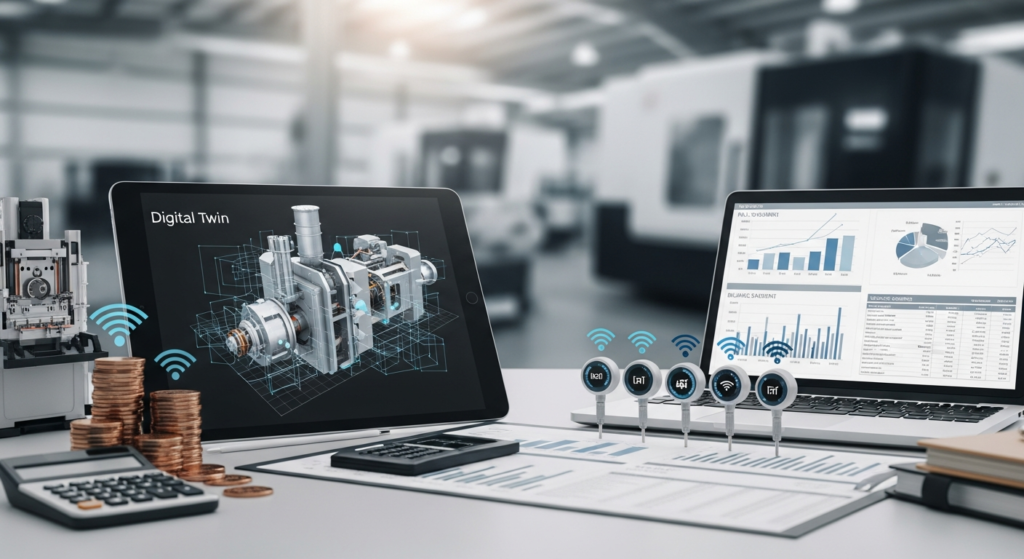
Digital twin technology provides asset-intensive manufacturers with real-time machine data for managing maintenance costs. A live IoT-based replica of physical machinery enables financial controllers and operations managers to shift maintenance from reactive OpEx to a planned cost center with tighter controls. In financial terms, the targets are specific: labor efficiency variances, standard machine-hour rates, and fixed overhead absorption, all affected by unplanned equipment failure.
This guide sets out the finance and accounting protocols and workflows for deploying a digital twin, using a discrete manufacturing scenario based on a $40M-turnover aluminum casting and component assembly business.
Prerequisites for Your Digital Twin: Financial and Operational Baseline
Before finance approves capital allocation, the project requires a formal cost-benefit analysis and infrastructure audit.
Essential Hardware and IoT Sensors
- CapEx vs. OpEx Protocol: Classify hardware, including vibration, acoustic, and thermal sensors, as well as edge computing devices. Per standard capitalization thresholds (e.g., >$2,500), bundle these into a single Capital Work in Progress (CWIP) account during the build phase.
- Asset Useful Life: If the retrofit demonstrably extends the asset’s remaining service life or reduces expected failure risk, reassess depreciation schedules on the existing fixed asset register.
Software and Analytics Platforms
- Cloud/SaaS Integration: Ensure IoT platforms (AWS/Azure) and CAD mapping software exchange data reliably with the existing ERP. This supports automated BOM rollups and current standard-cost updates. SaaS fees must be budgeted as periodic OpEx.
IT/OT Infrastructure and Cloud Storage
- Network Upgrades: Establishing high-bandwidth operational technology (OT) networks often requires localized CapEx. Finance must validate the return on invested capital (ROIC) against historical downtime costs.
Cross-Functional Team Expertise
- Labor Reclassification: Divert plant engineers, IT staff, and cost accountants to the project. Their payroll costs during the implementation phase should be tracked using specific project codes to capitalize internal labor associated with software/system development, adhering to GAAP/IFRS standards.
Implementation Workflow: Predictive Asset Management
Scenario Context: The scenario is a $40M discrete aluminum casting manufacturer operating a bottleneck 1,200-ton high-pressure die-casting machine. Historically, sudden hydraulic failures have caused 48 hours of unplanned downtime each quarter, resulting in material overhead under-absorption and significant labor efficiency variances.
Step 1: Define the Scope and Establish Baseline Data
Isolate the most critical bottleneck asset. Do not attempt a multi-machine rollout.
- Financial Workflow: Pull historical maintenance work orders, MRO (Maintenance, Repair, and Operations) inventory usage on a FIFO basis, and scrap material variance reports for the targeted die-casting machine.
- Control Matrix: Establish a baseline “cost of failure” (e.g., $18,500 per hour in lost throughput and idled direct labor). Install edge sensors to capture baseline thermal and vibration telemetry during normal production runs.
Step 2: Build the Virtual Geometric Model
Map the physical asset to a 3D digital model.
- Workflow: Operations provides existing CAD files; external contractors map the physical dimensions.
- Accounting Treatment: Treat initial mapping contractor costs as capitalized system development, amortizing them over the expected 5-7 year life of the digital twin system.
Step 3: Integrate Real-Time Data Streams
Pipe IoT telemetry into the virtual model and the ERP system.
- ERP Linkage: Connect the machine’s actual runtime data to the ERP’s shop floor control module. This replaces manual operator log-ins and tightens the accuracy of actual vs. standard machine hours used in absorption costing.
Step 4: Train and Apply Machine Learning Algorithms
Use AI to detect minor anomalies, such as a 2-degree heat spike in a hydraulic pump, before they become failures.
- Inventory Effect: When the ML model predicts specific part failures weeks in advance, purchasing can transition MRO inventory from a “just-in-case” bloated stockpile to a “just-in-time” model. This reduces MRO holding costs and frees up working capital.
Step 5: Establish Automated Workflows and Alerts
The digital twin must trigger specific work orders and alerts, not just data dashboards.
- CMMS Integration: When an anomaly is detected, the system auto-generates a preventative work order in the CMMS.
- Audit Trail: The ERP automatically allocates the maintenance labor and MRO parts to a specific preventative maintenance general ledger account. Controllers get auditable detail on predictive vs. reactive maintenance spend ratios.
Implementation Risks and Controls
Overcomplicating the Initial Scope (Capital Blowouts)
- Risk: Attempting a factory-wide digital twin deployment. In a previous rationalization of a $60M international manufacturing footprint, site managers attempted to digitize 40 machines simultaneously. The result was a $1.2M CWIP write-off.
- Control: Enforce a strict pilot on a single bottleneck asset. Require a post-implementation financial audit validating the expected ROI before releasing funds for Phase 2.
Neglecting Data Quality and Cleansing (Corrupted Variances)
- Risk: Feeding unsynchronized sensor data into the ERP, leading to false standard cost updates and phantom labor efficiency variances.
- Control: Implement strict IT internal controls. Validate data streams against manual cycle counting controls during the first 90 days to ensure virtual data matches physical reality.
Siloing IT, OT, and Finance
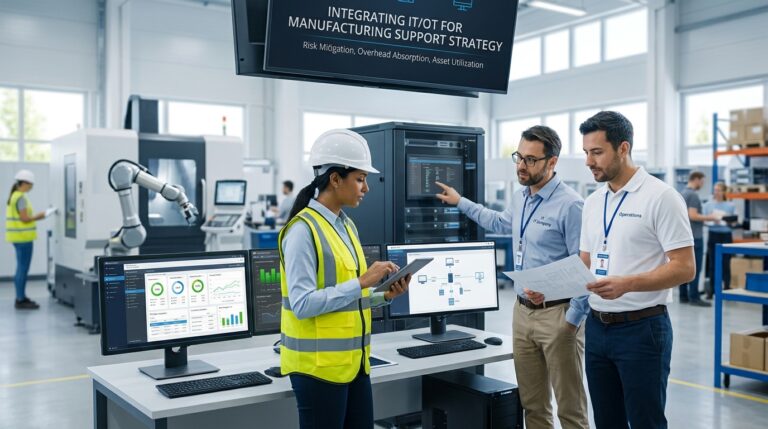
- Risk: Treating this as an IT science project. If cost accountants are excluded, the business fails to capture automated BOM rollups or adjust standard overhead rates based on improved machine uptime.
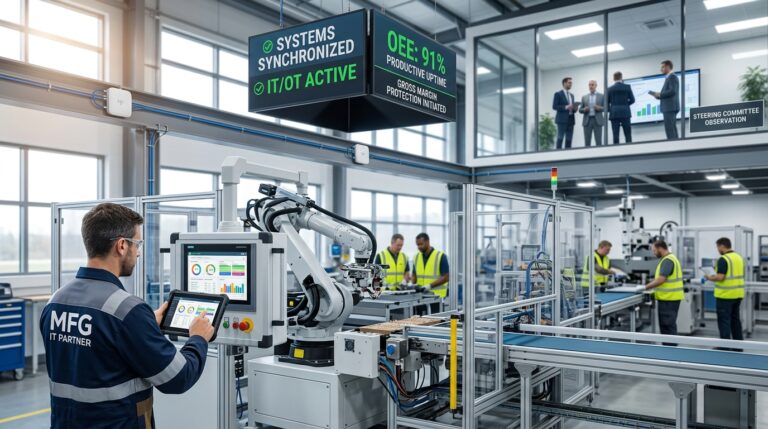
- Control: Mandate weekly cross-functional steering committee meetings. Finance must translate OT uptime improvements into revised standard costs for next year’s budget.
Overlooking Cybersecurity Vulnerabilities
- Risk: Connecting legacy industrial assets to cloud networks without properly configured firewalls and network segmentation, risking plant-wide shutdowns via ransomware.
- Control: Configure the digital twin deployment to meet IT audit standards, such as SOC 2 and ISO 27001. Treat cyber risk as a material financial risk on the corporate risk register.
Expected Effects on the P&L and Balance Sheet
Real-Time Asset Records and Month-End Close
When real-time twin data feeds the ERP, finance can support a strict 5-day month-end close by reducing manual maintenance accruals and WIP estimates. Machine states and MRO consumption are recorded continuously, so finance can rely on system evidence instead of late invoice estimates or manual shop-floor updates.
Automated Anomaly Detection: Financial Effect Matrix
| Metric | Pre-Digital Twin (Reactive) | Post-Digital Twin (Predictive) | Financial Effect |
|---|---|---|---|
| Unplanned Downtime | 192 hours/year | 14 hours/year | +$850,000 Volume Variance |
| MRO Inventory (FIFO) | $450,000 static holding | $180,000 JIT holding | +$270,000 Working Capital |
| Labor Efficiency | Highly unfavorable variances | Reduced idle time | Improved Gross Margin by 2.4% |
| Overhead Absorption | $300k Under-absorbed | Materially lower under-absorption | Favorable fixed cost recovery |
More Reliable Production Cycles
With unplanned downtime reduced, plant managers can use the digital twin to run scenario simulations. Finance can model P&L and cash forecasts around higher production speeds while staying within equipment limits. The business also gains up-to-date production and cost data for negotiating improved customer contract terms based on guaranteed delivery schedules.
Executive Questions
What is the financial distinction between a Digital Twin and a standard simulation?
Standard simulations use static standard costs and historical assumptions. A digital twin uses live telemetry. If a machine degrades, the digital twin feeds that change into current variance analysis, allowing controllers to update pricing assumptions and cash flow forecasts sooner.
What is the realistic capital requirement and payback period?
For a discrete manufacturer, retrofitting a single heavy-industrial asset, such as a die-casting machine or CNC center, requires a pilot investment of $35,000 to $65,000 (Hardware CapEx + SaaS OpEx). Assuming historical downtime costs of >$15,000/hour on bottleneck assets, the payback period is typically under 4.5 months.
Can legacy manufacturing equipment be integrated into a digital twin setup?
Yes. Retrofitting legacy assets with PLCs and edge gateways is usually cheaper compared to replacing a $2M piece of heavy machinery. If the retrofit extends the asset’s useful life, update fixed asset records and depreciation assumptions; it can defer major replacement cash outflows.