Combat Labor Shortages With Advanced Manufacturing
Why Advanced Manufacturing? Advanced manufacturing reduces reliance on premium-priced labor and standardizes output based on machine software. Labor requirements shift toward technology-based roles. Scenario Context: Discrete Manufacturing Setup Entity: Precision Outdoor Products (Discrete Manufacturer: Lawnmowers & Woodfires)Turnover: $40M p.a.Current State: 120 employees across 2 sites. High labor turnover and localized skill shortages have resulted in…
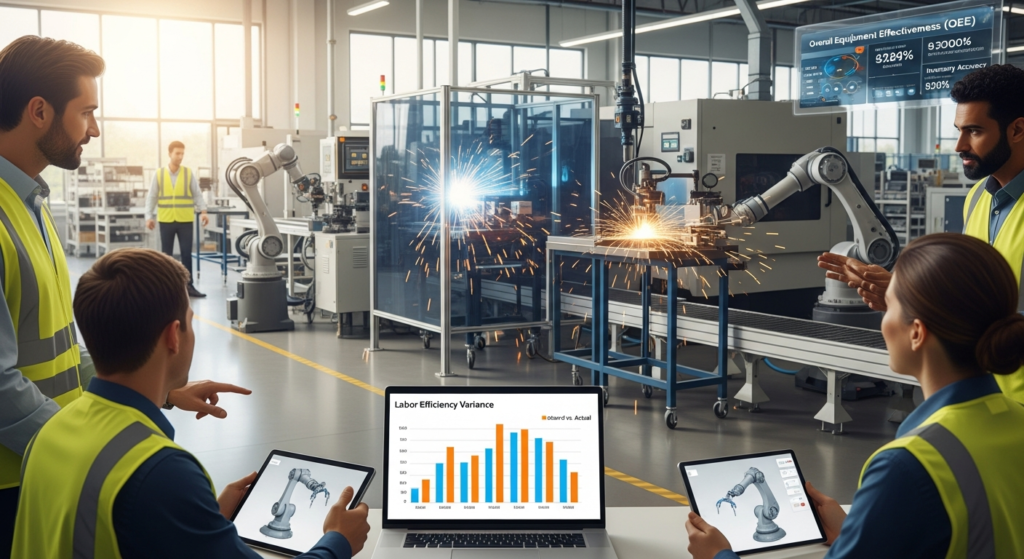
Why Advanced Manufacturing?
Advanced manufacturing reduces reliance on premium-priced labor and standardizes output based on machine software. Labor requirements shift toward technology-based roles.
Scenario Context: Discrete Manufacturing Setup
Entity: Precision Outdoor Products (Discrete Manufacturer: Lawnmowers & Woodfires)
Turnover: $40M p.a.
Current State: 120 employees across 2 sites. High labor turnover and localized skill shortages have resulted in $450K in unfavorable labor efficiency variances and $200K in unabsorbed overhead YTD due to idle capacity.
Objective: Consolidate the footprint from 2 sites to 1 and automate key sub-assemblies, including aluminum die-casting and chassis welding, to deliver >$1.4M p.a. in cost savings.
Step 1: Pre-Implementation Financial & Operational Audit
Conducting a Labor and Skills Gap Audit via Variance Analysis
Do not rely on anecdotal floor complaints. Identify labor shortages by isolating unfavorable labor efficiency and volume variances within your ERP.
- Action: Extract standard routing times versus actual times for all operational work centers. Pinpoint routing steps with recurring adverse variances.
- Shortcut: Filter your labor variance reports to isolate operations using temporary labor or excessive overtime, typically 1.5x to 2.0x standard rate. In the lawnmower plant, the chassis welding center showed a 22% unfavorable efficiency variance due to high turnover and reliance on underskilled temp workers.
Establishing IT and Infrastructure Readiness
Assess whether your current IT infrastructure can support the proposed manufacturing assets. These assets require reliable, high-volume data pipelines.
- Action: Audit current server capacities and network latency. If deploying cloud-based analytics, review OPEX subscription constraints versus CAPEX server upgrades.
- Control Check: Ensure your ERP allows API integration for edge-device data feeds. If running legacy on-premise systems, budget for middleware integration and categorize eligible build costs under Capital Work in Progress (WIP) until the asset is ready for its intended use.
Securing Leadership Approval and Budget Matrix
Build a discounted cash flow (DCF) model comparing the baseline case, including escalating direct labor costs and lost margin from unfulfilled orders, against the proposed CAPEX investment.
Investment vs. Labor Saving Matrix (Lawnmower Chassis Welding Center):
| Cost Element | Baseline (Manual Labor) | Proposed (Cobot Deployment) | Delta (Annualized) |
|---|---|---|---|
| Direct Labor (incl. burdens/overtime) | $480,000 (6 FTEs) | $160,000 (2 FTEs + 4 Cobots) | -$320,000 |
| Scrap / Rework (Material Variance) | $75,000 | $20,000 | -$55,000 |
| Equipment Depreciation (5-yr life) | $10,000 | $90,000 ($450K CAPEX) | +$80,000 |
| Software & Maintenance (OPEX) | $0 | $25,000 | +$25,000 |
| Net Financial Impact | $565,000 | $295,000 | Savings: $270,000 p.a. |
Payback period: 1.6 years. Internal Rate of Return (IRR) is expected to clear a standard 12% WACC hurdle rate.
Step 2: Selecting the Right Advanced Manufacturing Technologies
Collaborative Robots (Cobots) for Repetitive Tasks
Deploying cobots changes your cost structure from variable Direct Labor to fixed Manufacturing Overhead through depreciation.
- Accounting Impact: Standard cost routings must be updated. Standard labor hours per unit will drop, while overhead allocation rates will increase.
- Workflow: Target packaging and sub-assembly first. For aluminum casting, cobots performing machine tending can eliminate the hazard pay premiums and high turnover associated with manual extraction of hot castings.
The Industrial Internet of Things (IIoT) for Operational Visibility
IIoT sensors move factory maintenance away from reactive work, which is expensed as incurred and often carries high downtime penalties, toward predictive maintenance.
- Accounting Impact: Better machine uptime reduces unabsorbed manufacturing overhead. Real-time cycle counting controls via IIoT scales can also automate raw material consumption through backflushing, reducing physical stocktake variances.
- Workflow: Install vibration and thermal sensors on die-casting machines. Route data directly to the maintenance dashboard so repairs are scheduled locally before a mid-shift breakdown stops production.
Artificial Intelligence (AI) for Quality Control
AI machine vision systems can replace manual quality assurance lines and directly affect Bill of Materials (BOM) rollups.
- Accounting Impact: Improved first-pass yield reduces standard scrap allowances built into your BOMs. This lowers the standard cost of goods sold (COGS) and increases gross margin.
- Workflow: Install AI cameras above the lawnmower blade assembly line to detect micro-fractures, eliminate 3 manual inspection FTEs, and reduce customer return accruals.
Step 3: Developing and Executing Your Implementation Strategy
Launching a Small-Scale Pilot Program
Limit financial risk with a ring-fenced pilot before any plant-wide rollout.
- Action: Select one work center. Code all pilot costs, including hardware, freight, and integration consulting, to a specific WIP GL account. Do not begin depreciating the asset until engineering sign-off confirms the asset is ready for its intended use.
- Shortcut: Maintain the existing standard cost routing during the 30-day pilot and book the efficiency gains as favorable manufacturing variances. Update standard costs only after the pilot establishes a reliable baseline.
Integrating New Tech with Legacy Systems
Edge computing often provides the connection between legacy PLC machines and modern ERP/analytics.
- Action: Ensure IT and Finance agree on capitalizing integration software development under ASC 350-40 for Internal-Use Software. Maintenance of legacy systems must remain OPEX.
Upskilling Your Current Workforce
Automation changes labor classification. Operators become technicians.
- Action: Reclassify these wages from variable Direct Labor to fixed or semi-variable Indirect Labor in your P&L. Training costs incurred during the setup phase should generally be expensed immediately, avoiding unsupported capitalized assets.
Step 4: Common Mistakes to Avoid
Implementing Technology Without an Implementation Roadmap
The Mistake: Purchasing technologies that are not tied to constrained resources.
The Consequence: Capitalizing assets that do not improve throughput, leading to stranded assets and future impairment write-downs. If a cobot speeds up step A, but step B is the actual bottleneck, overall plant output remains static. You incur depreciation without generating incremental revenue.
Neglecting Employee Communication
The Mistake: Failing to manage floor-level change.
The Consequence: Intentional slowdowns or strikes, along with the premature loss of critical tacit knowledge. Financially, this appears as severe unfavorable volume variances and unabsorbed overhead. Secure the transition by communicating specific upskilling roles and adjusting incentive bonus structures to weight machine uptime and OEE more heavily than manual piece-rates.
Underestimating Cybersecurity Vulnerabilities
The Mistake: Connecting IIoT sensors directly to the primary corporate network without segmentation.
The Consequence: A ransomware attack halts production. In addition to lost revenue, poor IT General Controls (ITGC) will result in audit deficiencies. Ensure tested firewalls and data encryption protocols are validated by external IT auditors prior to go-live.
Step 5: Final Result: Measuring Success and Scaling Up
Tracking Key Performance Indicators (KPIs)
Tie operational metrics directly to the monthly 5-day financial close.
- Overall Equipment Effectiveness (OEE): Directly correlates to overhead absorption. Higher OEE = Favorable Volume Variance.
- Labor Efficiency Variance: Should move to a sustained favorable position as direct standard hours decrease.
- Inventory Accuracy: IIoT and automated material handling should tighten physical-to-perpetual inventory counts. If managing FIFO, automated routing minimizes inventory obsolescence write-offs.
Analyzing the Impact on Labor Dependency
Post-implementation, review the monthly P&L and cash flow forecasts. For the lawnmower plant, reducing headcount from 120 to 85 through natural attrition and role shifts, while increasing output capacity by 15%, shows that output can grow without proportional direct labor growth.
Scaling the Deployment Across the Enterprise
Once ROI is validated at Site A, use the developed Standard Operating Procedures (SOPs) to replicate the tech at Site B.
- Expected Outcome: Use this documented rollout model to support plant rationalization. By proving higher throughput per square foot via automation, you can justify consolidating the $40M operation from 2 sites down to 1, securing the >$1.4M overhead cost savings from rent, duplicate management, and redundant utilities.
Frequently Asked Questions
How does Advanced Manufacturing directly solve the skills gap?
Financially, advanced manufacturing reduces the need to source highly specialized, premium-priced labor, such as master welders. It standardizes the output via machine code, shifting the labor requirement to broader tech-maintenance roles. This reduces labor rate variance and lowers the risk of single-point production dependencies.
What is the typical ROI timeline for implementing industrial automation?
For mid-market discrete manufacturing with $10M-$60M turnover, targeting 12 to 24 months is standard. Calculate it by dividing total landed CAPEX, including hardware, software, integration, and training, by the annual benefit from net labor savings, reduced scrap, and margin on incremental throughput.
Are these technologies only viable for large, enterprise-level manufacturers?
No. Cloud infrastructure and Manufacturing-as-a-Service (MaaS) have shifted automation from heavily capitalized models to operational leasing models. Under IFRS 16 / ASC 842, SMEs can lease cobots on usage-based contracts, matching the cash outflow directly to production volume and preserving working capital lines for raw material procurement.