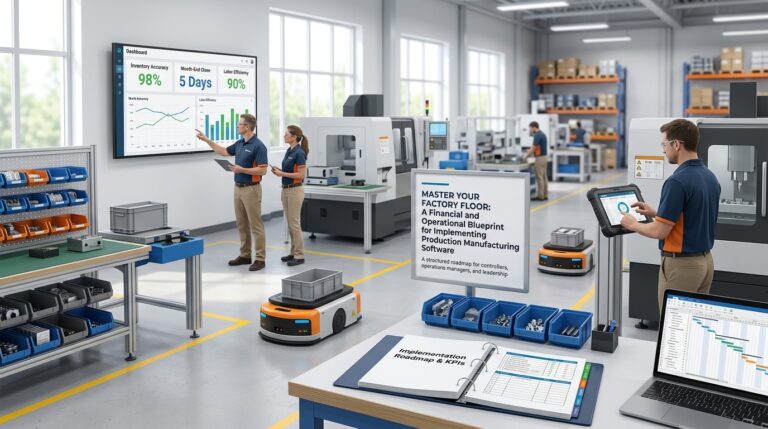
Choosing the Best Manufacturing and Distribution Software
Evaluating and deploying manufacturing and distribution software is a capital allocation and internal control exercise. Connecting factory floor operations with outbound logistics affects working capital requirements, cost of goods sold (COGS) accuracy, and standard margin realization. A suitable system protects absorption costing and keeps physical inventory aligned with the general ledger (GL), while giving planners…
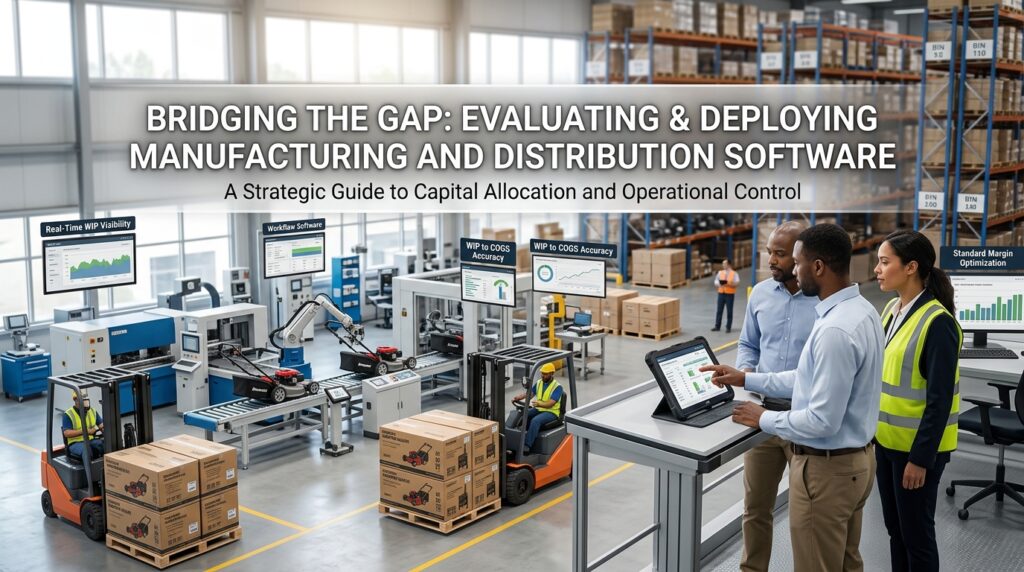
Evaluating and deploying manufacturing and distribution software is a capital allocation and internal control exercise. Connecting factory floor operations with outbound logistics affects working capital requirements, cost of goods sold (COGS) accuracy, and standard margin realization. A suitable system protects absorption costing and keeps physical inventory aligned with the general ledger (GL), while giving planners the accuracy needed to manage working capital more tightly through demand forecasting.
Use this selection plan to assess the technical, financial, and operational requirements for software in a commercial distribution and manufacturing environment.
Preparation for Software Selection
Before evaluating software vendors, establish the current-state baseline of your operational metrics and financial controls. A documented audit reduces scope creep and implementation delays.
A Clear Audit of Current Supply Chain Bottlenecks
- Workflow Mapping: Document the end-to-end lifecycle, from raw material purchase order (PO) generation to finished goods dispatch.
- Variance Analysis: Identify recurring negative variances in material yield or labor efficiency. Pinpoint physical bottlenecks that are driving excessive work-in-progress (WIP) inventory.
- Control Deficiencies: Document instances of bypassed cycle counting controls, reliance on manual Excel-based bill of materials (BOM) rollups, or frequent write-downs during annual physical stocktakes.
Input from Cross-Functional Stakeholders
- Requirements Gathering: Capture the specific needs of each function: intuitive barcoding for raw material issuance on the floor, efficient load-building and cross-docking for logistics, and automated 3-way matching (PO, receipt, invoice) with real-time variance posting for Finance.
- System Authority: Define data ownership. For example, Engineering owns the BOM routing, while Finance owns the standard cost applied to those routing centers.
A Defined Budget and Scalability Timeline
- Total Cost of Ownership (TCO): Calculate the 5-year TCO. Incorporate initial licensing (CAPEX for on-premise, OPEX for SaaS), implementation consultancy, data migration, and projected downtime costs.
- Growth Projections: Ensure the software architecture supports multi-site consolidation. (Using scalable software previously allowed me to rationalize two separate $30M manufacturing sites into one, generating >$1.4M p.a. in facility and duplicated labor savings).
Evaluation Plan: Manufacturing and Distribution Software
Step 1: Identify Required Core Capabilities
- Costing & Inventory Valuation: The system must natively support your valuation method (Standard Costing, FIFO, Moving Average) and calculate complex overhead absorption rates automatically.
- BOM & Routing: Require multi-level BOM capabilities capable of handling sub-assemblies and co-products, with direct links to shop floor labor tracking.
- Distribution Functions: Confirm that the system can manage multiple warehouses and calculate reorder points (ROP) from lead times. Put-away should be directed by rule rather than staff preference.
2: Assess System Integration and Compatibility
- ERP/GL Integration: The manufacturing execution and warehouse management modules must post sub-ledger transactions directly to the GL without manual batch uploads.
- API Architecture: Validate open APIs for connecting third-party logistics (3PL) platforms, freight forwarding tracking, and foreign exchange (FX) management systems for international sourcing operations.