Manufacturing IT Support: Why Generalists Fail
The Importance of Manufacturing IT Support to Profitability The gross margin of a manufacturing operation relies on reliable coordination between Information Technology (IT) and Operational Technology (OT). A generalist IT provider typically views a manufacturing environment as a matter of corporate data availability and email uptime. That mismatch can disrupt factory floor operations and weaken…
The Importance of Manufacturing IT Support to Profitability
The gross margin of a manufacturing operation relies on reliable coordination between Information Technology (IT) and Operational Technology (OT). A generalist IT provider typically views a manufacturing environment as a matter of corporate data availability and email uptime. That mismatch can disrupt factory floor operations and weaken Enterprise Resource Planning (ERP) data accuracy, inflating both unfavorable labor efficiency variances and unabsorbed overhead.
Moving from a generalist IT vendor to a dedicated manufacturing IT partner should be treated as an internal control that protects gross margin, rather than merely as an operational upgrade. Use the following financial and operational steps to implement specialized manufacturing IT support.
What You Need: Prerequisites for Upgrading Your IT Strategy
Before initiating an RFP (Request for Proposal) for a new IT partner, finance and operations must agree on the baseline metrics and asset valuations.
- A Full Audit of Current IT and OT Assets: Reconcile the physical plant floor technology (PLCs, HMIs, ICS, barcode scanners) with the fixed asset register. Differentiate between corporate IT assets (capitalized servers, laptops) and operational tech. Ensure depreciation schedules reflect the true useful life of plant-floor systems, which often outlast office IT but require specialized lifecycle management.
- Calculated Costs of Production Downtime per Hour: Standardize a downtime cost model. This must capture Direct Labor (idle time), Unabsorbed Manufacturing Overhead (fixed overhead spread over zero production), and variable costs (e.g., expedited freight or materials spoilage).
- A List of Industry-Specific Compliance Requirements: Map requirements like CMMC, NIST 800-171, or ISO 27001 to internal financial controls. For manufacturers with international supply chains, secure EDI (Electronic Data Interchange) compliance is required for mitigating supply chain risk.
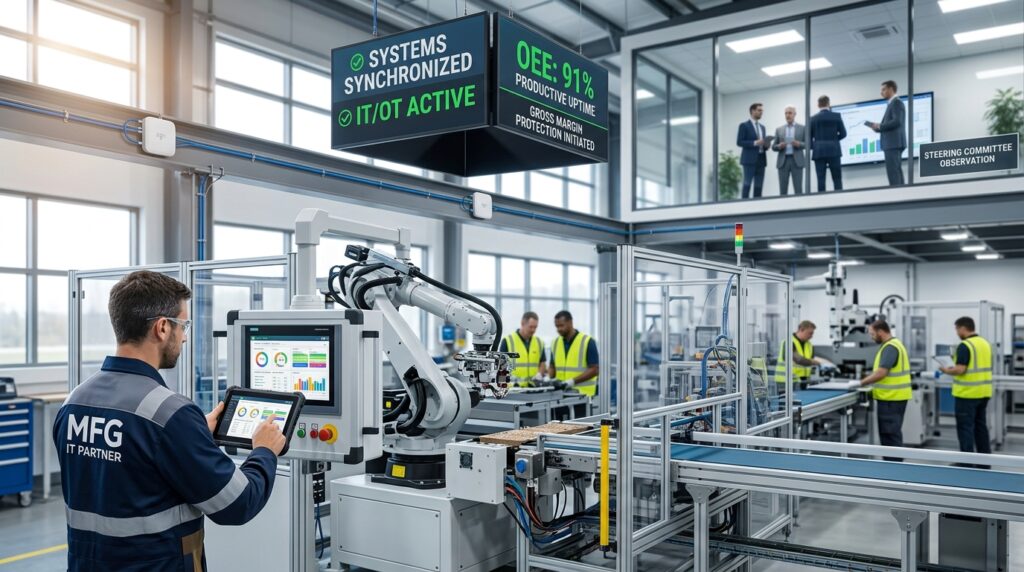
- Plant and Finance Sign-off: Form a steering committee comprising the Plant Controller, Operations Manager, and Floor Supervisors. This ties OPEX and CAPEX IT budgets to forecasted Overall Equipment Effectiveness (OEE) improvements.
Example Scenario: Discrete Manufacturing (Woodfires & Lawnmowers)
Context: A $35M turnover discrete manufacturer operating on two shifts.
A generalist IT provider performed a standard Windows server patch at 9:00 PM. The patch inadvertently took the Manufacturing Execution System (MES) offline for 4 hours during the second shift.
Financial Impact Matrix: 4-Hour MES Outage
| Cost Category | Calculation Metric | Financial Impact (Unfavorable) |
|---|---|---|
| Idle Direct Labor | 45 operators × $28/hr × 4 hrs | $5,040 |
| Unabsorbed Overhead | 12 assembly lines × $180/hr × 4 hrs | $8,640 |
| Overtime Premium (Make-up) | 45 operators × $14/hr (0.5x premium) × 4 hrs | $2,520 |
| Expedited Outbound Freight | 3 LTL air-freight upgrades to meet wholesale SLA | $4,200 |
| Total Variance to Standard | Gross margin reduction | $20,400 |
Shortcut used by experienced controllers: To estimate downtime impact during vendor negotiations, multiply your total daily factory overhead and direct labor by the percentage of the day lost. Then add a 20% buffer for downstream supply chain disruption.
Step 1: Assess the Shortcomings of Your Current Generalist Provider
- Response Times During Critical Production Halts: Generalists typically operate on an SLA that treats an offline barcode scanner the same as a broken office printer. In discrete manufacturing, a downed scanner breaks the cycle counting control environment, halting FIFO inventory relief and freezing work-in-progress (WIP) transfers.
- Gaps in Operational Technology (OT) Knowledge: Generalists often lack expertise in Industrial Control Systems (ICS) and SCADA. When machinery fails to communicate with the ERP, standard costing rollups fail because real-time scrap, yield, and labor hours are not captured. The result is large month-end inventory valuation discrepancies.
- Office IT vs. Plant Floor Systems: A generalist may secure the corporate perimeter while ignoring legacy Windows XP systems running critical CNC machines. That leaves an unsecured bridge between the office and the plant floor, introducing material business interruption risk.
- Supply Chain and ERP Integration Vulnerabilities: Broken API links with international component suppliers delay raw material receipts. Planners then alter production schedules, which increases setup cost variances.
2: Define Your Dedicated Manufacturing IT Support Requirements
- 24/7/365 Support Matched to Production Shifts: Support SLAs must mirror production schedules. If the third shift is absorbing overhead to meet a forecasted $13M turnover run-rate, IT support must be active, not on call.
- Expertise in Manufacturing-Specific Software (ERP, MES, MRP): The provider must understand the financial implications of Bill of Materials (BOM) rollups, routings, and backflushing. IT troubleshooting should focus on data integrity for accurate absorption costing and clean sub-ledger to general ledger reconciliation.
- Industrial Cybersecurity Measures (Air-gapping, ICS Protection): OT networks must be segmented from the corporate network where feasible and tightly controlled where full separation is not practical. Ransomware protection supports controls over WIP data loss and audit failures.
- Infrastructure Capable of Supporting IoT and Factory Automation: As capital is deployed to consolidate manufacturing sites (e.g., moving a $60M international footprint from two sites to one), the IT backbone must support high-density IoT data logging. This data is also needed to substantiate claims for R&D automation tax credits.
3: Implement the Transition to a Specialized IT Partner
- Provider Vetting Based on Proven Manufacturing Case Studies: Demand verifiable references where the provider integrated shop-floor PLCs with standard ERPs (e.g., SAP, NetSuite, Plex). Inspect their track record on protecting month-end close processes.
- A Migration Plan with Zero Production Downtime: Schedule cutovers during planned maintenance shutdowns or weekend non-production hours. Controller Rule: Never allow a system migration during the last 5 days of the month or the first 3 days of the new month. The 5-day month-end close cycle must be protected.
- Clear Communication Channels for Floor Operators: Implement one-click ticketing directly from factory floor HMIs. Direct labor should not waste time explaining machine routing logic to a remote helpdesk technician.
- Preventive Maintenance and Real-Time Network Monitoring: Use IT monitoring to prevent failures instead of only responding after failures. Real-time condition monitoring extends the lifecycle of capital equipment and reduces R&M (Repairs & Maintenance) OPEX volatility.
Common Mistakes to Avoid When Transitioning Providers
- Treating IT and OT as Separate, Siloed Entities: Financially, this leads to duplicate software licensing and fragmented Capex planning. IT/OT must be managed as a unified infrastructure cost center.
- Prioritizing Bottom-Line Contract Costs Over Industry-Specific Expertise: Saving $15,000 annually on a generalist IT retainer is a poor trade-off when a single 4-hour OT downtime event costs $20,400 in lost absorption and overtime premiums.
- Failing to Include Plant Floor Staff in the Transition Training: When direct labor operators do not understand new IT protocols, they bypass controls to keep machines running. This reduces physical stocktake accuracy and undermines BOM variance reporting.
- Neglecting Planned Growth and Automation Goals in the SLA: Do not sign rigid SLAs based solely on current headcount. As the business grows (e.g., taking a loss-making $4M entity into a profitable $13M business), automation will increase IP addresses and network endpoints without proportionally increasing human headcount. The SLA must price by endpoint and data load, not just by user.
Frequently Asked Questions (FAQ) About Manufacturing IT Support
- What is the exact difference between standard IT and Manufacturing IT Support? Standard IT focuses on data confidentiality and office productivity, while Manufacturing IT extends that responsibility to physical asset utilization, ERP data integrity, and continuous production flow.
- How does specialized IT support affect machine downtime and OEE? Specialized IT uses predictive network monitoring and immediate remediation of MES/OT failures to increase machine availability. Higher availability increases the volume of favorable overhead absorption.
- Will a dedicated IT provider help us achieve regulatory and supply chain compliance? Yes. Proper IT/OT segmentation and encrypted EDI protocols provide the auditable internal controls required by ISO, SOX, and Tier-1 wholesale customers.
- How long does it typically take to transition from a generalist to a specialized provider? A low-risk transition typically requires 60 to 90 days. This allows for a full audit of plant floor legacy systems, coordination with the financial reporting calendar, and testing of shadow environments before cutover.
Target State: A Resilient, Maintainable Manufacturing Operation
- Controlled IT/OT Convergence Across the Facility: Corporate finance and plant management gain a shared, governed data set. Real-time yield and scrap data feed directly into standard costing sub-ledgers, enabling tight financial control and an accelerated 5-day month-end close.
- Reduced Unplanned Downtime: Preventive manufacturing IT reduces unfavorable labor and overhead variances. Production schedules require less buffer for systemic technology failures.
- Secure, Scalable Manufacturing Systems That Support Production: The IT/OT environment can add machines, endpoints, and data flows while keeping access controls and ERP data controls intact.