Custom Manufacturing Software Development Blueprint
Legacy Migration and Custom Manufacturing Software Development: A Financial and Operational Blueprint Legacy manufacturing systems, characterized by hard-coded on-premise ERPs, siloed shadow IT (manual Excel spreadsheets), and unsupported server infrastructure, create technical debt that is rarely measured. From a controller’s perspective, these outdated architectures compromise inventory valuation accuracy, obscure material yield variances, and extend month-end…
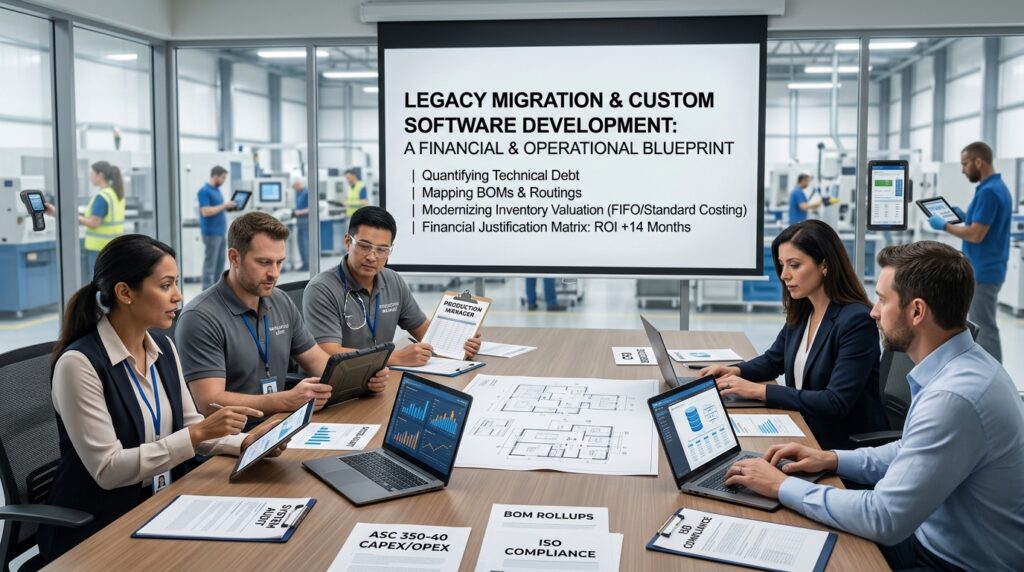
Legacy Migration and Custom Manufacturing Software Development: A Financial and Operational Blueprint
Legacy manufacturing systems, characterized by hard-coded on-premise ERPs, siloed shadow IT (manual Excel spreadsheets), and unsupported server infrastructure, create technical debt that is rarely measured. From a controller’s perspective, these outdated architectures compromise inventory valuation accuracy, obscure material yield variances, and extend month-end close cycles beyond acceptable internal control thresholds.
Custom manufacturing software development can replace these systems with tailored relational databases and APIs, supported by automated workflows mapped directly to a facility’s specific routing and Bill of Materials (BOM). Migrating to custom architecture is a capital investment in data integrity, standard cost rollups, and faster detection of margin leakage.
What You Need Before Starting Your Legacy Migration
A Dedicated Internal Stakeholder Team
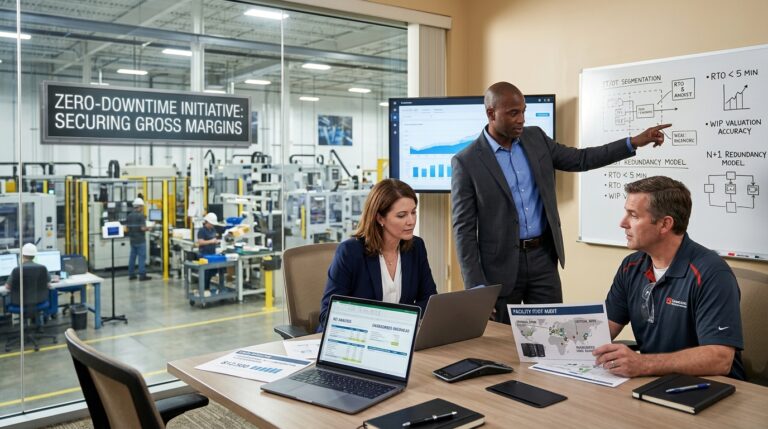
Migration usually fails when operations and finance are not measuring success the same way. Stakeholder selection must connect floor execution and the General Ledger.
- Identify Project Champions: Assign execution responsibility to the Cost Accountant, Production Manager, and Warehouse Lead. These individuals own the data generated by standard costing and cycle counting controls.
- Role Allocation: Establish a steering committee to enforce project scope. The CFO/GM dictates hurdle rates and NPV (Net Present Value) expectations, while IT manages system architecture.
Complete Inventory of Existing Legacy Systems
Before capitalizing new software, audit the systems and workarounds already in use.
- System Audit: Catalog all active ledgers, sub-ledgers, MRP modules, and off-system access databases.
- Identify Data Silos: Document instances where physical plant workflows bypass the legacy ERP (e.g., manual scrap reporting, separate spreadsheets for tracking unabsorbed overhead).
Established Budget and Timeline Parameters
Software development must be modeled using strict CapEx and OpEx guidelines (e.g., ASC 350-40 regarding internal-use software).
- Financial Scope: Define the budget encompassing developer hours, API licensing, middleware, and hardware upgrades (scanners, tablets).
- Milestone Mapping: Link payment tranches to functional deliverables. Timeline objectives must align with low-season production cycles to mitigate inventory disruption.
Defining Your Manufacturing Software Development Requirements
Analyzing Current Workflow Bottlenecks
Most operational bottlenecks show up somewhere in the P&L or balance sheet.
- Inefficiency Identification: Target systemic reporting lags. If WIP (Work in Process) inventory requires manual reconciliation, labor efficiency variances and material usage variances arrive too late to correct the underlying production run.
- Functional Requirements: The custom build must automate real-time BOM rollups and integrate automated cycle counting to eliminate the need for complete annual physical stocktakes.
Mapping Out Hardware and IoT Integrations
Accurate absorption costing requires precise machine and labor hour tracking.
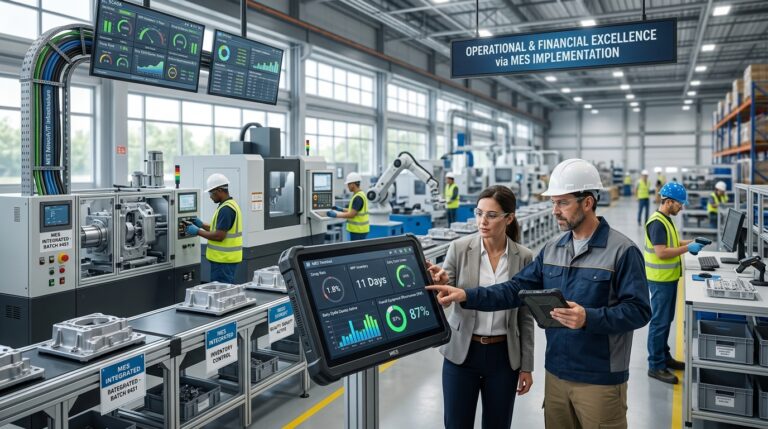
- Machine Integration: Map PLC (Programmable Logic Controller) outputs directly to the new software to capture exact machine cycle times.
- Middleware: Establish APIs that convert raw sensor data into variance reports against standard routing times.
Establishing Data Security and Compliance Standards
- Security Protocols: Implement strict Segregation of Duties (SoD) within the software roles. A user issuing raw materials to a job order cannot also have the authorization to adjust inventory balances.
- Compliance: Embed SOX-compliant audit trails and secure historical data retention per ISO and IRS/local tax authority requirements.
Realistic Scenario: Discrete Manufacturer (Aluminum Casting & Woodfires)
Context: A $35M turnover discrete manufacturing plant suffering from margin erosion due to obsolete on-premise software. The business struggles with delayed supplier payments and high carrying costs.
Financial Justification Matrix for Custom Software Migration
| Metric | Legacy Environment (Current) | Target Custom Environment (Post-Migration) | Financial Impact (Annualized) |
|---|---|---|---|
| Inventory Accuracy | 82% (High variance at physical stocktake) | 99.5% (Perpetual FIFO cycle counting) | $180,000 reduction in shrinkage/obsolescence |
| Month-End Close | 12 Days (Manual WIP valuation) | 5 Days (Automated sub-ledger posting) | Redeployment of 60 accounting hours/month |
| Labor Variance | Unidentified until end-of-month | Real-time shift reporting via floor tablets | $110,000 reduction in unabsorbed labor |
| Procurement | Reactive ordering, expedited freight | Min/Max automated MRP triggers | $85,000 savings in premium freight costs |
| Total ROI | N/A (Sunk Maintenance: $95k/yr) | CapEx: $450k (Amortized over 5 yrs) | Payback Period: 14 Months |
Custom Software Migration Process
Step 1: Data Extraction and Cleansing
Migrating inaccurate data can create inventory and cost misstatements.
- Historical Extraction: Pull all static data (Item Master, Routings, BOMs, Vendor terms).
- Cleansing: Purge obsolete SKUs and duplicate vendor records, and recalculate moving average costs or standard costs to prevent duplicate payment errors.
2: Custom Architecture Design and Prototyping
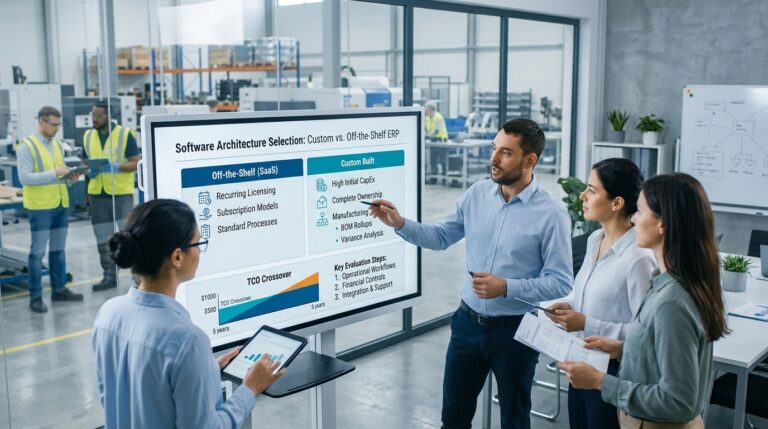
- Scalable Architecture: Select cloud-based environments (OpEx hosting) over bare-metal servers (CapEx hardware) to improve scalability and disaster recovery.
- Prototyping: Finance must review wireframes and business rules to ensure inventory valuation methods (FIFO, LIFO, Standard) are configured correctly before full development begins.
3: Agile Development and System Integration
- Iterative Sprints: Build and release modules in logical sequences (e.g., Procure-to-Pay first, then Order-to-Cash, then Production Scheduling).
- Integration: Tie the new software to automated warehouse barcoding scanners and PLC hardware on the floor.
4: Rigorous Testing in a Sandbox Environment
- User Acceptance Testing (UAT): Floor operators execute test batches. Cost accountants run parallel month-end simulations to ensure the new sub-ledgers reconcile perfectly with the GL.
- Load Testing: Stress test the system with high-volume transaction simulations (e.g., receiving thousands of purchased-in components simultaneously) to prevent latency during production peaks.
Migration Risks to Control
Neglecting User Training for the Factory Floor
- The Mistake: Treating software deployment purely as an IT function, leaving floor operators confused. This results in missing labor scans, corrupting absorption costing.
- The Practical Shortcut: Designate floor-level “Super Users” and compensate them for overtime to beta-test the UI. Treat training time as part of the deployment budget rather than an informal production burden.
Failing to Prioritize Data Backups Before Migration
- The Mistake: Executing ETL (Extract, Transform, Load) processes without static, off-site backups, risking total loss of accounts receivable and historical cost data.
- The Practical Shortcut: Run a hard financial close in the legacy system on a Friday, lock the period, and clone the database to a cold-storage server before any migration scripts are executed.
The “Big Bang” Deployment Approach
- The Mistake: Launching all modules overnight. If a localized failure occurs, production can halt and the revenue disruption can be severe.
- The Practical Shortcut: Execute a phased parallel run with the legacy system retained as a read-only safety net. Transition warehousing and receiving first, stabilize, and then cut over WIP and production routing.
Operating Result After Migration
Faster Variance Detection and Real-Time Analytics
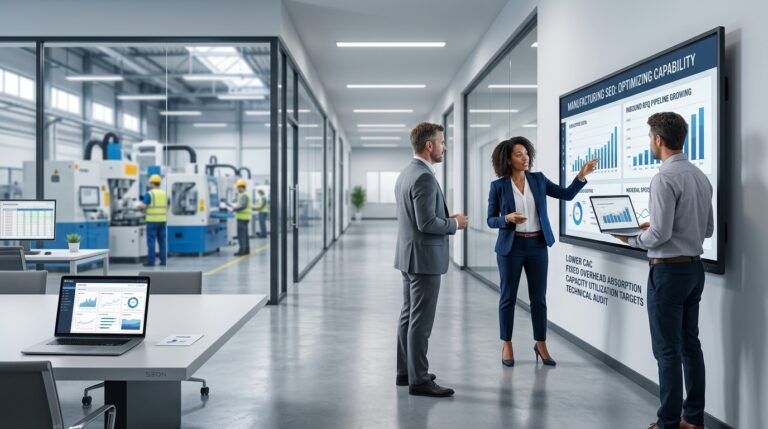
Custom software gives finance earlier variance detection instead of limiting the team to retrospective reporting. Automated data capture allows the controller to monitor Purchase Price Variance (PPV) and machine utilization in real-time. The target is a repeatable 5-day month-end close, with timely financials for pricing, procurement, and capacity decisions.
Supply Chain Visibility
Purchased-in, wholesaled products and raw material components are tracked via API links with international suppliers. This visibility can improve working capital use, allowing the CFO to negotiate improved payment terms and rely on automated min/max inventory triggers to prevent stockouts.
Architecture for Future Industry 4.0 Integrations
The custom database becomes the core, normalized ledger, with enough structure to support advanced integrations such as AI-driven predictive maintenance modeling and automated robotic picking. The cost benefit should be measured through downtime, handling labor, scrap, and unit-cost trends.
Frequently Asked Questions
How long does a typical legacy migration take in manufacturing?
For a facility generating $10M–$50M with 50–120 employees, a custom migration realistically requires 9 to 18 months. This accounts for thorough data cleansing, sprint development, and parallel month-end testing. Rushing this timeline usually results in broken inventory ledgers and audit failures.
What are the core Manufacturing Software Development Requirements I should focus on?
From an executive standpoint: reliable API integration with disparate machines and freight forwarders, strict role-based internal controls for audit compliance, real-time costing algorithms, and an ultra-simplified UI for factory floor workers to minimize keystroke errors during scrap or yield reporting.
Will a legacy migration disrupt our current production lines?
Disruption can be minimized if the cutover is modeled correctly. Phased rollouts, thorough UAT in a sandbox environment, and off-hours (weekend/holiday) deployments reduce floor disruption. Parallel runs ensure that if the custom environment fails a transactional stress test, the legacy system continues to process the production load until the code is patched.