
Manufacturing Software Company: Step-by-Step Guide
Manufacturing Software Evaluation: Financial and Operational Selection Protocol An ERP, MES, or QMS deployment should be evaluated by its effect on margins, balance sheet accuracy, and cash conversion. Selecting the right manufacturing software business requires specific evaluation of how its system architecture handles standard costing and bill of materials (BOM) rollups, including the labor routings…
Manufacturing Software Evaluation: Financial and Operational Selection Protocol
An ERP, MES, or QMS deployment should be evaluated by its effect on margins, balance sheet accuracy, and cash conversion. Selecting the right manufacturing software business requires specific evaluation of how its system architecture handles standard costing and bill of materials (BOM) rollups, including the labor routings that drive them. The protocol below sets out how to move from legacy, disconnected systems to a single ERP/MES/QMS operating environment that supports a 5-day month-end close and cost controls.
What You Need: The Pre-Evaluation Checklist
Software implementation does not repair broken processes; it magnifies their impact on your P&L. Internal baseline metrics must be locked down before engaging vendors.
Define Your Key Business Objectives
Quantify operating problems in strict financial terms. Avoid generic goals like “better visibility.”
- Inventory bottlenecks: Target a specific reduction in Days Sales in Inventory (DSI).
- Material usage: Identify the baseline scrap rate and target material yield improvements.
- Machine downtime: Measure unabsorbed overhead costs stemming from idle capacity.
Assemble Your Internal Project Team
The selection committee needs cross-functional authority, not observers.
- Finance/Accounting: Validates GL mapping, inventory valuation (FIFO/Standard Costing), and multi-currency capabilities for international sourcing.
- Operations/Shop Floor: Tests labor tracking and work center capacity logic.
- Supply Chain: Evaluates MRP (Material Requirements Planning) parameters, lead times, and supplier portal integrations.
Map Out Current Process Inefficiencies
Document exactly where control failures occur. Map the discrepancy between the physical plant workflow and the financial ledger. Look for phantom WIP (Work in Progress), unrecorded scrap, and delayed sub-ledger postings that disrupt the month-end close.
Establish a Realistic Budget and Timeline
Distinguish between Capital Expenditure (CapEx) for on-premise servers or perpetual licenses and Operational Expenditure (OpEx) for SaaS subscriptions.
- Include costs for backfilling key staff dedicated to the project.
- Budget for a formal physical inventory count and variance reconciliation immediately preceding go-live.
Realistic Scenario: Discrete Manufacturer (Woodfires & Lawnmowers)
Context: A discrete manufacturer with $40M turnover, 120 employees, and a mix of fabricated sub-assemblies and purchased-in wholesale products sourced internationally.
Problem: The business suffered a margin erosion of 4% over two years. Legacy systems failed to capture real-time FX fluctuations on imported components, and BOM rollups were manually calculated quarterly, leading to material Purchase Price Variances (PPV) and Labor Efficiency Variances.
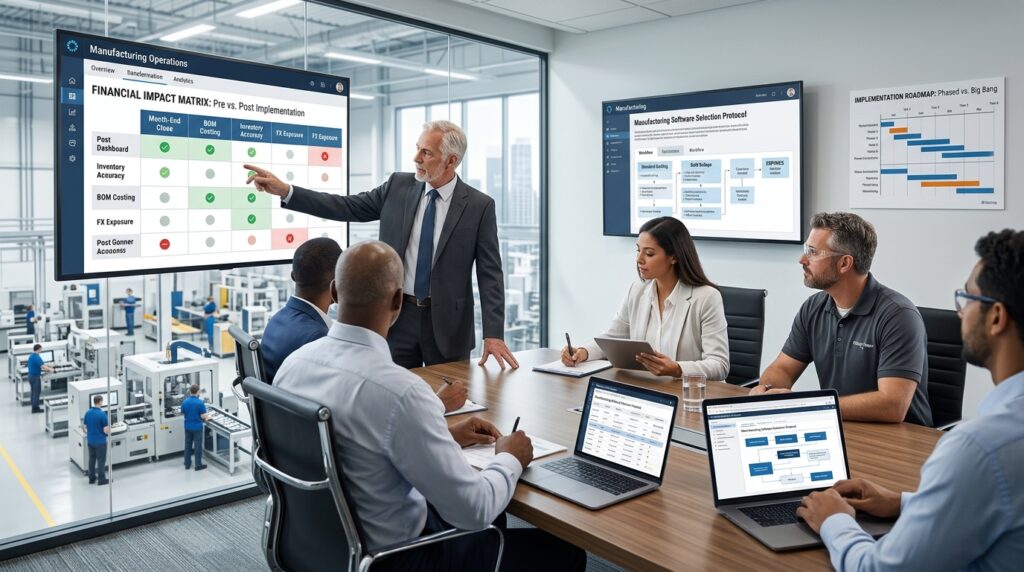
Financial Impact Matrix: Pre vs. Post Implementation
| Metric | Legacy System Baseline | Post-Implementation Target | Accounting Impact |
|---|---|---|---|
| Month-End Close | 14 Days | 5 Days | Accelerated reporting; timely B/S reconciliation. |
| BOM Costing | Quarterly Manual Rollup | Real-time / Nightly Batch | Accurate standard costs; precise gross margin analysis. |
| Inventory Accuracy | 82% (Annual Stocktake) | 98% (Perpetual/Cycle Count) | Elimination of $200k+ annual inventory write-offs. |
| FX Exposure | Manual AP Adjustment | Automated 3-way match at spot rate | Mitigated P&L volatility on imported component purchases. |
Step 1: Evaluating and Selecting the Right Manufacturing Software Company
Assessing Industry-Specific Expertise
Start with production mode. A package built for process manufacturing, such as fluids, formulations, and batch yields, will fail in a discrete environment such as aluminum casting or metal fabrication, where4 routing steps, machine centers, and multi-level BOMs drive the economics. If you also run a wholesaling division, verify mixed-mode capability rather than assuming it exists.
Analyzing Scalability and Integration Capabilities
Do not stop at API claims. The architecture must support posting-level financial integration and execute a 3-way match — PO, Receipt, Invoice — without manual rekeying. It also needs a reliable interface with CAD systems so BOM updates do not depend on manual transfer, where engineering changes can become material usage variances on the shop floor.
Reviewing Vendor Support and Post-Launch Consulting
Examine the Service Level Agreements (SLAs). Support coverage has to match factory operating hours, particularly in multi-shift operations. Get the patch release schedule in writing, and confirm that updates will not overwrite critical GL mappings.
2: Designing the Implementation Roadmap
Choosing Between a Phased Rollout vs. a “Big Bang” Approach
- Phased Approach: Roll out financial modules and inventory control first, followed by shop floor execution (MES) and advanced MRP. This isolates risk and stabilizes the general ledger, though it requires building temporary integration bridges.
- Big Bang: Required when legacy systems are thoroughly obsolete or highly entangled. It demands a formal freeze on operational changes and a validated data migration protocol.
Executing Data Migration and Cleansing
Data migration determines whether the new system produces reliable financial results.
- Obsolete Stock: Write off dead stock before migration. Do not port dirty data into a new system.
- Standard Cost Reset: Recalculate and freeze standard costs for materials, direct labor, and fixed/variable overhead absorption rates based on current supplier prices, labor rates, and overhead assumptions, not legacy errors.
- Routing Times: Validate machine cycle times. Incorrect routings will immediately generate false labor efficiency and capacity variances post-launch.
Leading Employee Training and Change Management
For shop floor operators, scanning errors are balance-sheet errors. Training should make the balance-sheet impact clear: a missed scan, an unrecorded scrap event, or an incorrect job clocking entry can distort overhead absorption.
Common Mistakes to Avoid
Ignoring End-User Feedback During Selection
Executive-only selection creates systems that look acceptable in a boardroom and fail at the machine. If operators face complex, multi-screen data entry requirements, they will bypass the system to save time. WIP valuations then become fiction, and standard costing falls apart.
Underestimating Data Migration Complexity
Accountant’s Shortcut: Never attempt a 1-to-1 historical transaction migration. Port over only open AR, open AP, open POs, current WIP, and ending inventory balances. Keep the legacy system alive in a read-only state for historical audit trails. Migrating years of transactional history will almost always corrupt the new GL.
Customizing Instead of Configuring
Modifying core source code to replicate a flawed legacy process is a serious error. Customization permanently increases the cost of future software upgrades and often breaks automated accounting workflows, including WIP-to-Finished Goods journal entries. Force the business to adopt the software’s standard configurations.
Frequently Asked Questions
How long does it take to implement a system from a manufacturing software company?
A standard enterprise deployment for a $30m-$60m manufacturer ranges from 6 to 12 months. Any timeline shorter than 6 months typically indicates inadequate conference room piloting (CRP) and insufficient stress-testing of financial reporting.
Should we choose a cloud-based or on-premise system?
Cloud (SaaS) systems shift costs from CapEx to OpEx, provide continuous updates, and reduce internal IT headcount requirements. On-premise solutions require significant upfront CapEx for servers, SQL licenses, and related infrastructure, but may be necessary if unstable internet latency would disrupt real-time shop floor barcoding. Consult current accounting standards regarding the capitalization of SaaS implementation costs.
What is the typical ROI timeline for manufacturing software?
Measurable ROI typically materializes in 18 to 24 months. Financial controllers should track ROI through reductions in rush-freight costs and obsolete inventory write-offs, along with lower administrative effort for stock reconciliations and month-end processing.
Target State: Financial Control and Shop Floor Discipline
Measuring System Adoption and Efficiency Gains
Post-go-live, the focus shifts to variance analysis and continuous auditing.
- Purchase Price Variance (PPV): Isolate sourcing inefficiencies versus standard cost inaccuracies.
- Material Yield / Scrap: Track deviations from BOM standards daily.
- Labor Efficiency: Monitor actual vs. standard hours to adjust routing times.
- Overhead Absorption: Ensure production volumes are adequately absorbing fixed factory overhead to prevent margin dilution.
Maintaining Cost Controls After Go-Live
Use current system data to test cost assumptions and control exceptions. Run quarterly reviews to adjust minimum/maximum stock parameters, update supplier lead times, and revise overhead absorption rates. The system should support a 5-day month-end close and give the executive team the P&L, Balance Sheet, and Cash Flow visibility needed for pricing, sourcing, and working-capital decisions.