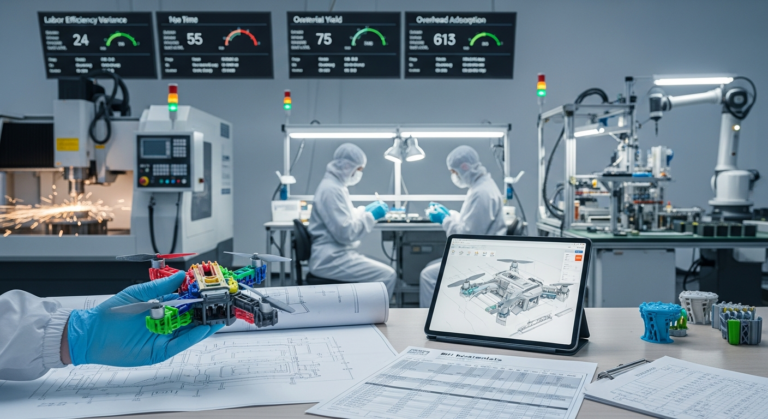
How Is AI Used in Manufacturing Robotics? 5-Step Guide
This 5-step guide “How is AI Used in Manufacturing” covers preparation, training AI, deploying, mistakes to avoid, and benefits when fully deployed. Step 1: Capital Allocation and Infrastructure Preparation for AI-Robotics AI-driven robotics changes cost behavior by replacing variable direct labor with fixed capital assets and amortized software costs. Before issuing a purchase order, the…
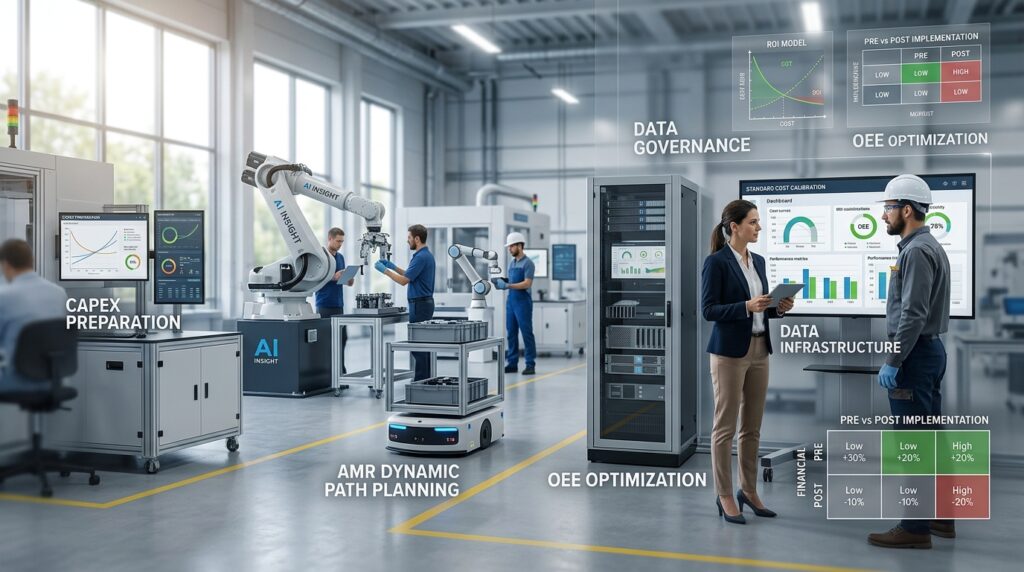
This 5-step guide “How is AI Used in Manufacturing” covers preparation, training AI, deploying, mistakes to avoid, and benefits when fully deployed.
Step 1: Capital Allocation and Infrastructure Preparation for AI-Robotics
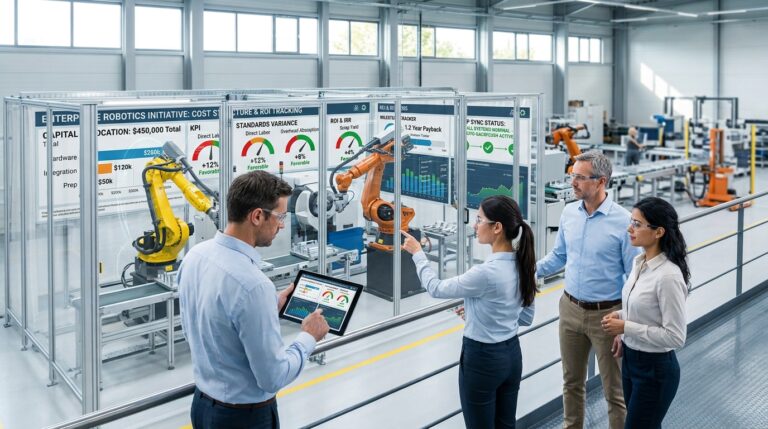
AI-driven robotics changes cost behavior by replacing variable direct labor with fixed capital assets and amortized software costs. Before issuing a purchase order, the financial controller must validate whether the data environment and plant hardware can support the CapEx model.
Master Data Governance and IIoT Sensors
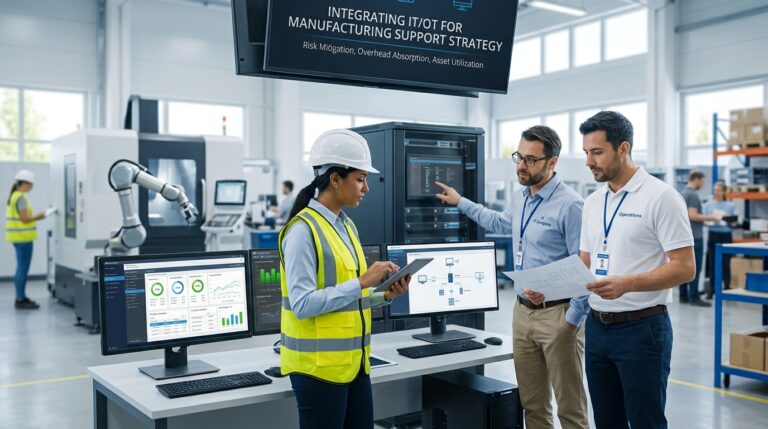
AI models rely on accurate, granular operational data. For accounting, this requires complete and consistent ERP master data.
- Workflow Impact: Scrub Bills of Materials (BOM) and standard routings. If legacy equipment runs with undocumented micro-stoppages, the AI will model those inefficiencies.
- Financial Action: Implement controls that reconcile sensor counts, machine events, and ERP production records. Capitalize the installation of Industrial IoT (IIoT) sensors as leasehold improvements or plant and equipment, depending on asset mobility.
Advanced Robotic Hardware: AMRs and Cobots
Legacy asset registers often contain fully depreciated machinery that cannot interface with edge computing.
- CapEx Planning: Model the acquisition of Autonomous Mobile Robots (AMRs) or Collaborative Robots (Cobots). Assess the project against internal hurdle rates using a discounted cash flow (DCF) model that includes labor substitution plus expected reductions in workers’ compensation premiums and safety compliance costs.
- Shortcut: Where tax rules allow, accelerate depreciation on legacy assets due for replacement to clear the balance sheet and reduce current-year corporate tax liabilities.
Machine Learning Frameworks and Edge Computing
Latency can limit automation’s manufacturing performance. Edge computing usually splits costs between capitalized hardware and expensed cloud/software services.
- Treatment: Capitalize hardware and depreciate over 3–5 years. Treat Cloud-based machine learning subscriptions as OPEX (SaaS). You can often capitalize engineers internal labor costs configuring the AI algorithms under ASC 350-40, Internal-Use Software, or categorizing as qualifying expenditures for R&D tax credits.
2: Training AI Models and Calibrating Standard Costs
During training, the factory floor will carry dual-running costs. Finance must isolate these implementation costs from standard production variances to avoid distorting gross margin reports.
Implementing Machine Vision for Quality Control
Machine vision AI trains on images of defective versus conforming products.
- Cost Control Impact: The primary accounting impact is on material yield variances. Catching microscopic flaws at the point of operation, rather than at end-of-line inspection, prevents absorbing overhead from accumulating on defective units.
- Financial Output: Recalibrate standard material allowances. Reduce scrap provisions only after post-implementation yield data supports the new standard.
Predictive Maintenance Algorithms
Traditional preventive maintenance incurs predictable but often unnecessary downtime, creating step-fixed costs. Reactive maintenance causes large unabsorbed overhead when machines fail without warning.
- Financial Output: AI predictive maintenance reduces unplanned maintenance expense and shifts repair work into scheduled downtime. The system monitors motor torque and vibration, then schedules work when you can address failure risk inside planned downtime. That improves the Overall Equipment Effectiveness (OEE) multiplier used in overhead absorption rate calculations.
3: Deploying AI-Powered Robots and Floor Execution
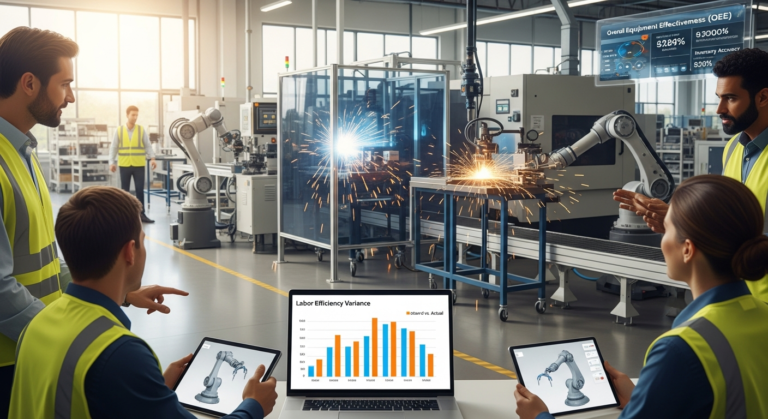
After go-live, finance should track labor efficiency variances, fixed-overhead absorption, and WIP inventory levels.
Integrating Cobots with the Direct Workforce
Cobots eliminate traditional safety cages, reducing the physical footprint of work cells.
- Cost Reallocation: Direct labor headcount drops, but indirect labor increases through robot technicians and automation support. Standard labor rates must be updated in the ERP to reflect this new labor mix.
- Workflow Impact: Standard routings in the ERP must be updated for higher throughput speeds. Otherwise, favorable labor efficiency variances can artificially inflate standard margins over time.
Automating Dynamic Path Planning with AMRs
AMRs handle intra-facility logistics through dynamically calculated routes, reducing manual transport delays.
- Inventory Valuation: AMRs integrate with Warehouse Management Systems (WMS) to automate inventory transfers from Raw Materials to WIP. Real-time tracking removes much of the manual scanning burden and reduces physical vs. perpetual stock discrepancies during month-end cycle counting.
- Cash Flow: Faster internal routing shortens lead times. That allows safety stock to be reduced and directly decreases the cash conversion cycle.
Realistic Scenario: $40M Discrete Manufacturer, Aluminum Casting and Assemblies
Context: A $40M turnover aluminum casting and assembly plant operating 2 shifts. The program replaced three manual material handling routes with AMRs and installed two AI-vision cobots on the high-defect deburring line.
Financial Matrix: Pre- vs. Post-Implementation Annualized
| Metric | Pre-AI Implementation | Post-AI Implementation | Variance / Financial Impact |
|---|---|---|---|
| Direct Labor Deburring | 8 FTEs ($480k) | 2 FTEs ($120k) | $360k favorable labor variance |
| Scrap / Rework Rate | 4.5% ($1.8M BOM cost) | 1.2% ($480k BOM cost) | $1.32M favorable material yield variance |
| WIP Inventory Hold | $3.2M | $2.1M | $1.1M cash freed up (AMR velocity) |
| Annual Depreciation | $400k | $650k | ($250k) increased fixed overhead |
| Maintenance OPEX | $300k reactive | $180k predictive | $120k favorable fixed overhead variance |
Net P&L Impact: +$1.55M EBIT improvement in Year 1.
Tax Strategy Used: Claimed a $250k R&D tax credit for internal engineering time spent writing the dynamic routing logic for the AMRs to integrate with the legacy ERP.
4: Common Financial and Operational Mistakes to Avoid
AI robotics creates financial risk if accounting and operational controls are ignored.
- Failing to Update Standard Costs and Routings: If BOMs and routing times are not updated post-deployment, the ERP will generate large favorable labor variances. This distorts inventory valuation, can overvalue WIP, and misleads the sales team on actual product profitability. The result is often underpriced contracts.
- Overcapitalizing the Implementation: Capitalizing standard training time for machine operators or routine data-cleaning expenses violates GAAP/IFRS. These costs must be expensed as incurred. Stranded assets also become a problem when pilot programs fail but remain on the balance sheet.
- Ignoring the Labor Mix Shift: Assuming a 1:1 cost reduction in payroll is a critical error. You are substituting $25/hour semi-skilled variable labor for $85/hour fixed salaried automation engineers. The breakeven volume must be recalculated to reflect the higher fixed-cost base.
5: Fully Deployed AI-Robotics System with Closed-Loop Controls
In a mature deployment, shop-floor data updates ERP quantities, routings, and variance reports with less manual input.
Improving Uptime and Throughput
Financially, higher throughput makes overhead absorption more predictable. Volume variances can narrow because the AI adjusts production line speeds to the constraint of the bottleneck machine. The goal is continuous flow without WIP inventory pile-ups.
Enabling Continuous Process Tuning
As production data accumulates, the AI can refine robotic movements and reduce cycle time by milliseconds. It may also reduce electrical draw. Finance should capture these gains in utility usage, labor efficiency, and variance forecasts; automated shop-floor data can also shorten month-end close.
Frequently Asked Questions: CFO Perspective
Exactly how is AI used in manufacturing to reduce costs?
AI reduces labor inefficiencies, scrap, rework, and unabsorbed overhead from breakdowns. Some of those variable costs are replaced by predictable, depreciable capital expenses. It also lowers standard BOM costs through tighter material-yield controls and reduces working capital tied up by moving inventory via AMRs based on JIT/FIFO principles.
Do AI-powered robots completely replace human factory workers?
No. They reduce direct, touch-labor hours and shift payroll weighting from variable direct labor to fixed indirect overhead, including automation technicians along with supervisory and programming support. This changes the cost-volume-profit (CVP) equation. The breakeven point rises, but contribution margins increase at higher volumes.
How long does it take to implement AI in factory robotics?
Cash flow usually worsens before it improves. A pilot work-cell takes 3 to 6 months to deploy, and during that period you will incur double operating costs: legacy labor plus new implementation OPEX. A facility-wide rollout takes 1 to 3 years. Payback periods typically range from 18 to 28 months, depending on the baseline cost of capital and the accuracy of initial master data.