Manufacturing AI Software: Step-by-Step Guide
Executive Summary: Financial and Operational Case for AI Robotics Integrating manufacturing AI software with existing robotic assembly lines should be evaluated primarily by margin expansion and asset utilization. For a financial controller, the case rests on three P&L metrics: lower adverse material usage variances, stronger labor efficiency variances, and better factory overhead absorption through improved…
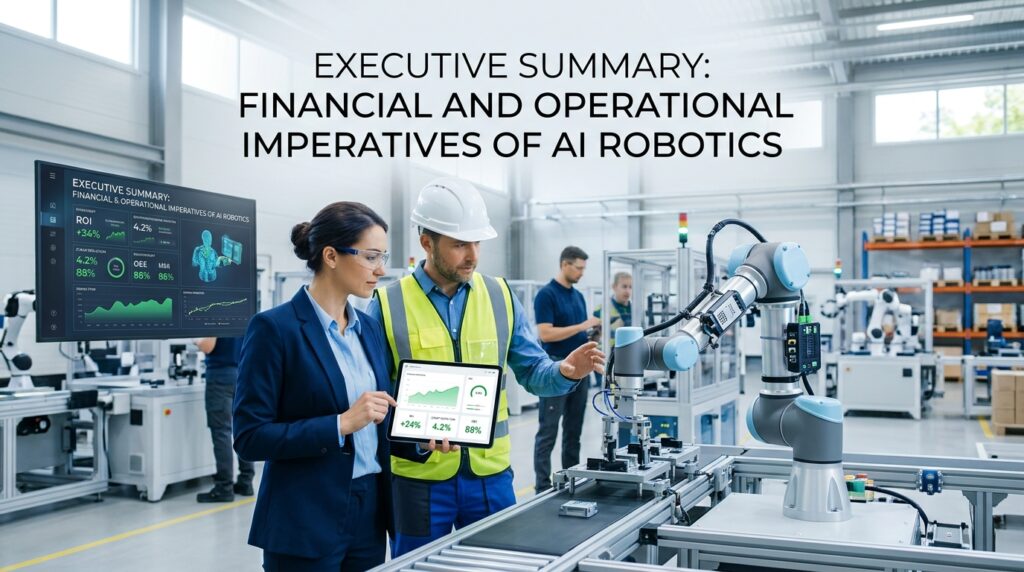
Executive Summary: Financial and Operational Case for AI Robotics
Integrating manufacturing AI software with existing robotic assembly lines should be evaluated primarily by margin expansion and asset utilization.
For a financial controller, the case rests on three P&L metrics: lower adverse material usage variances, stronger labor efficiency variances, and better factory overhead absorption through improved Overall Equipment Effectiveness (OEE). This guide sets out the financial, operational, and physical plant workflows needed to execute the integration without weakening internal controls or slowing a 5-day month-end close.
Prerequisites for AI Integration: Capital and Resource Allocation
Before committing Capital Expenditure (CAPEX) or Operating Expenditure (OPEX), establish the baseline standard costs and confirm the asset registers.
Hardware Infrastructure (CAPEX)
Before upgrading to sensor-rich robotic arms, evaluate the net book value of existing legacy robots.
- Action: Determine if the AI integration qualifies as a capitalized betterment extending useful life or increasing output under fixed asset accounting policies, or if it must be expensed as repairs and maintenance.
- Requirement: Edge computing devices must be procured and depreciated over an appropriate useful life, typically 3-5 years.
Software and Network Requirements (OPEX vs. CAPEX)
Determine the software licensing model immediately because it drives the accounting treatment.
- On-Premise Perpetual Licenses: Capitalize under ASC 350-40, Internal-Use Software, along with direct implementation costs.
- SaaS Models: Treat as OPEX. Ensure cloud-hosting fees and 5G/industrial Ethernet bandwidth upgrades are accurately forecasted in the monthly factory overhead budget.
The Cross-Functional Team (Labor Capitalization)
Establish a project code within your ERP to track the time of your robotics engineer, IT/network specialist, and data scientist.
- Accounting Shortcut: Capitalize the internal payroll costs of these employees during the Application Development Stage to protect current-year EBITDA. Expense all costs during the Preliminary Project Stage and Post-Implementation Stage.
Step 1: Preparing Your Robotic Infrastructure
As mechanical systems are connected to AI software, reconcile factory floor activity to the General Ledger (GL).
Conducting a Factory Floor Audit
Identify manufacturing bottlenecks using Time-Driven Activity-Based Costing (TDABC).
- Workflow: Start with the last 12 months of unabsorbed overhead and direct labor efficiency variances. Then identify the work centers generating the highest variance, such as bin picking or automated optical inspection. That becomes the financial baseline for the project’s Return on Investment (ROI).
Upgrading Sensors and Data Collection
AI algorithms require high-volume telemetry. Procurement must source IoT sensors, vision cameras, and force-torque sensors.
- Control Metric: Update Bill of Materials (BOM) routings to reflect new machine run times. Ensure procurement negotiates extended payment terms, e.g., Net 60 or Net 90, with sensor OEMs to protect working capital during the integration phase.
Establishing Communication Protocols
PLCs and SCADA systems should communicate via OPC UA or MQTT directly into the ERP database. This eliminates manual WIP (Work in Progress) tracking and supports a controlled 5-day month-end close.
2: Deployment and Model Training
Deployment puts inventory control and production continuity at risk.
Initial Software Installation and Digital Twinning
Use a “digital twin” to simulate physical workflows before the line is disturbed. For cost control, this avoids physical scrap and raw material waste during the trial phase. Software testing and integration costs at this stage should be capitalized.
Feeding and Training the Machine Learning Models
Feed the model historical production data: standard routing times, scrap rates, and machine downtime logs. The model needs a baseline for standard-cost physical movement before it can identify operational anomalies.
The Pilot Run and Real-Time Adjustments
Isolate the pilot run in a single robotic cell.
- Inventory Control: Quarantine finished goods produced during the pilot. Apply strict cycle counting in this cell so the ERP inventory module matches physical output. Test batches must not distort FIFO inventory valuation.
Realistic Scenario: Aluminum Casting Discrete Manufacturer
Context: An aluminum casting and CNC machining business with $40M annual turnover, operating 3 shifts, and employing 85 factory floor staff. The business is suffering from a 6% scrap rate, an adverse material variance, and high spindle downtime in the robotic deburring cell.
The Financial Model (Pre- and Post-AI Integration)
| Metric | Pre-AI (Standard) | Post-AI Pilot (Actual) | Financial Impact (Annualized) |
|---|---|---|---|
| Robotic Cycle Time (Per Unit) | 4.2 Minutes | 3.6 Minutes | 14.2% Capacity Increase |
| Scrap Rate (Material Variance) | 6.0% | 1.8% | $420,000 Favorable Variance |
| Predictive Maintenance Downtime | 24 hrs/month | 4 hrs/month | $85,000 Favorable Overhead |
| Cell Direct Labor Allocation | 2 Operators | 0.5 Operators (Shared) | $115,000 Labor Savings |
Total CAPEX + Implementation OPEX: $280,000
Payback Period: 5.4 Months
Shortcut applied: The business treated the legacy robot retrofit as a fixed asset betterment. That avoided a large immediate charge to the P&L and spread the $280k over 5 years ($56k/year depreciation), producing an immediate first-year net P&L benefit of over $564k.
Common Mistakes to Avoid
- Ignoring Master Data Accuracy (BOMs & Routings): AI can optimize a robotic path and still fail financially if the underlying ERP BOM and standard routings are outdated. A 20% cycle-time reduction must be reflected in re-rolled standard costs. Otherwise, the ERP will generate large, unexplained favorable labor variances that distort inventory valuation and cost of goods sold (COGS).