Cloud ROI: Transforming Software in Manufacturing
The Financial and Operational Economics of Cloud-Based Factory Automation In manufacturing, cloud architecture changes how companies allocate capital, absorb overhead, and control financial data. The move from siloed, on-premise legacy systems to interconnected cloud environments shifts much of IT infrastructure from depreciating capital assets (CapEx) to scalable operating expense (OpEx). For controllers and plant managers,…
The Financial and Operational Economics of Cloud-Based Factory Automation
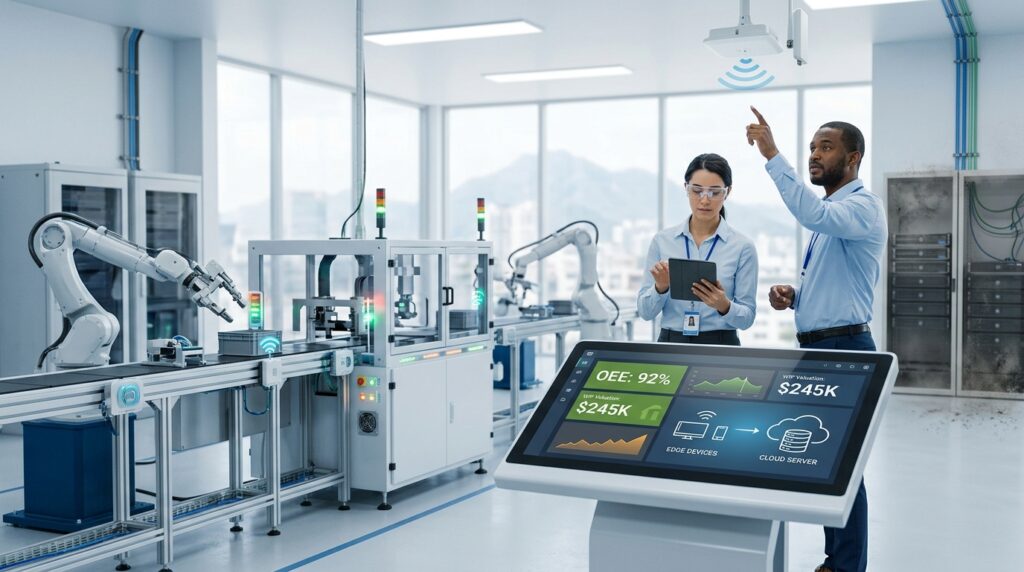
In manufacturing, cloud architecture changes how companies allocate capital, absorb overhead, and control financial data. The move from siloed, on-premise legacy systems to interconnected cloud environments shifts much of IT infrastructure from depreciating capital assets (CapEx) to scalable operating expense (OpEx).
For controllers and plant managers, a larger operational effect is real-time machine-to-machine (M2M) communication. It removes much of the data-capture latency that has historically plagued standard costing environments, improving bill of materials (BOM) rollups and inventory valuation while making labor efficiency variances more current.
Prerequisites for Cloud-Based Software in Manufacturing
A High-Capacity Industrial Network Infrastructure
Cloud integration requires enough bandwidth to support continuous, high-volume data telemetry.
- Evaluating Bandwidth: Financial models must account for infrastructure upgrades. Existing CAT5 cabling or legacy Wi-Fi will bottleneck data streams, resulting in delayed backflushing of materials and inaccurate daily WIP (Work in Process) valuations.
- Upgrading Infrastructure: In many plants, 5G or industrial-grade Wi-Fi becomes a required capital investment. These assets should be capitalized under PP&E and depreciated over 5–7 years, subject to local tax code provisions.
Cloud-Compatible Edge Devices and IIoT Sensors
Edge computing preprocesses data locally to reduce cloud storage costs and bandwidth usage.
- IoT Retrofitting: Identify machinery requiring sensor retrofitting. These sensors capture precise machine hours and cycle times, replacing manual timesheets and reducing labor efficiency and machine utilization variances.
- Gateway Selection: Select edge gateways capable of filtering telemetry data. Transmitting raw, unfiltered data to the cloud can sharply increase data hosting fees (OpEx).
A Cross-Functional Implementation Team
Siloed implementations lead to chart of accounts (CoA) misalignment.
- IT/OT/Finance Coordination: The team must coordinate Information Technology, Operational Technology, and Finance. Finance defines how shop floor transactions map to the General Ledger (GL).
- Role Definition: Network architects build the network; plant managers define the physical workflows. Financial controllers then enforce internal controls and audit trails over automated inventory movements.
Cloud Migration Process
Step 1: Auditing Your Current Software Ecosystem
Before migrating, establish a baseline for existing financial and operational data.
- Mapping Systems: Document the current data flow between ERP, MES, and SCADA platforms. In legacy setups, MES and ERP often operate asynchronously, leading to phantom inventory and cycle counting discrepancies.
- Identifying Bottlenecks: Locate data silos where manual intervention occurs. Every manual data entry point is a risk for inventory shrinkage and a delay in the month-end close.
Step 2: Selecting the Appropriate Cloud Deployment Model
The deployment model directly impacts total cost of ownership (TCO) and compliance (SOX, IFRS).
- Architecture Comparison:
- Public Cloud: Lowest OpEx, highly scalable. Ideal for non-proprietary transaction processing.
- Private Cloud: Higher cost, customized security. Necessary for highly guarded intellectual property, such as proprietary aluminum casting molds.
- Hybrid Cloud: The standard manufacturing compromise. Core ERP and GL reside in the public cloud; mission-critical edge control remains local.
- Compliance & Sovereignty: Ensure data hosting locations comply with regional data sovereignty laws to avoid contingent liabilities and regulatory fines.
Step 3: Migrating Core Applications and Data
Migration requires controlled risk management; factory downtime can leave overhead unabsorbed.
- Phased Rollout: Never execute a "big bang" cutover in a continuous manufacturing environment. Implement parallel runs to validate BOM rollups and standard cost outputs before decommissioning on-premise servers.
- Cloud Data Lakes: Centralize historical production data. That preserves access to historical LIFO/FIFO layers and multi-year absorption costing analysis.
Step 4: Connecting the Shop Floor to the Cloud
Configure shop-floor events to trigger ERP transactions.
- API Integration: Ensure APIs securely map machine-level events, such as an automated welding cycle completion, to the ERP, executing automatic material backflushing and WIP staging.
- Stress Testing: Run volume stress tests during off-peak hours. At peak production, system latency can cause material staging bottlenecks and artificial downtime, negatively impacting overhead recovery rates.
Scenario: Discrete Manufacturing (Lawnmowers & Woodfires)
Context: A $40M-turnover discrete manufacturing business is rationalizing two international sites into one to eliminate redundant overhead. The objective is a consolidated cloud ERP/MES environment that supports a strict 5-day month-end close and delivers $1.4M p.a. in cost savings.
The Workflow & Accounting Impact:
- Legacy Issue: The legacy on-premise ERP at Site A used standard costing, but routing times were updated annually. Operators manually recorded machine times. The resulting labor efficiency variances were highly distorted, and the month-end WIP valuation required a 3-day manual stocktake, pushing the close to Day 9.
- Cloud Setup: During the consolidation to the primary site, we implemented a cloud-based MES heavily reliant on IIoT sensors attached to the stamping presses and assembly lines.
- Accounting Flow:
- Machine sensors, operating as edge devices, captured exact cycle times.
- APIs sent this data to the cloud ERP in real time and converted direct labor and machine hours into absorbed overhead.
- As a completed lawnmower rolled off the line, the system backflushed the BOM components based on real-time LIFO valuation.
- Outcome: By automating the data flow from physical plant to GL, WIP accuracy reached 99.2%. We eliminated the monthly physical WIP stocktake, replacing it with weekly automated cycle counting controls.
- Implementation Note: Do not migrate historical routing data. We initiated a zero-based approach for the new cloud BOMs, forcing industrial engineers to physically verify standard times. This single step prevented porting historical inefficiency into the new financial model, securing the $1.4M overhead savings target.
Implementation Risks to Control
Overlooking Strict Cybersecurity Protocols
- The Attack Surface: Each added cloud connection, gateway, and sensor creates another access point to secure. Without Zero-Trust Network Access (ZTNA), ransomware can halt production.
- Financial Consequence: Unplanned factory downtime leads to material under-absorption of fixed overhead and failure to meet customer SLAs, invoking penalty clauses. Encrypt data at rest and in transit to satisfy external audit requirements.
Underestimating Bandwidth and Latency Requirements
- Network Bottlenecks: Assuming standard broadband can handle SCADA telemetry is a costly error. Latency causes machine mis-timing and quality defects, including scrap.
- Financial Consequence: Increased scrap rates directly hit the P&L via adverse material usage variances. Use edge computing to handle time-sensitive, sub-second machine logic locally.
Neglecting Change Management and Operator Training
- SOP Failures: Assuming operators will intuitively adopt cloud dashboards is risky. If floor workers find the new UI cumbersome, they will bypass it, moving physical inventory without system transactions.
- Financial Consequence: System bypass makes inventory records unreliable. The result is stockouts and expediting costs, with large write-downs during the annual physical audit.
Connected Factory Capabilities
Using Predictive Maintenance
Cloud AI algorithms analyze vibration and temperature telemetry to predict failures.
- Accounting Impact: Predictive maintenance makes Maintenance, Repair, and Operations (MRO) more planned and controlled, reducing reactive expedited spend. It also reduces the working capital tied up in MRO spare parts inventory.
Increasing Scalability
Cloud architecture reduces dependence on plant-owned servers.
- Accounting Impact: When acquiring new facilities or expanding operations, cloud ERPs allow rapid deployment of standard chart of accounts and BOM structures, along with established SOPs, shortening post-merger integration and synergy capture timelines.
Ongoing Cost and Resource Control
Eliminating on-premise server rooms reduces the physical footprint and HVAC energy consumption, and it can lower specialized IT headcount.
| Metric | Legacy On-Premise (5-Year TCO) | Cloud Architecture (5-Year TCO) | Financial Impact |
|---|---|---|---|
| Capital Expenditure | High (Servers, SANs, Networking) | Low (Edge devices only) | Improved Return on Capital Employed (ROCE) |
| Maintenance/Upgrades | Significant IT overtime, patches | Built into subscription fee | Predictable, smoothed OpEx |
| Downtime Costs | High (Hardware failure risk) | Low (Redundant cloud backups) | Lower fixed-overhead under-absorption |
Frequently Asked Questions (FAQs)
Is cloud-based software in manufacturing secure against industrial espionage and cyber threats?
Cloud providers use a Shared Responsibility Model. The provider secures the infrastructure, including servers and hypervisors, while the manufacturer secures the data and access protocols.