Best Manufacturing Inventory Software – Accounting Integration & AI
This guide walks through the best manufacturing inventory software with accounting integration & AI, organised by the size and complexity of operation they serve. We’ll also look at where AI is genuinely changing the game in 2026, and where it’s still mostly marketing. For manufacturers, the gap between the shop floor and the finance office…
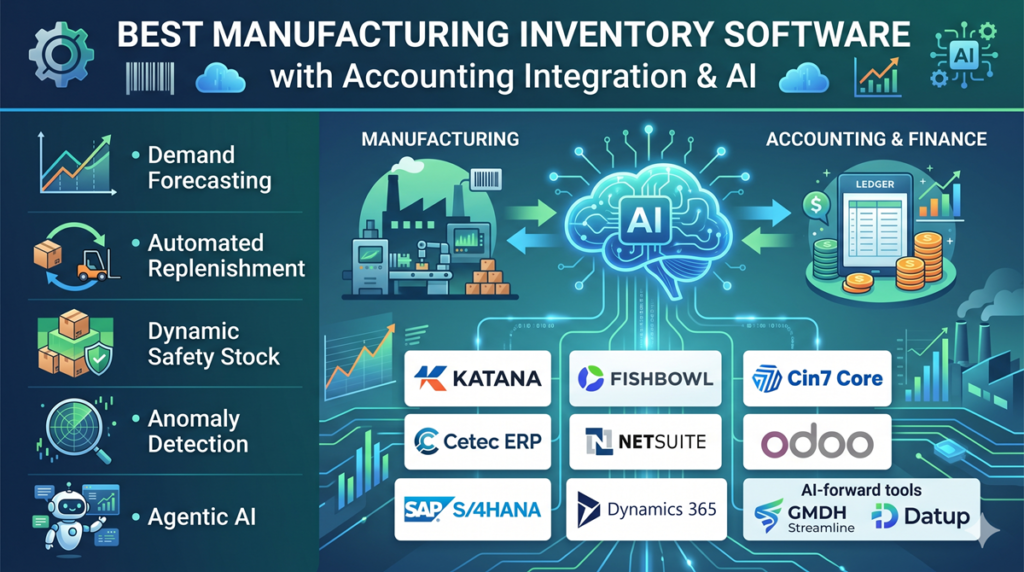
This guide walks through the best manufacturing inventory software with accounting integration & AI, organised by the size and complexity of operation they serve. We’ll also look at where AI is genuinely changing the game in 2026, and where it’s still mostly marketing.
For manufacturers, the gap between the shop floor and the finance office is where margins quietly disappear. Stock sits longer than it should. Work-in-progress costs drift away from quoted prices. Month-end reconciliation turns into a multi-day archaeology project.
The fix isn’t a better spreadsheet, it’s inventory software that talks to your accounting system in real time, so every receipt, issue, build, and shipment posts to the general ledger the moment it happens.
Why accounting integration matters more than any other feature
You can have the most beautiful production-scheduling dashboard in the world, but if your manufacturing inventory software doesn’t push costs into your general ledger automatically, you’re running two sets of books. That means:
- Inventory valuations on your balance sheet drift from what’s actually on the shelf
- COGS is calculated retrospectively rather than per transaction, masking margin erosion
- Tax filings rely on adjustments and estimates rather than transactional data
- Auditors charge you more, because they have to reconcile manually
A proper integration handles bills of materials (BOMs), work orders, landed costs, scrap, and variances, and posts them to the right accounts without human re-keying. That’s the baseline. Everything else is gravy.
How AI is reshaping manufacturing inventory software in 2026
A quick word on AI before we get to the tools, because nearly every vendor now claims to have it. The capabilities that genuinely move the needle for manufacturers are:
- Demand forecasting that ingests historical sales, seasonality, supplier lead times, and external signals to recommend purchase quantities and timing
- Automated replenishment that converts those forecasts into purchase orders and transfer requests with minimal manual intervention
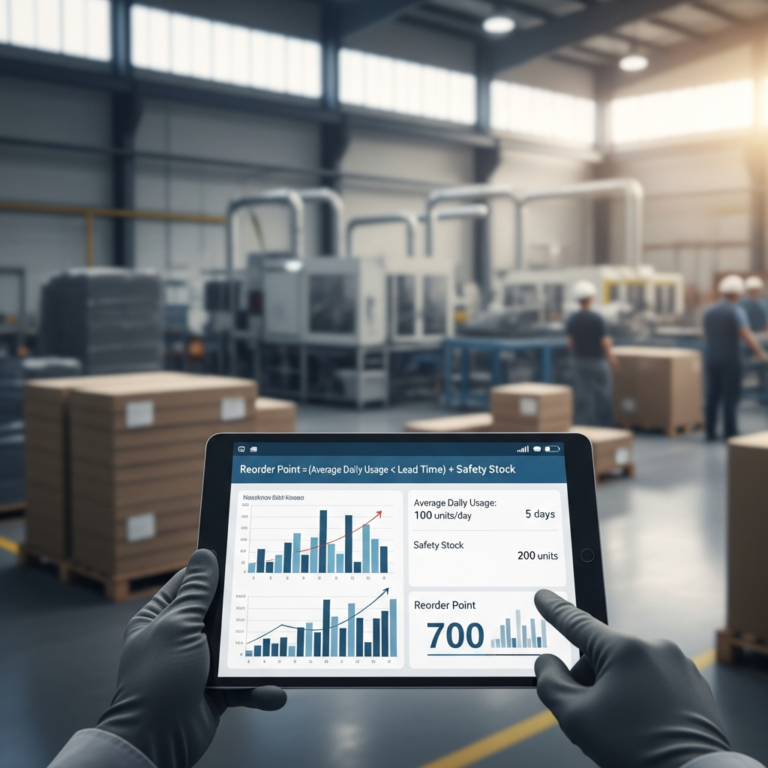
- Dynamic safety stock calculated per SKU based on actual variability, not a flat percentage
- Anomaly detection that flags slow-moving inventory, stockout risks, and cost variances before they show up in the month-end report
- Agentic AI that doesn’t just recommend but executes, drafting purchase orders, updating quantities, and syncing data across connected systems
These features matter most when you’re managing dozens to thousands of SKUs with variable demand. If you’re a small shop building to order, AI forecasting is less critical than tight BOM control and accurate job costing.
The best manufacturing inventory software by manufacturer size
Small manufacturers (under ~$5M revenue, QuickBooks or Xero shop)
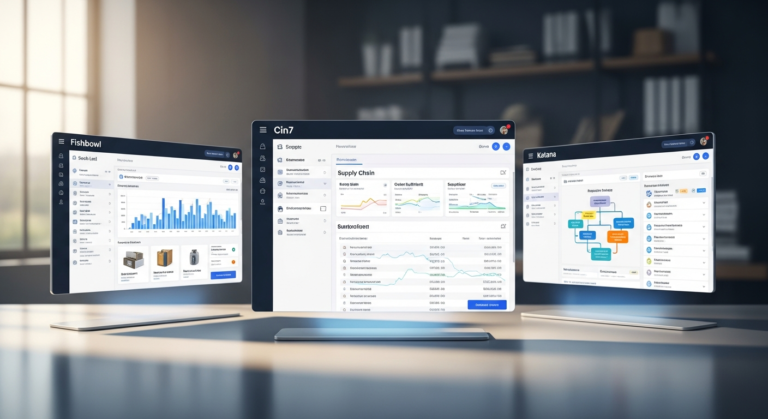
Katana is purpose-built for small manufacturers and is one of the easiest entry points into proper manufacturing ERP. Its visual dashboard, drag-and-drop production planning, and automated stock-level updates give small teams real-time visibility without an implementation project that takes six months.
Native integrations with QuickBooks, Xero, Shopify, WooCommerce, BigCommerce, and ShipStation mean your inventory and accounting move together. It’s particularly strong for makers, food producers, and light-assembly businesses that have outgrown spreadsheets but aren’t ready for full ERP.
Fishbowl has long been the go-to upgrade for QuickBooks-based manufacturers who need more than QuickBooks alone can offer. Its strength is exactly that QuickBooks integration, bidirectional, mature, and well-supported, combined with BOM management, work orders, barcode scanning, and multi-location tracking. It’s a good fit for small-to-medium manufacturers and distributors who want to keep their accounting platform but add serious inventory muscle.
MISys Manufacturing is worth a look if you’re in electronics, machinery, or fabricated metals. It integrates with QuickBooks and Sage 50, and offers serial and lot tracking, multi-level BOMs, and bin tracking, features that genuinely matter when you’re managing components with traceability requirements. It’s modular, so you can add capability as you grow.
Cin7 Core (formerly DEAR) sits in the cloud-based SMB sweet spot, covering purchasing, sales, warehouse management, and light manufacturing in a single back-end system. Its ForesightAI demand-forecasting add-on is one of the more accessible AI capabilities for small operations, generating purchase recommendations from your own transaction history.
Medium manufacturers (~$5M to $50M revenue)
This is the band where you typically need full work-order management, multi-location inventory, and real cost accounting. It’s where the choice between a dedicated manufacturing platform and a full ERP starts to matter.
Odoo deserves serious consideration here. It’s an all-in-one open-source platform covering CRM, sales, accounting, inventory, manufacturing, and projects in genuinely integrated modules, not bolted-together acquisitions. The free Community edition lets you trial it without commitment, and the paid editions scale well. For manufacturers who want one system rather than five, Odoo is often the best value on the market.
Cetec ERP is the value pick, affordable, web-based, and surprisingly capable. It handles production, inventory, and accounting in one platform, with real-time tracking and automated receipt cost corrections that keep inventory and accounting aligned without manual reconciliation. For mid-sized manufacturers watching costs, it’s hard to beat.
MIE Trak Pro is a full ERP aimed specifically at manufacturers. It handles inventory, job tracking, purchasing, and scheduling, and integrates with major accounting platforms. It’s particularly strong for job shops and custom manufacturers where every order is different.
JobBOSS² is purpose-built for custom metal manufacturing, quoting, job tracking, scheduling, and shop-floor data collection, all tied to inventory and costs. If you’re a machine shop or fabricator, it speaks your language out of the box.
Statii is worth mentioning for small-to-medium bespoke manufacturers in the UK and Europe. It handles multi-level BOMs, stock control, and production integration in a focused, no-nonsense package.
Large manufacturers and enterprise
At the top end, the question shifts from “which inventory tool” to “which ERP”, because at this scale, inventory, accounting, production, and supply chain need to live in a single transactional system.
Oracle NetSuite is the cloud ERP standard for mid-market and enterprise manufacturers. It integrates manufacturing operations, financial accounting, and cost management in real time, with strong capabilities in standard costing, WIP valuation, variance analysis, and lot and serial number traceability. Its multi-entity, multi-currency, multi-location architecture makes it the default choice for growing manufacturers with global operations.
SAP S/4HANA remains the heavyweight for large enterprises, with advanced manufacturing planning, inventory costing, and integrated financial reporting. It’s expensive and demanding to implement, but for global enterprises with complex multi-plant operations, it’s still the benchmark.
Microsoft Dynamics 365 is the strong cloud alternative, with finance and supply chain modules built for manufacturing cost tracking, WIP accounting, and profitability analysis. Its integration with the broader Microsoft stack (Power BI, Azure, Teams) is a real advantage for organisations already invested there.
Epicor Kinetic and Sage X3 are the established mid-market-to-enterprise choices, particularly strong in discrete and process manufacturing respectively. Both offer deep manufacturing functionality with integrated financials.
Plex and SYSPRO are specialised manufacturing platforms worth shortlisting if you want manufacturing-first design rather than a general ERP retrofitted for production environments.
DELMIAworks (formerly IQMS) is the choice for plastics, packaging, and automotive suppliers, with deep MES capability integrated into the same database as finance and inventory.
AI-forward options worth a shortlist regardless of size
A handful of platforms are leading on the AI front and deserve consideration even if they don’t fit neatly into a size bucket:
- GMDH Streamline combines AI demand forecasting with MRP in a single platform, with particular strength for manufacturers managing BOMs, supplier constraints, and replenishment cycles
- Logility is a mature supply-chain optimisation platform with agentic AI capabilities added in its 2026 releases, suited to larger retailers and manufacturers
- Datup is built for industrial operations over $10M revenue, claiming over 95% forecast accuracy by connecting historical data, ERP, WMS, and TMS sources
- Relex is a forecasting powerhouse, particularly in grocery, CPG, and home improvement
These are typically layered alongside your core ERP rather than replacing it.
How to choose the Best Manufacturing Inventory Software
Start with your accounting platform, not your inventory system. If you’re committed to QuickBooks or Xero, your choice narrows quickly. Fishbowl, Katana, Cin7 Core, and MISys are all built to plug in cleanly. If you’re on Sage, MISys and Sage’s own X3 deserve attention. If you’re running NetSuite, Dynamics, or SAP, the inventory module is already there. Your real decision is whether to extend it or layer specialised tools on top.
Then ask three more questions:
- How complex are your BOMs? Multi-level, configurable, or with revision control? That rules out the lightweight options fast.
- Do you need traceability? Lot, serial, expiry, regulatory? Medical, food, aerospace, and electronics manufacturers have hard requirements that some platforms handle natively and others bolt on awkwardly.
- What’s your AI maturity? If you don’t have clean historical data yet, AI forecasting will disappoint you. Get your master data in order first; the AI will pay off later.
The right software won’t fix a broken process, but the wrong software will calcify it. Take the demos, run a proof of concept with your real data, and talk to two or three reference customers in your industry before you sign. The platforms above are the ones most worth your time in 2026.