Generative AI in Manufacturing Industry: Ultimate Guide
Allocating capital to Generative AI in a robotic manufacturing industry changes how standard costs are set and analyzed, with direct effects on labor efficiency variances and overhead absorption rates, along with overall equipment effectiveness (OEE). Moving from deterministic PLC programming to generative, autonomous robotic toolpath generation requires controls over capitalization, variance analysis, and pilot costs….
Allocating capital to Generative AI in a robotic manufacturing industry changes how standard costs are set and analyzed, with direct effects on labor efficiency variances and overhead absorption rates, along with overall equipment effectiveness (OEE). Moving from deterministic PLC programming to generative, autonomous robotic toolpath generation requires controls over capitalization, variance analysis, and pilot costs. Without controls, integration costs can dilute gross margins long before efficiency gains appear.
Use this protocol to govern the integration of Generative AI into industrial robotics for finance and manufacturing operations leaders.
Prerequisites for AI Robotic Integration
Auditing Your Current Hardware and IoT Infrastructure
Before approving CapEx for AI integration, conduct a physical audit of existing robotic assets against the fixed asset register. Legacy PLCs and robotic arms nearing the end of their depreciation schedules may lack the processing capacity for edge-computed AI models.
- Control: Categorize required hardware upgrades, such as high-throughput edge servers and vision sensors, strictly into CapEx vs. OpEx. Ensure edge computing infrastructure meets the company’s capitalization threshold to avoid immediate hits to the current month’s P&L.
Establishing a Controlled Data Environment
Generative models map synthetic scenarios against historical operational data. Weak cycle counting controls or scrap data coded to general overhead rather than specific job variances will train the AI on unreliable baselines.
- Control: Reconcile your Bill of Materials (BOM) rollups and existing standard labor routings. Ensure historical machine data, including spindle, weld, and idle time, aligns with the direct labor hours booked in the ERP.
Assembling a Cross-Functional Team
Coordinating Operational Technology (OT) and Information Technology (IT) requires a cross-functional project team.
- Control: Establish a unique cost center or internal project code for the integration team. Differentiate between routine maintenance labor, which is expensed immediately, and development labor, which may be capitalized as internally developed software under ASC 350-40, depending on the jurisdiction.
Step 1: Designing the AI Integration Strategy
Identifying High-Variance Robotic Applications
Start with bottlenecks that generate severe unfavorable labor efficiency variances or material usage variances.
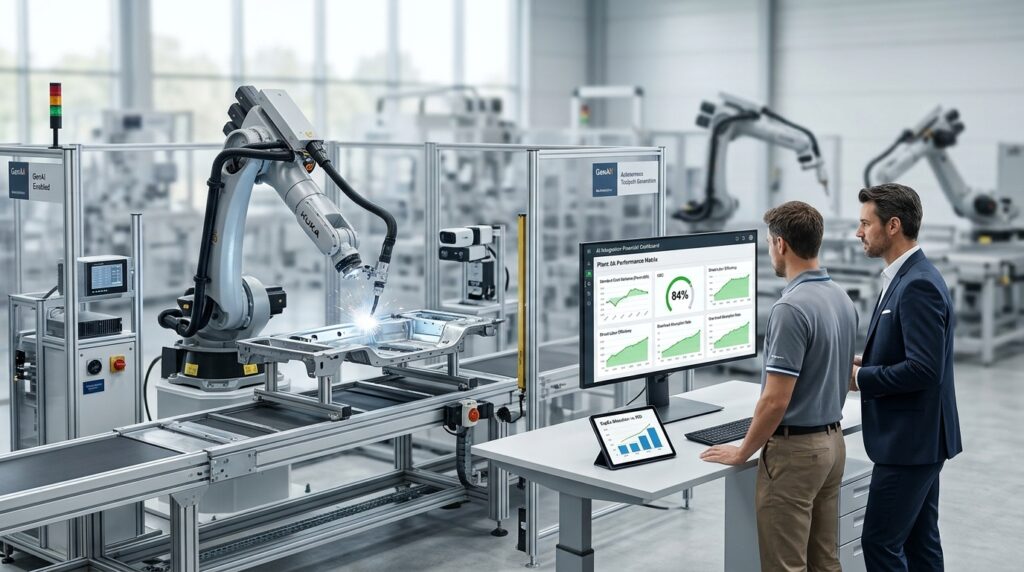
- Discrete Manufacturing Scenario: In a $40M turnover lawnmower manufacturing plant, the chassis welding cell was a historic bottleneck. Standard routing allowed 4.2 minutes per chassis. Actual cycle times ran closer to 5.8 minutes because manual rework from thermal distortion was routine. The result was a persistent unfavorable labor variance. By deploying GenAI to dynamically adjust welding toolpaths based on real-time thermal vision data, the objective is to eliminate rework and stabilize the overhead absorption rate.
Mapping the Data Pipeline and Security Protocols
Unsecured operational data can expose CAD files, BOMs, and process parameters that support IP value.
- Control: Implement strict internal controls over financial reporting (ICFR) for automated data feeds. If cloud-based LLMs are used, require SOC 2 reports and contractual restrictions to prevent proprietary CAD files and BOMs from being used in public model training sets.
2: Training and Deploying the Models
Utilizing Synthetic Data Generation for Robot Training
Generative AI creates synthetic visual data, such as simulated defective welds or out-of-tolerance cast aluminum parts, to train machine vision without wasting physical raw materials.
- Cost Tracking Note: Track all engineering hours and cloud computing costs associated with this phase. These activities frequently qualify for R&D tax credits. In past plant rationalizations, precise tracking of experimental development hours yielded upward of $750K in tax credits, directly offsetting the initial integration CapEx.
Simulating Robotic Environments via Digital Twins
A digital twin lets the team test AI-generated code against virtual models of physical assets before a real robot moves. That reduces the risk of hardware collisions.
- Control: Treat the digital twin software licensing as a prepaid expense, amortizing it over the life of the pilot program. Do not release full production CapEx funding until the digital twin proves a positive ROI hurdle rate, such as IRR > 15%, based on simulated cycle time reductions.
Real-World Deployment and Iterative Testing
Deploy the model to the physical floor in a gated pilot.
- Control: Isolate the pilot cell in the ERP. Create a specific “AI Pilot Scrap” general ledger account. If you blend pilot phase material waste into standard material usage variances, it will distort month-end variance analysis and trigger false alarms during the 5-day close.
Implementation Risks to Control
Neglecting Data Quality and Standardization
Poor inputs produce unreliable outputs. If sensor data is not normalized, the AI will generate erratic toolpaths. There is also an accounting consequence: if standard costs are not updated to reflect the new AI-driven routings, overhead may be materially over-absorbed and inventory valuations on the balance sheet may be artificially inflated.
Underestimating the Need for Human-in-the-Loop Oversight
Relying entirely on AI without manual override protocols creates physical collision risk. One unchecked robotic arm collision can write off a $150,000 asset instantly, triggering an unbudgeted impairment charge and a material cash outflow for replacement.
Over-Complicating Initial Pilot Programs
Attempting a plant-wide rollout simultaneously can create unrecoverable implementation costs. Isolate the effort to a single workcell. Release project funding in tranches, contingent upon specific operational milestones such as a 95% automated pass rate on the vision inspection system.
Operating a Factory With AI-Controlled Robotic Cells
Measuring ROI and Efficiency Gains
Evaluate the pilot against standard costing baselines. The primary success measure is the reduction in unit cost and the improvement of gross margin.
Financial Impact Matrix: Lawnmower Chassis Welding Cell (Pre- vs. Post-GenAI)
| Metric | Pre-AI (Standard/Actual) | Post-AI (Actual) | Financial Impact (Annualized) |
|---|---|---|---|
| Cycle Time | 4.2 min (Std) / 5.8 min (Act) | 4.0 min (Act) | Eliminated unfavorable labor variance. |
| Scrap Rate | 3.5% | 0.8% | $112,000 favorable material usage variance. |
| OEE | 68% | 84% | Higher fixed overhead absorption; lower unit cost. |
| Rework Labor | 1.2 FTE | 0.2 FTE | $65,000 direct labor savings. |
Expanding the Deployment Across the Plant Floor
After the pilot ROI is validated, build a pro-forma P&L and 12-month cash forecast for plant-wide rollout. Review vendor payment terms as part of the CapEx plan. Negotiating 60- or 90-day terms with equipment suppliers can allow operational savings from reduced scrap and lower labor hours to support equipment lease payments, limiting net cash outflow.
Frequently Asked Questions (FAQ)
How does generative AI differ from traditional machine learning in robotics?
In this context, traditional machine learning is classification-based, such as predicting spindle failure for preventative maintenance, which stabilizes maintenance OpEx. Generative AI creates new outputs; it can generate PLC code to dynamically optimize a toolpath around an unexpected physical obstacle. If successful, that can compress cycle times and alter the BOM routing standards.
What is the typical timeline for implementing generative AI in manufacturing industry settings?
A disciplined rollout requires 6 to 12 months.
- Months 1-3: Data cleansing, BOM auditing, and CapEx approval.
- Months 4-7: Digital twin simulation and R&D capitalization phase.
- Months 8-12: Real-world pilot, ERP standard cost updates, and scaling.
Accelerating this timeline usually means bypassing internal controls. The likely result is untracked cost, unreconciled inventory, or both at month-end.
Are there specific safety protocols for AI-driven industrial robots?
Yes. Compliance with ISO 10218 and ISO/TS 15066 is mandatory to limit liability and control workers’ compensation insurance premiums. Generative AI must be constrained by hard-coded, immutable safety parameters, including speed limits and spatial boundaries, that sit at the lowest level of the hardware controller to ensure safe human-robot collaboration. Failure to do so exposes the firm to material contingent liabilities.