Robotics & AI Manufacturing: The Ultimate Guide
The Financial and Operational Mechanics of Implementing Robotics and AI in Manufacturing Implementing AI manufacturing robotics with AI-managed production systems requires capital allocation and changes to the cost structure. Moving manual production lines into AI-managed robotic cells shifts the cost base from variable direct labor to fixed manufacturing overhead, depreciation, software amortization, and specialized maintenance….
The Financial and Operational Mechanics of Implementing Robotics and AI in Manufacturing
Implementing AI manufacturing robotics with AI-managed production systems requires capital allocation and changes to the cost structure. Moving manual production lines into AI-managed robotic cells shifts the cost base from variable direct labor to fixed manufacturing overhead, depreciation, software amortization, and specialized maintenance. The transition requires disciplined management of capital expenditure, CapEx, precise updates to standard costing, and rigorous integration with the existing Enterprise Resource Planning, ERP, and Manufacturing Execution Systems, MES.
Scenario Context: Discrete Manufacturing, Aluminum Casting & Machining
This guide uses a scenario from a $40M turnover discrete manufacturer producing aluminum cast components for commercial lawnmowers.
- Current State: Manual deburring and visual inspection stations are creating a production bottleneck. Direct labor efficiency variances are consistently unfavorable, $15k–$25k/month.
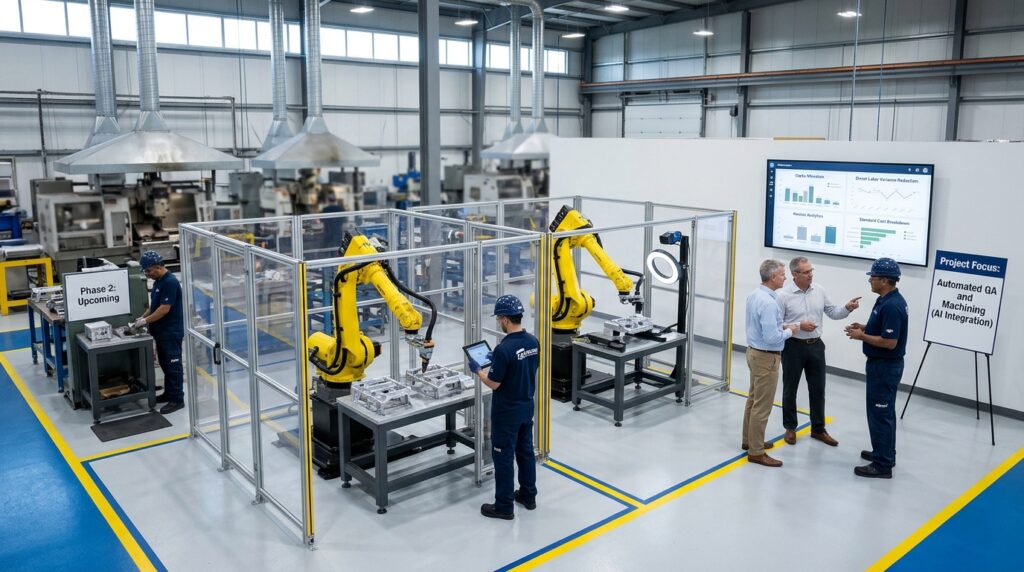
- Project Scope: Implementation of two 6-axis industrial robots with AI computer vision for automated deburring and QA.
- Budget: $1.2M total expenditure, $850k CapEx for hardware/site prep; $350k OpEx for SaaS, training, and integration.
Prerequisites
Needs Assessment and Constraint Analysis
Automate constraint operations first. Deploy hardware only where work centers generate high labor inefficiency, scrap, or significant Material Usage Variances, MUV.
- Financial Audit: Run a 12-month trailing analysis on labor efficiency variances by routing step. Identify processes where actual cycle times consistently exceed standard cycle times.
- Inventory Impact: Assess work-in-process, WIP, queues. If WIP backs up before a specific manual station, automating that node accelerates throughput and releases trapped working capital.
Budget and ROI Forecasting
Segregate CapEx from OpEx immediately to model accurate depreciation schedules and EBITDA impacts.
| Cost Category | Accounting Treatment | Scenario Allocation | Example Items |
|---|---|---|---|
| Hardware & Machinery | Capitalize, 7-year MACRS | $700,000 | Robotic arms, LiDAR, safety cages |
| Site Preparation | Capitalize | $150,000 | Concrete anchoring, power drops |
| AI SaaS Platform | Expense, OpEx / Period | $150,000/yr | Cloud analytics, vision model licensing |
| Integration & Training | Expense, OpEx | $200,000 | Engineering consulting, labor training |
- ROI Note: When calculating Return on Investment, ROI, and Internal Rate of Return, IRR, factor in the R&D tax credits available for engineering integration, which can offset initial cash outflows. Our target hurdle rate for this class of automation is strictly >18% IRR with a payback period under 24 months.
Assembling a Cross-Functional Team
Maintain segregation of duties. Engineering selects the technical specs, but Finance must control the vendor Master Services Agreements, MSAs, and payment terms.
- Action: Mandate 60-day or 90-day payment terms, EOM, with robotics integrators. Tie milestone payments strictly to Factory Acceptance Testing, FAT, and Site Acceptance Testing, SAT, sign-offs.
Step 1: Selecting the Right Hardware and Software
Choosing Between Industrial Robots and Cobots
The choice affects standard labor routing updates and facility overhead allocations.
- Industrial Robots: High payload/speed. Requires safety cages. Significant site prep, capitalized. Routing shifts entirely to machine hours; direct labor is removed from the specific Bill of Materials, BOM, routing step.
- Cobots, Collaborative: Lower payload/speed. Minimal site prep. Human operators remain in the cell. Direct labor hours are reduced, not eliminated, requiring fractional labor allocations in standard costs.
Selecting AI Manufacturing Software Platforms
Ensure the AI platform integrates via API with your existing ERP to feed real-time production data.
- Capitalization Rules, ASC 350-40: For on-premise AI software, capitalize costs incurred during the application development stage. Preliminary project and post-implementation training costs must be expensed. For cloud-based SaaS, expense subscription fees over the term of the arrangement.
Evaluating Sensor and Vision System Add-Ons
End-of-Arm Tooling, EOAT, items such as specialized grippers or welding tips, often have a useful life of less than 12 months due to intense wear.
- Accounting Logic: Expense high-wear EOAT directly to factory supplies or maintenance rather than capitalizing, avoiding the administrative burden of tracking micro-assets on the fixed asset register.
2: Deployment and System Integration
Redesigning the Facility Layout
Plant layout modifications require strict tracking of internal labor if maintenance staff perform the site prep. Capture their wages via distinct internal project codes so the labor can be legitimately capitalized into the asset’s basis rather than absorbed as period overhead.
Hardware Installation and Network Integration
During installation, the machinery sits in a Capital Work in Progress, CWIP, clearing account. Depreciation must not commence until the asset is placed into service, producing saleable goods.
- Cybersecurity Control: Isolate robotic cells on air-gapped or strictly firewalled Industrial IoT, IIoT, VLANs. A ransomware attack locking programmable logic controllers, PLCs, halts throughput, resulting in material unabsorbed overhead variances at month-end.
Workforce Training and Process Handoff
As manual workers transition to supervisory roles, standard costing environments must be updated.
- BOM Rollup Action: Decrease standard direct labor hours for the automated product lines and correspondingly increase machine overhead allocation rates. Failure to update the routing master data prior to the next standard cost roll will result in large, misleading favorable labor variances and unfavorable overhead absorption variances.
Implementation Risks
Scaling Too Quickly, Overcapitalization
Deploying automated cells across an entire facility simultaneously traps capital and degrades liquidity. If the AI integration fails or requires extended debugging, you risk extended production downtime.
- Solution: Run a single-cell pilot first. After SAT, monitor cycle times for one financial quarter. Validate the yield improvement against the financial model, then approve phase-two CapEx.
Neglecting IT General Controls, ITGC
Connecting PLCs to cloud AI bypasses traditional perimeter security. From an audit perspective, if financial systems, ERP, accept automated production counts from compromised edge devices, your inventory valuation becomes materially misstated.
Underestimating the Need for Quality Data, The BOM Trap
AI models optimize based on existing ERP data. If your current BOMs contain inaccurate standard quantities, ghost inventory, or flawed scrap rates, the AI will make production adjustments based on unreliable data.
- Go-Live Control: Mandate a full physical cycle count of all raw materials and sub-assemblies related to the automated cell prior to go-live. Cleanse the BOMs. Unreliable source data generates algorithmic Purchase Price Variances, PPV, and phantom stockouts.
Target State: Validated AI-Assisted Manufacturing
Real-Time Autonomous Operations
After validation and tuning, the robotic cell should produce stable throughput and more predictable cycle times. Finance can then rely on automated, real-time shop floor data collection, enabling a faster 5-day month-end close by eliminating manual labor ticket reconciliation.
Predictive Maintenance and Reduced Unplanned Downtime
AI vibration and thermal analysis shift maintenance from reactive to predictive.
- Financial Impact: Unplanned downtime generates unabsorbed fixed overhead. Predictive maintenance allows scheduling during non-shift hours, improves fixed-overhead absorption, and can extend the useful life of the equipment.