Production Manufacturing Software: 4-Step Guide
Control Factory-Floor Costs and Operations: A Financial and Operational Plan for Implementing Production Manufacturing Software Production manufacturing software, whether a standalone Manufacturing Execution System (MES) or an integrated ERP module, is the financial and operational ledger of the factory floor. It controls raw-material procurement, direct-labor tracking, and the absorption of manufacturing overhead. A botched implementation…
Control Factory-Floor Costs and Operations: A Financial and Operational Plan for Implementing Production Manufacturing Software
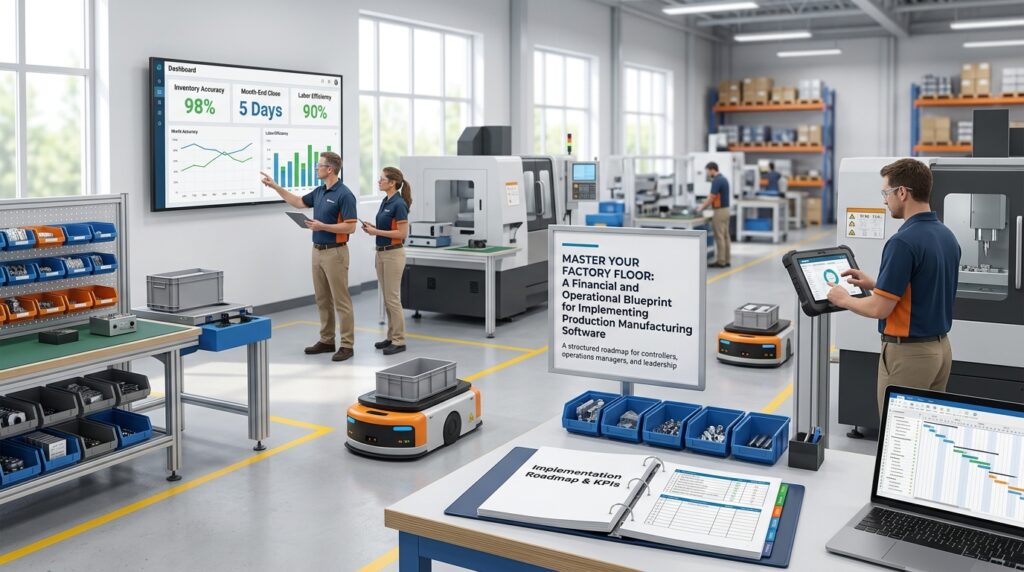
Production manufacturing software, whether a standalone Manufacturing Execution System (MES) or an integrated ERP module, is the financial and operational ledger of the factory floor. It controls raw-material procurement, direct-labor tracking, and the absorption of manufacturing overhead. A botched implementation leaves financial data compromised, WIP variances unexplained, and month-end closes delayed. When implemented properly, the implementation connects physical plant workflows to the general ledger. The result is a 5-day month-end close and tighter cost control.
Use this implementation plan to digitize your facility, with financial controllers, operations managers, and executive leadership as the core audience.
What You Need Before You Start
A Dedicated, Cross-Functional Implementation Team
Software implementation cannot be delegated solely to IT. Form a steering committee comprising:
- Executive Sponsor (CFO/GM): Controls the CapEx/OpEx budget and mandates adoption.
- Financial Controller: Ensures sub-ledger to GL mapping, standard costing rollups, and variance reporting logic are sound.
- Plant Manager: Aligns software workflows with physical shop-floor realities.
- Key Operators: Validates data entry feasibility on the floor.
Clear Operational and Financial KPIs
Establish baseline metrics to measure ROI. Reject vague objectives.
- Target Metrics Matrix:
| KPI | Current State | Target State | Financial Impact |
|---|---|---|---|
| Inventory Accuracy | 82% (Annual Stocktake) | >98% (Cycle Counting) | Eliminate $150k annual write-downs |
| Month-End Close | 12 Days | 5 Days | Reallocate 50 hrs/mo to FP&A |
| Labor Efficiency | 75% Absorption | 90% Absorption | Reduce unabsorbed overhead by $20k/mo |
Mapped-Out Workflows, BOMs, and Routings
Most shop-floor actions should have a corresponding inventory, labor, or costing transaction. Document your exact manufacturing processes. Your Bill of Materials (BOM) must reflect material inputs and scrap rates accurately. Routings need to state standard machine hours and direct labor hours, because these inputs drive absorption costing.
Step 1: Evaluating Current Manufacturing Operations
Identify Bottlenecks and Variance Leakage
Audit the factory floor to find where physical workflow diverges from accounting assumptions. Are operators spending 20 minutes looking for raw materials? That downtime translates directly to unfavorable labor efficiency variances. Capacity constraints matter too; when machines sit underused, fixed overhead is often under-absorbed.
Audit Existing Legacy Systems and Shadow IT
List all current tools. Operations teams frequently rely on shadow IT: offline Excel spreadsheets, whiteboards, and side files created to bypass cumbersome legacy ERPs. These workarounds create significant reconciliation problems at month-end. The new software must replace these workarounds or bring them into controlled workflows so the financial record can be reconciled.
2: Selecting the Right Production Software
Cloud-Based (SaaS) vs. On-Premise Solutions
Evaluate the cost and deployment model of the software:
- Cloud-Based (SaaS): Treated as an Operational Expense (OpEx). Lower upfront cash outlay, automatic updates, and remote access, which supports managing multiple sites.
- On-Premise: Capital Expenditure (CapEx). Requires server infrastructure and ongoing internal IT maintenance. Preferable only if plant internet connectivity is highly unstable or data security compliance demands isolated local networks.
Essential Modules and Financial Integrations
The software needs to handle scheduling, materials, inventory valuation, and shop-floor costing:
- Material Requirements Planning (MRP): Links directly to your sales forecasts and open POs to control working capital.
- Perpetual Inventory Tracking: Supports your valuation method: FIFO, LIFO, or Standard Costing, and cycle counting controls.
- Shop Floor Data Collection: Captures labor and machine time in real time to trigger immediate WIP valuation and overhead absorption.
Vendor Evaluation and Data Stress-Testing
Demand a proof-of-concept. Give vendors a complex, multi-level BOM from your actual production environment, such as an assembly with five sub-assemblies and outside processing steps. Then test the details: scrap reporting, rework routings, and the resulting financial journal entries.
3: Preparing Data and Infrastructure
Data Cleansing and Cost Rollups
Migrating dirty data is a common cause of failed ROI.
- Inventory: Write off obsolete SKUs prior to migration. Keep obsolete items out of the new system database.
- Costing: Update supplier pricing and recalculate standard labor and overhead rates based on current practical capacity, not historical ideals. Then perform a complete BOM cost rollup to validate standard costs against current purchase prices, labor rates, and overhead rates.
Hardware and Shop-Floor Data Capture
Paper travelers cause data latency. Equip the factory floor for real-time data capture:
- Install rugged barcode scanners at work centers to track material consumption from raw material to WIP.
- Deploy tablet kiosks for operators to clock on and off specific production orders, ensuring accurate direct labor capture.
4: Execution, Testing, and Training
Sandboxing and Sub-Ledger Verification
Before deployment, execute a complete “Procure-to-Pay” and “Order-to-Cash” cycle in a sandbox environment using dummy data.
- Accountant’s Shortcut: Run a dummy work order through every routing step. Confirm raw materials are credited, WIP is debited, overhead is absorbed, and Finished Goods is debited at completion while WIP clears. If a balance remains in WIP, your routing logic is flawed.
Role-Based Training with Financial Context
Train operators on more than button sequences; explain why. Machine operators need to understand that failing to scan a scrap part creates an inventory discrepancy, requires a manual journal entry, and negatively impacts plant profitability metrics.
Phased Go-Live
Avoid switching every function at once; implement modularly.
- Phase 1: Core inventory control and purchasing, establishing base material costs.
- Phase 2: Shop floor data collection and WIP tracking.
- Phase 3: Advanced scheduling and MRP automation.
Realistic Scenario: Discrete Manufacturing (Aluminum Casting)
The Context: A $35M turnover aluminum casting and machining business was experiencing gross margin erosion and severe month-end delays. The accounting team was booking a recurring, unexplained $120,000 unfavorable monthly WIP variance.
The Root Cause: Operators were issuing raw aluminum ingots to the floor based on loose estimates. Scrap from the machining centers, or swarf, was not being recorded back into inventory for remelting. The legacy system’s BOMs did not account for realistic yield losses.
The Implementation Action:
- BOM Restructuring: We updated the BOMs to include a standard 8% scrap allowance based on historical process yields.
- Shop Floor Controls: Implemented barcode scanning at the melting furnace. Operators could not begin a routing step without scanning the exact weight of ingots consumed.
- WIP Clearing: Configured the software to automatically backflush labor and overhead based on actual machine hours recorded via IoT sensors, rather than manual timesheets.
The Result: Within 90 days, the unexplained WIP variance dropped to under $8,000 per month. Inventory accuracy improved to 99.2% through automated cycle counting. The annual plant shutdown for physical stocktakes was no longer required. The financial controller also achieved a stable 5-day month-end close, giving the executive team reliable monthly P&L and cash forecasts.
Common Mistakes to Avoid
- Underestimating Data Migration Complexity: Loading inaccurate standard costs or outdated BOMs into a new MRP engine will trigger false purchasing recommendations, leading to excess working capital tied up in the wrong raw materials.
- Allowing “Negative Inventory” Configurations: Never allow the software to process a production order if the system shows zero raw materials. Negative inventory balances destroy the integrity of your COGS calculations and break FIFO valuation logic. Force operators to fix the inventory discrepancy in real time.
- Failing to Secure Floor-Level Buy-In: If the CFO signs the check but production managers allow operators to bypass data entry to “save time,” the system fails. The executive sponsor must enforce strict discipline: If it is not in the system, it did not happen.
Frequently Asked Questions
How long does it take to implement production manufacturing software?
For a mid-market manufacturer ($10m–$60m turnover), expect a 6 to 9-month implementation cycle. Fast-tracking this usually results in skipped data validation, leading to post-go-live reconciliation crises.
Can small manufacturers benefit from this software?
Yes. Cloud-based MES/ERP systems allow SMEs to replace spreadsheet-based production tracking with system-controlled inventory, WIP, and costing. They let a $4m loss-making shop control inventory, labor reporting, and purchasing as revenue grows, without adding administrative headcount at the same rate.
What is the ROI of manufacturing software?
ROI is typically realized within 12 to 18 months. Hard savings stem from lower working capital requirements, reduced inventory holding costs, elimination of annual physical stocktake downtime, and reduction of unfavorable material usage variances. Soft savings include faster month-end closes and improved customer retention due to accurate lead-time quoting.
Operating Target: A Financially Controlled Factory Floor
Used properly, this financially driven implementation method connects factory costs to traceable, real-time transactions. Management gets a clear view of labor efficiency variances, capacity constraints, and true product margins. Manual shadow accounting is removed. The close becomes a stable 5-day process. The factory can increase production volume without losing visibility into gross margins.